Results by title
4 books match the query 'Postcolony'
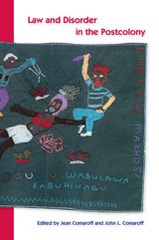
Law and Disorder in the Postcolony
Edited by Jean Comaroff and John L. Comaroff
University of Chicago Press, 2006
Are postcolonies haunted more by criminal violence than other nation-states? The usual answer is yes. In Law and Disorder in the Postcolony, Jean and John Comaroff and a group of respected theorists show that the question is misplaced: that the predicament of postcolonies arises from their place in a world order dominated by new modes of governance, new sorts of empires, new species of wealth—an order that criminalizes poverty and race, entraps the “south” in relations of corruption, and displaces politics into the realms of the market, criminal economies, and the courts.
As these essays make plain, however, there is another side to postcoloniality: while postcolonies live in states of endemic disorder, many of them fetishize the law, its ways and itsmeans. How is the coincidence of disorder with a fixation on legalities to be explained? Law and Disorder in the Postcolony addresses this question, entering into critical dialogue with such theorists as Benjamin, Agamben, and Bayart. In the process, it also demonstrates how postcolonies have become crucial sites for the production of contemporary theory, not least because they are harbingers of a global future under construction.
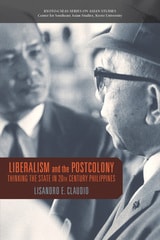
Liberalism and the Postcolony
Thinking the State in 20th-Century PhilippinesLisandro E. Claudio
National University of Singapore Press, 2017
Through the biographies of four Filipino scholar-bureaucrats—Camilo Osias, Salvador Araneta, Carlos P. Romulo, and Salvador P. Lopez—Lisandro E. Claudio argues that liberal thought served as the grammar of Filipino democracy in the twentieth century. Melding political philosophy and narrative history, he takes us through various articulations of liberalism in pedagogy, international affairs, economics, and literature. In this first book on Filipino liberals in the twentieth century, Claudio brings to light an obscured history of the Philippine state and also argues for a new liberalism rooted in the postcolonial experience, a timely intervention in light of the ascent of President Rodrigo Duterte and the current developments in Southeast Asian politics.
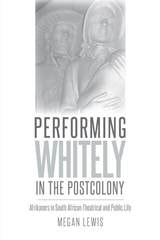
Performing Whitely in the Postcolony
Afrikaners in South African Theatrical and Public LifeMegan Lewis
University of Iowa Press, 2016
Performing Whitely examines the multiple speech acts, political acts, and theatrical acts of the Afrikaner volk or nation in theatrical and public life, including pageants, museum sites, film, and popular music as well as theatrical productions. Lewis explores the diverse ways in which Afrikaners perform whitely, and the tactics they use, including nostalgia, melodrama, queering, abjection, and kitsch. She first investigates the way that apartheid’s architects leveraged whiteness in support of their nation-building efforts in the early twentieth century. In addition to re-enacting national pilgrimages of colonial-era migrations and building massive monuments at home, Afrikaner nationalists took their show to the United States, staging critical events of the Boer War at the 1904 St. Louis Exposition. A case study of the South African experience, Performing Whitely also offers parables for global whitenesses in the postcolonial era.
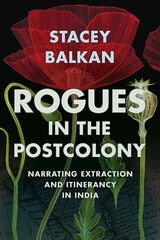
Rogues in the Postcolony
Narrating Extraction and Itinerancy in IndiaStacey Balkan
West Virginia University Press, 2022
Rogues in the Postcolony is a study of Anglophone Indian picaresque novels that dramatize the impacts of extractive capitalism and colonial occupation on local communities in several Indian states. In this materialist history of development on the subcontinent, Stacey Balkan considers works by Amitav Ghosh, Indra Sinha, and Aravind Adiga that critique violent campaigns of enclosure and dispossession at the hands of corporate entities like the English East India Company and its many legatees. By foregrounding the intersections among landscape ideology, agricultural improvement, extractive capitalism, and aesthetic expression, Rogues in the Postcolony also attends to the complicity of popular aesthetic forms with political and economic policy, as well as the colonial and extractivist logics that often frame discussions around the so-called Anthropocene epoch.
Bringing together questions about settler-colonial practices and environmental injustice, Rogues in the Postcolony concludes with an investigation of new extractivist frontiers, including solar capitalism, and considers the possibility of imagining life after extraction on the Indian subcontinent and beyond.