Results by title
7 books match the query 'Potawatomi Indians'

Fort Dearborn
A NovelJerry Crimmins
Northwestern University Press, 2008
In a story that brings to life the founding of one of the world's great cities, Fort Dearborn takes us back to Chicago's early struggle of fire and blood. Through the eyes of two young boys and their fathers—one father a sergeant with the United States First Infantry, the other a Potawatomi warrior—we see the events that lead up to the Fort Dearborn Massacre. Using scores of letters, historical documents and maps, and long-forgotten Native American speeches, Jerry Crimmins breathes life into the little known drama that took place in the vicinity of the fort that once occupied what is now downtown Chicago. A suspenseful narrative, Fort Dearborn is also a remarkable historical account, minutely observed and meticulously documented, preserving a key moment in American history.

Imprints
The Pokagon Band of Potawatomi Indians and the City of ChicagoJohn N. Low
Michigan State University Press, 2016
Imprints: The Pokagon Band of Potawatomi Indians and the City of Chicago examines the ways some Pokagon Potawatomi tribal members have maintained a distinct Native identity, their rejection of assimilation into the mainstream, and their desire for inclusion in the larger contemporary society without forfeiting their “Indianness.” Mindful that contact is never a one-way street, Low also examines the ways in which experiences in Chicago have influenced the Pokagon Potawatomi. Imprints continues the recent scholarship on the urban Indian experience before as well as after World War II.
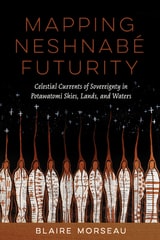
Mapping Neshnabé Futurity
Celestial Currents of Sovereignty in Potawatomi Skies, Lands, and WatersBlaire Morseau; Foreword by Grace L. Dillon
University of Arizona Press, 2025
In Mapping Neshnabé Futurity Blaire Morseau weaves together on-the-ground insights and Indigenous speculative fiction to illustrate the profound ways in which Anishinaabé/Neshnabé (Potawatomi, Odawa, and Ojibwe) communities are reclaiming their sovereignty and crafting vibrant futures. Morseau lays out how Neshnabék have marshaled dissent to hydrologic fracturing, oil pipelines, and other damaging infrastructures of capitalist settler futurity. The book positions these efforts as vital acts of nation building and visionary reclamation of space, both terrestrial and celestial.
Morseau also challenges the hegemonic narratives of settler futurism found in mainstream science fiction, which often perpetuate colonial fantasies and exclude marginalized voices. By fusing ethnography of tribal nation-building projects and analysis of Indigenous speculative fiction, Morseau provides a path to Indigenous futurisms and its role in imagining decolonization. Morseau’s analysis underscores the potency of Indigenous knowledge systems and ceremonial practices in imagining and actualizing alternative futures.
Mapping Neshnabé Futurity is an essential read for scholars and activists alike, urging a rethinking of how we conceive of futurity and sovereignty. This work shows how counter-mapping projects both on the ground and in the skies reclaim space in the Great Lakes region—Neshnabé homelands—and are part of larger constellations of Indigenous futurities and stories of survivance.

Ogimawkwe Mitigwaki (Queen of the Woods)
Simon Pokagon
Michigan State University Press, 2010
Simon Pokagon, the son of tribal patriarch Leopold Pokagon, was a talented writer, advocate for the Pokagon Potawatomi community, and tireless self-promoter.
In 1899, shorty after his death, Pokagon's novel Ogimawkwe Mitigwaki (Queen of the Woods)—only the second ever published by an American Indian—appeared. It was intended to be a testimonial to the traditions, stability, and continuity of the Potawatomi in a rapidly changing world. Read today, Queen of the Woods is evidence of the author's desire to mark the cultural, political, and social landscapes with a memorial to the past and a monument to a future that included the Pokagon Potawatomi as distinct and honored people.
This new edition offers a reprint of the original 1899 novel with the author's introduction to the language and culture of his people. In addition, new accompanying materials add context through a cultural biography, literary historical analysis, and linguistic considerations of the unusual text.

Skunk Hill
A Native Ceremonial Community in WisconsinRobert A. Birmingham
Wisconsin Historical Society Press, 2015
In Skunk Hill, archeologist Robert A. Birmingham traces the largely unknown story of this community, detailing the role it played in preserving Native culture through a harsh period of US Indian policy from the 1880s to 1930s. The story’s central focus is the Drum Dance, also known as the Dream Dance or Big Drum, a pan-tribal cultural revitalization movement that swept the Upper Midwest during the Great Suppression, emphasizing Native values and rejecting the vices of the white world. Though the community disbanded by the 1930s, the site, now on the National Register of Historic
Places with two dance circles still visible on the grounds, stands as testimony to the efforts of its members to resist cultural assimilation.

The Prairie People
Continuity and Change in Potawatomi Indian Culture, 1665-1965James A. Clifton
University of Iowa Press, 1998

Two-Moon Journey
The Potawatomi Trail of DeathPeggy King Anderson
Indiana Historical Society Press, 2018