Results by title
4 books match the query 'Potentiality'
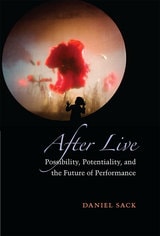
After Live
Possibility, Potentiality, and the Future of PerformanceDaniel Sack
University of Michigan Press, 2015
In the dark of the blackout before the curtain rises, the theater holds its many worlds suspended on the verge of appearance. How can a performance sustain this sense of potentiality that grounds all live production? Or if a stage-world does begin, what kinds of future might appear within its frame? Conceiving of the theater as a cultural institution devoted to experimenting with the future, this book begins and ends on the dramatic stage; in between it traverses literature, dance, sculpture, and performance art to explore the various futures we make in a live event.
After Live conceives of traditional dramatic theater as a place for taming the future and then conceptualizes how performance beyond this paradigm might stage the unruly nature of futurity. Chapters offer insights into the plays of Beckett, Churchill, Eno, and Gombrowicz, devised theater practices, and include an extended exploration of the Italian director Romeo Castellucci. Through the lens of potentiality, other chapters present novel approaches to minimalist sculpture and dance, then reflect on how the beholder him or herself is called upon to perform when confronted by such work.
[more]
Authoring
An Essay for the English Profession on Potentiality and SingularityJanis Haswell and Richard Haswell
Utah State University Press, 2010
The postmodern conviction that meaning is indeterminate and self is an illusion, though fascinating and defensible in theory, leaves a number of scholarly and pedagogical questions unsatisfied. Authoring—the phenomenological act or felt sense of creating a text—is “a remarkably black box,” say Haswell and Haswell, yet it should be one of the central preoccupations of scholars in English studies. Not only can the study of authoring accommodate the “social turn” since postmodernism, they argue, but it accommodates as well conceptions of, and the lived experience of, personal potentiality and singularity.
Without abandoning the value of postmodern perspectives, Haswell and Haswell use their own perspective of authorial potentiality and singularity to reconsider staple English-studies concerns such as gender, evaluation, voice, character, literacy, feminism, self, interpretation, assessment, signature, and taste. The essay is unique as well in the way that its authors embrace often competing realms of English studies, drawing examples and arguments equally from literary and compositionist research.
In the process, the Haswells have created a Big Idea book, and a critique of the field. Their point is clear: the singular person/mysterious black box/author merits deeper consideration than we have given it, and the book’s crafted and woven explorations provide the intellectual tools to move beyond both political divisions and theoretical impasses.
[more]
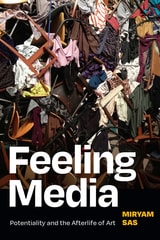
Feeling Media
Potentiality and the Afterlife of ArtMiryam Sas
Duke University Press, 2022
In Feeling Media Miryam Sas explores the potentialities and limitations of media theory and media art in Japan. Opening media studies and affect theory up to a deeper engagement with works and theorists outside Euro-America, Sas offers a framework of analysis she calls the affective scale—the space where artists and theorists work between the level of the individual and larger global and historical shifts. She examines intermedia, experimental animation, and Marxist theories of the culture industries of the 1960s and 1970s in the work of artists and thinkers ranging from filmmaker Matsumoto Toshio, photographer Nakahira Takuma, and the Three Animators' Group to art critic Hanada Kiyoteru and landscape theorist Matsuda Masao. She also outlines how twenty-first-century Japanese artists—especially those responding to the Fukushima disaster—adopt and adapt this earlier work to reframe ideas about collectivity, community, and connectivity in the space between the individual and the system.
[more]
The Future of Futurity
Affective Capitalism and Potentiality in a Global CityPurnima Mankekar and Akhil Gupta
Duke University Press, 2025
In The Future of Futurity, Purnima Mankekar and Akhil Gupta examine the lives and experiences of call center agents in India’s business process outsourcing (BPO) industry, who live in Bengaluru and work for customers in the Global North. Mankekar and Gupta show how futurity—an affective-temporal potentiality and mode of being that emphasizes the unfolding of time—enables BPO workers to strive for hopeful futures despite their experiences of growing inequality, volatility, and violence. Drawing on long-term fieldwork with managers, owners, and workers of BPO companies, the authors explore how workers find pathways for navigating a globalized world and for imagining their futures in it. They point to the heterogeneous lives, yearnings, and anxieties of BPO workers, foregrounding the disjunctions and conjunctions between labor, corporeality, intimacy, family life, and mobility. Mankekar and Gupta show how workers’ daily lives and imaginings of the future point to the relationships between futurity, capital, and technology as well as futurity’s imbrications with contemporary racial capitalism. In so doing, the authors insist on the transformative potential of futurity even in conditions of extreme precarity.
[more]