Results by title
4 books match the query 'Potter, David'
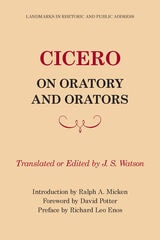
Cicero on Oratory and Orators
Translated by J.S. Watson. Introduction by Ralph A. Micken. Foreword by David Potter. Preface by Richard Leo Enos
Southern Illinois University Press, 1986
Contains Cicero’s De Oratore and Brutus, influential sources over the centuries for ideas on rhetoric and training for public leadership.
The De Oratore, written in 55 B.C., argues that rhetoric is socially significant because states are established and maintained through the leadership of eloquent men.
The three books of dialogues in this volume feature discussions between well-known figures in Roman history, including Lucius Crassus, Marcus Antonius, Quintus Lutatius Catulus, Quintus Marcius Scaevola, Caius Aurelius Cotta, Julius Caesar Strabo Vopicus, and Publius Sulpicus Rufus.
The Brutus continues the theme of the dialogues, giving a history of eminent orators whose performances exemplify the Ciceronian theory that rhetoric finally adds up to leadership.
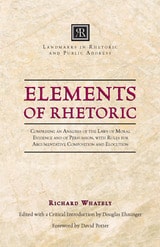
Elements of Rhetoric
Comprising an Analysis of the Laws of Moral Evidence and of Persuasion, with Rules for Argumentative Composition and ElocutionRichard Whately. Edited with a Critical Introduction by Douglas Ehninger. Foreword by David Potter.
Southern Illinois University Press, 1963
Direct, comprehensive, well organized, simple in statement, Elements of Rhetoric is in all respects well fitted to fulfill its assigned role as a textbook. The remarks on practical problems and the examples and analogies confirm contemporary reports that Whately was himself a talented and stimulating teacher.
The modern field of speech was born near the beginning of the twentieth century, some seventy years after Whately wrote. But influential leaders in the new field endorsed Whately’s judgments, and courses and textbooks in public address have remained strongly influenced by his ideas. Whately’s views on a number of major questions in rhetoric have proved sound and fruitful during many decades of practice, and his book remains one of the most influential works on the subject.
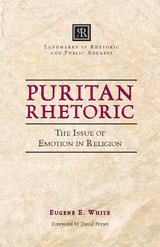
Puritan Rhetoric
The Issue of Emotion in ReligionEugene E. White. Foreword by David Potter
Southern Illinois University Press, 1972
The nature of Puritanism in America and the role of emotion in religion is the subject of this important and useful collection of five religious orations, discussed and appraised by Professor White for students of Puritanism and rhetoric. The five orations presented here consist of three by Jonathan Edwards, “Future Punishment,” “Distinguishing Marks,” and “The Nature of the Affections”; one by Charles Chauncy, “Enthusiasm Described and Caution’d Against”; and one by Ebenezer Gay, “Natural Religion, as Distinguished from Revealed.”
In the first or introductory part of the book, Professor White discusses in considerable detail the broader implications of the confrontation between rationalists and revivalists in New England, represented by the following orations, during this most important upheaval in the Colonies prior to the Revolution. The orations themselves are arranged to represent the force and counterforce of reason versus emotionalism and the precarious balance maintained momentarily and, eventually, lost. And in the third part of the book Professor White provides critical analysis and suggested appraisal for further interpretation and inquiry.
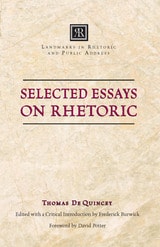
Selected Essays on Rhetoric
Thomas De Quincey, Edited with a Critical Introduction by Frederick Burwick. Foreword by David Potter
Southern Illinois University Press, 1967
The five essays presented here—Rhetoric, Style, Language, Conversation, and Greek Literature—were published together for the first time in The Collected Writings of Thomas De Quincey in 1889–1890. Frederick Burwick brings the essays together again in this volume, introducing them by tracing the sources and development of a belletristic theory of rhetoric, which he says “is one of the most original, and for a few critics, the most puzzling of the nineteenth century.” Burwick makes the edition complete with a comprehensive index and a selected bibliography.