Results by title
6 books match the query 'Powers and duties'
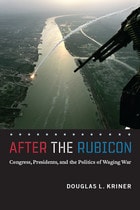
After the Rubicon
Congress, Presidents, and the Politics of Waging WarDouglas L. Kriner
University of Chicago Press, 2010
When the United States goes to war, the nation’s attention focuses on the president. As commander in chief, a president reaches the zenith of power, while Congress is supposedly shunted to the sidelines once troops have been deployed abroad. Because of Congress’s repeated failure to exercise its legislative powers to rein in presidents, many have proclaimed its irrelevance in military matters.
After the Rubicon challenges this conventional wisdom by illuminating the diverse ways in which legislators influence the conduct of military affairs. Douglas L. Kriner reveals that even in politically sensitive wartime environments, individual members of Congress frequently propose legislation, hold investigative hearings, and engage in national policy debates in the public sphere. These actions influence the president’s strategic decisions as he weighs the political costs of pursuing his preferred military course.
Marshalling a wealth of quantitative and historical evidence, Kriner expertly demonstrates the full extent to which Congress materially shapes the initiation, scope, and duration of major military actions and sheds new light on the timely issue of interbranch relations.
Congress Responds to the Twentieth Century
Edited by Sunil Ahuja and Robert E. Dewhirst
The Ohio State University Press, 2003
Congress and the Constitution
Neal Devins and Keith E. Whittington, eds.
Duke University Press, 2005
Several contributors offer wide-ranging accounts of the workings of Congress. They look at lawmakers’ attitudes toward Congress’s role as a constitutional interpreter, the offices within Congress that help lawmakers learn about constitutional issues, Congress’s willingness to use its confirmation power to shape constitutional decisions by both the executive and the courts, and the frequency with which congressional committees take constitutional questions into account. Other contributors address congressional deliberation, paying particular attention to whether Congress’s constitutional interpretations are sound. Still others examine how Congress and the courts should respond to one another’s decisions, suggesting how the courts should evaluate Congress’s work and considering how lawmakers respond to Court decisions that strike down federal legislation. While some essayists are inclined to evaluate Congress’s constitutional interpretation positively, others argue that it could be improved and suggest institutional and procedural reforms toward that end. Whatever their conclusions, all of the essays underscore the pervasive and crucial role that Congress plays in shaping the meaning of the Constitution.
Contributors. David P. Currie, Neal Devins, William N. Eskridge Jr.. John Ferejohn, Louis Fisher, Elizabeth Garrett, Michael J. Gerhardt, Michael J. Klarman, Bruce G. Peabody, J. Mitchell Pickerill, Barbara Sinclair, Mark Tushnet, Adrian Vermeule, Keith E. Whittington, John C. Yoo
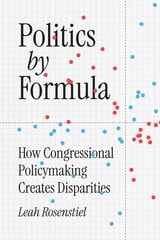
Politics by Formula
How Congressional Policymaking Creates DisparitiesLeah Rosenstiel
University of Chicago Press, 2026
A clear-eyed study that reveals how politics shapes and often distorts important federal programs, driving inequalities across states.
From Medicaid to Section 8 Housing Choice Vouchers, a large percentage of the annual US federal budget (approximately $1 trillion) is distributed through grants-in-aid, a policy tool that allocates aid to state and local governments rather than to individual Americans. When members of Congress use grants-in-aid to fund healthcare, housing, and other forms of support, they are not solely determining how much assistance one person receives. Instead, they can allot certain localities larger grants, which carry big implications for the quality of public services available to citizens living in different states.
Many reasonably assume that these assistance programs distribute funding to states impartially because they use statistical formulas based on population levels, poverty, and other characteristics that, ostensibly, measure need. However, in Politics by Formula, Leah Rosenstiel shows how this seemingly technocratic aspect of federal policymaking is deeply affected by both the structure of political institutions and the motivations of elected officials. Key congressional committees—and especially their leaders—design formulas to benefit their constituencies. Superficially neutral formulas can shield these political decisions from scrutiny, but formulas also constrain congressmembers. Drawing on formal modeling and quantitative and qualitative evidence, Rosenstiel elucidates how these dynamics shape whose and what needs are met and where.
Strategic Responsiveness
How Congress Confronts Presidential PowerScott H. Ainsworth, Brian M. Harward, and Kenneth W. Moffett
University of Michigan Press, 2025
Strategic Responsiveness takes a theoretically developed and empirically oriented approach— situated within legal and historical contexts—to explore the system of separated powers. The authors find that Congress is not as weak as many perceive it to be and show how members of Congress often anticipate individualized policy loss and choose to respond. These policy struggles shape the constitutional order as surely as broad, statutory constraints might. While the aggrandizement of the presidency and the usurpation of congressional control are not countered, ordinary policy losses are. For members and senators, presidential overreach is fine as long as the policy wins continue, but policy losses may motivate members to reassert congressional prerogatives in policymaking through increased oversight. Strategic Responsiveness reveals how profoundly important policy-level disputes are in the politics of maintaining a particular constitutional order.
The Judicial Power of the Purse
How Courts Fund National Defense in Times of CrisisNancy Staudt
University of Chicago Press, 2011
Congress and the president are not the only branches that deal with fiscal issues in times of war. In this innovative book, Nancy Staudt focuses on the role of federal courts in fiscal matters during warfare and high-cost national defense emergencies. There is, she argues, a judicial power of the purse that becomes evident upon examining the budgetary effects of judicial decision making. The book provides substantial evidence that judges are willing—maybe even eager—to redirect private monies into government hands when the country is in peril, but when the judges receive convincing cues that ongoing wartime activities undermine the nation’s interests, they are more likely to withhold funds from the government by deciding cases in favor of private individuals and entities who show up in court.
In stark contrast with conventional legal, political, and institutional thought that privileges factors associated with individual preferences, The Judicial Power of the Purse sheds light on environmental factors in judicial decision making and will be an excellent read for students of judicial behavior in political science and law.