Results by title
83 books match the query 'Pragmatism' and 8 start with a
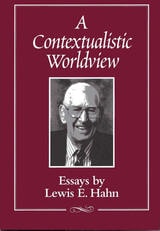
A Contextualistic Worldview
Essays by Lewis E. HahnLewis E. Hahn
Southern Illinois University Press, 2001
This selection of articles by Lewis E. Hahn addresses the philosophical school of contextualism and four contemporary American philosophers: John Dewey, Henry Nelson Wieman, Stephen C. Pepper, and Brand Blanshard.
Stressing the relatively recent contextualistic worldview, which he considers one of the best world hypotheses, Hahn seeks to achieve a broad perspective within which all things may be given their due place. After providing a brief outline, Hahn explains contextualism in relation to other philosophies. In his opening chapter, as in later chapters, he expresses contextualism as a form of pragmatic naturalism. In spite of Hahn’s high regard for contextualism, however, he does not think it would be good if we were limited to a single worldview. “The more different views we have and the more different sources of possible light we have, the better our chances that some of these cosmic maps will shed light on our world and our place in it.”

A Pragmatism of Beginnings
Governing Crises in the AnthropocenePol Bargués
University of Michigan Press, 2027
As climate change, pandemics, disasters, migrations, and conflicts increasingly overlap, crises are becoming more complex and difficult to address. The Anthropocene is an era characterized by uncertainty and contestation, in which traditional approaches to crisis management are no longer working. This book examines the ideas that have emerged to help societies move forward, including resilience, navigation, adaptation, precaution, and slow peacebuilding. While these approaches promise hope and progress, A Pragmatism of Beginnings critically highlights their limitations, showing how they often focus on coping with crises in ways that merely preserve and reproduce a decaying status quo.
Drawing on philosophical pragmatism, the book places these imaginaries that drive crisis management today in dialogue with the work of the classical pragmatists William James, John Dewey, and Jane Addams, as well as contemporary philosophers Bruno Latour, Graham Harman, and Elizabeth Grosz, to assess both their promises and their limitations. Across a series of case studies covering disaster response, peacebuilding, global health, climate governance, migration management, and the Women, Peace and Security agenda, the book shows how contemporary crisis governance often seeks to preserve the status quo by managing risks and avoiding breakdown rather than pursue transformative change. A Pragmatism of Beginnings argues that responding to today’s crises requires more; it also demands the courage and imagination to seize new beginnings.
A Pragmatist Philosophy of Life in Ortega y Gasset
John T. Graham
University of Missouri Press, 1994
Jose Ortega y Gasset (1883-1955), the most widely known and well liked of Spanish philosophers, was much admired in the United States from the 1930s through the 1960s for Revolt of the Masses, History as a System, and Dehumanization of Art, among other works. Those popular works, however, poorly reflected the complexity of Ortega's philosophy. In this first historical analysis of all the parts of Ortega's total thought, John Graham explores the extent to which Ortega's metaphysics was built not only on a native Spanish realism but also upon the pragmatism of William James. Graham details the extent to which Ortega developed an existentialsim before Martin Heidegger and a new historicism less absolute than Benedetto Croce's, by means of a phenomenological method-all within a comprehensive philosophy of life similar to Wilhelm Dilthey's, but more realist and social. In addition, an extensive bibliographical essay examines how Ortega's philosophy, as a whole and in each part, has stood in the estimation of critics worldwide from the 1920s to the present.
Over ten years in preparation, A Pragmatist Philosophy of Life in Ortega y Gasset reveals how open, adaptable, and inventive was pragmatism as Ortega elaborated its philosophical implications and applications for Spain, Europe, and the Americas. It is based on extensive use of the twelve volumes of Ortega's Obras completas, the eighty microfilm reels of his archive in the Library of Congress, and his private library of fifteen hundred volumes in Madrid. These sources, many of which have not been available previously, provide the essential evidence needed to demonstrate the novelty and subtlety, the diversity and unity, of Ortega's thematic "system" of thought.
Students and scholars of intellectual history, Spanish literature, and philosophy will welcome this important new study.
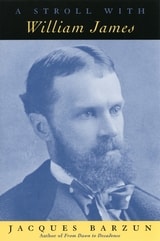
A Stroll with William James
Jacques Barzun
University of Chicago Press, 1983
Abductive Analysis
Theorizing Qualitative ResearchIddo Tavory and Stefan Timmermans
University of Chicago Press, 2014
America's Philosophical Vision
John E. Smith
University of Chicago Press, 1992
American philosophers like Peirce, James, Royce, and
Dewey have forged a unique philosophical tradition—one
that is rich and complex enough to represent a genuine
alternative to the analytic, phenomenological, and
hermeneutical traditions which have originated in Britain
or Europe.
"In my judgment, John Smith has no equal today in
combining two scholarly qualities: the analysis of
philosophical texts with penetration and rigor, and the
discernment of what it is in these texts that matters.
These qualities are in evidence throughout the essays in
America's Philosophical Vision. Whether he is
evaluating Rorty's view of Dewey; the pragmatic theory of
experience and truth; theories of freedom, creativity,
and the self; Royce's conception of community; or
synoptic philosophic visions, Smith always succeeds in
uniting a comprehensive understanding of philosophic
writings with a sure grasp of their import for human
culture and aspiration. It is a great benefit to
students of American thought that these papers have now
been collected into one volume."—James Gouinlock, Emory
University
An Alternate Pragmatism for Going Public
Jim Webber
Utah State University Press, 2017
An Alternate Pragmatism for Going Public interrogates composition’s most prominent responses to contemporary K–16 education reform. By “going public,” teachers, scholars, and administrators rightfully reassert their expertise against corporate-political standards and assessments like the Common Core, Complete College America, and the Collegiate Learning Assessment. However, author Jim Webber shows that composition’s professional imperative for self-defense only partly fulfils the broader aims of “going public,” which include fostering public participation that can assess and potentially affirm the public good of professional judgment.
Drawing on the pragmatic/democratic tradition, Webber envisions an alternate rhetoric of professionalism, one that not only reasserts compositionists’ expertise but also expands opportunities for publics to authorize this expertise. While this public inquiry and engagement may not safeguard professional standing against neoliberal reform, it reorients composition toward an equally important goal, enabling publics to gauge the adequacy of the educational standardization so often advocated by contemporary reform.
An Alternate Pragmatism for Going Public shows how public engagement can serve composition’s efforts related to “going public.”
Anthropology from a Pragmatic Point of View
Immanuel Kant. Translated by Victor Lyle Dowdell. Revised and Edited by Hans H. Rudnick
Southern Illinois University Press, 1996
In the fall semester of 1772/73 at the Albertus University of Königsberg, Immanuel Kant, metaphysician and professor of logic and metaphysics, began lectures on anthropology, which he continued until 1776, shortly before his retirement from public life. His lecture notes and papers were first published in 1798, eight years after the publication of the Critique of Judgment, the third of his famous Critiques. The present edition of the Anthropology is a translation of the text found in volume 7 of Kants gesammelte Schriften, edited by Oswald Külpe.
Kant describes the Anthropology as a systematic doctrine of the knowledge of humankind. (He does not yet distinguish between the academic discipline of anthropology as we understand it today and the philosophical.) Kant’s lectures stressed the "pragmatic" approach to the subject because he intended to establish pragmatic anthropology as a regular academic discipline. He differentiates the physiological knowledge of the human race—the investigation of "what Nature makes of man"—from the pragmatic—"what man as a free being makes of himself, what he can make of himself, and what he ought to make of himself." Kant believed that anthropology teaches the knowledge of humankind and makes us familiar with what is pragmatic, not speculative, in relation to humanity. He shows us as world citizens within the context of the cosmos.
Summarizing the cloth edition of the Anthropology, Library Journal concludes: "Kant’s allusions to such issues as sensation, imagination, judgment, (aesthetic) taste, emotion, passion, moral character, and the character of the human species in regard to the ideal of a cosmopolitan society make this work an important resource for English readers who seek to grasp the connections among Kant’s metaphysics of nature, metaphysics of morals, and political theory. The notes of the editor and translator, which incorporate material from Ernst Cassirer’s edition and from Kant’s marginalia in the original manuscript, shed considerable light on the text."