Results by title
3 books match the query 'Prenatal care'
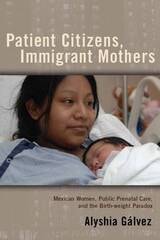
Patient Citizens, Immigrant Mothers
Mexican Women, Public Prenatal Care, and the Birth Weight ParadoxGalvez, Alyshia
Rutgers University Press, 2011
According to the Latina health paradox, Mexican immigrant women have less complicated pregnancies and more favorable birth outcomes than many other groups, in spite of socioeconomic disadvantage. Alyshia Gálvez provides an ethnographic examination of this paradox. What are the ways that Mexican immigrant women care for themselves during their pregnancies? How do they decide to leave behind some of the practices they bring with them on their pathways of migration in favor of biomedical approaches to pregnancy and childbirth?
This book takes us from inside the halls of a busy metropolitan hospital’s public prenatal clinic to the Oaxaca and Puebla states in Mexico to look at the ways Mexican women manage their pregnancies. The mystery of the paradox lies perhaps not in the recipes Mexican-born women have for good perinatal health, but in the prenatal encounter in the United States. Patient Citizens, Immigrant Mothers is a migration story and a look at the ways that immigrants are received by our medical institutions and by our society
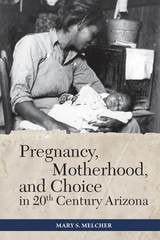
Pregnancy, Motherhood, and Choice in Twentieth-Century Arizona
Mary S. Melcher
University of Arizona Press, 2012
Early twentieth-century Arizona was a life-threatening place for new and expectant mothers. Towns were small and very far apart, and the weather and harsh landscape often delayed midwives. It was not uncommon for a woman to give birth without medical care and with the aid of only family members. By the 1920s, Arizona was at the top of the list for the highest number of infant deaths.
Mary Melcher’s Pregnancy, Motherhood, and Choice in Twentieth-Century Arizona provides a deep and diverse history of the dramatic changes in childbirth, birth control, infant mortality, and abortion over the course of the last century. Using oral histories, memoirs, newspaper accounts, government documents, letters, photos, and biographical collections, this fine-grained study of women’s reproductive health places the voices of real women at the forefront of the narrative, providing a personal view into some of the most intense experiences of their lives.
Tackling difficult issues such as disparities in reproductive health care based on race and class, abortion, and birth control, this book seeks to change the way the world looks at women’s health. An essential read for both historians and public health officials, this book reveals that many of the choices and challenges that women once faced remain even today.
Reproductive Boundaries
Psychosocial Care and Pregnancy in SwitzerlandEdmée Ballif
Rutgers University Press, 2026
Reproductive Boundaries examines the shifting boundaries of prenatal care in Switzerland, focusing on the Pregnancy Support Center's innovative psychosocial model. By redefining the territory of care, the Center extends its reach beyond the medical domain, exemplifying the reproductivization of life, the increasing organization of various life aspects through a reproductive lens. The book explores how this approach challenges traditional borders between medical and psychosocial care, offering an alternative to Switzerland's heavily medicalized reproductive care. Through ethnographic insights into reproductive talk, it reveals how psychosocial advisors shift the boundaries of reproductive care, balancing support with broader state goals of reproductive governance. Set against Switzerland's history of stratified reproductive policies, the study critically examines how psychosocial care reshapes the landscape of pregnancy, raising questions about surveillance and evolving gender roles. This thought-provoking work invites readers to reconsider the limits and possibilities of care in a fragmented society.
This book is also freely available online as an open access digital edition. (https://www.rutgersuniversitypress.org/media/wysiwyg/documents/Reproductive_Boundaries_PDF.pdf)