Results by title
6 books match the query 'Presbyterian'

Born Again
The Christian Right GlobalizedJennifer S. Butler
Pluto Press, 2006
This book reveals how Christian conservative groups are able to shape policy in every corner of the world. Drawing on interviews with religious leaders, it reveals how today's most powerful Christian Right organisations are building interfaith coalitions, connecting Catholic, Mormon and Muslim allies to advance a conservative agenda.
The US under Bush Jr. has given them a significant voice in shaping US policy on issues including women's rights, reproductive health, human cloning, children's rights and AIDS.
In short, the Christian Right is globalising -- a phenomenon that promises to challenge progressive social policy on a world-wide scale - as well as transform the Christian Right itself.

John Henry Livingston and the Dutch Reformed Tradition in the Early American Nation
John W. Coakley
Rutgers University Press, 2027
John Henry Livingston (1746-1825) was from a prominent New York family of merchants, lawyers and statesmen but chose to become a minister in the Dutch Reformed Church. In his twenties he studied in the Netherlands, absorbing ideas that upheld simultaneously the authority of the individual conscience and the traditional Reformed beliefs rooted in the authority of a state-supported church. Returning to New York City he served as a pastor, as his denomination’s professor charged with educating students for ministry, and eventually, president of the American Dutch church’s college, then called Queens (but later called Rutgers). Throughout his career he articulated, and defended what he saw as the harmony between the traditional body of Reformed belief and the ideals of the American state.
Our Southern Zion
A History of Calvinism in the South Carolina Low Country, 1690-1990Erskine Clarke
University of Alabama Press, 1996
Three centuries of faith, intellect, and resilience—Calvinism’s quiet power in the Southern low country.
The South Carolina low country has long been regarded—not only in popular imagination and paperback novels but also by respected scholars—as a region dominated by what earlier historians called “a cavalier spirit” and by what later historians have simply described as “a wholehearted devotion to amusement and the neglect of religion and intellectual pursuits.” Such images of the low country have been powerful interpreters of the region because they have had some foundation in social and cultural realities. It is a thesis of this study, however, that there has been a strong Calvinist community in the Carolina low country since its establishment as a British colony and that this community (including in its membership both whites and after the 1740s significant numbers of African Americans) contradicts many of the images of the "received version" of the region. Rather than a devotion to amusement and a neglect of religion and intellectual interests, this community has been marked throughout most of its history by its disciplined religious life, its intellectual pursuits, and its work ethic.
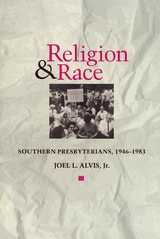
Religion and Race
Southern Presbyterians, 1946 to 1983Joel L. Alvis Jr
University of Alabama Press, 1994
Joel Alvis focuses on the relationships and tensions in the Presbyterian Church, U.S., whose ecclesiastical boundaries never expanded significantly beyond its original territory in the Confederacy and border South. By the time of the civil rights movement, the church was actively involved in ecumenical activities despite its regional isolation, and that involvement created unease in some quarters of the denomination. This concise institutional history traces how the church shaped and was shaped by its regional culture and explores the denomination's own cultural struggle to determine what role race issues would play in the definition of being Presbyterian.
Storm of Words
Science, Religion, and Evolution in the Civil War EraMonte Harrell Hampton
University of Alabama Press, 2014
A study of the ways that southern Presbyterians in the wake of the Civil War contended with a host of cultural and theological questions
Southern Presbyterian theologians enjoyed a prominent position in antebellum southern culture. Respected for both their erudition and elite constituency, these theologians identified the southern society as representing a divine, Biblically ordained order. Beginning in the 1840s, however, this facile identification became more difficult to maintain, colliding first with antislavery polemics, then with Confederate defeat and reconstruction, and later with women’s rights, philosophical empiricism, literary criticisms of the Bible, and that most salient symbol of modernity, natural science.
As Monte Harrell Hampton shows in Storm of Words, modern science seemed most explicitly to express the rationalistic spirit of the age and threaten the Protestant conviction that science was the faithful “handmaid” of theology. Southern Presbyterians disposed of some of these threats with ease. Contemporary geology, however, posed thornier problems. Ambivalence over how to respond to geology led to the establishment in 1859 of the Perkins Professorship of Natural Science in Connexion with Revealed Religion at the seminary in Columbia, South Carolina. Installing scientist-theologian James Woodrow in this position, southern Presbyterians expected him to defend their positions.
Within twenty-five years, however, their anointed expert held that evolution did not contradict scripture. Indeed, he declared that it was in fact God’s method of creating. The resulting debate was the first extended evolution controversy in American history. It drove a wedge between those tolerant of new exegetical and scientific developments and the majority who opposed such openness. Hampton argues that Woodrow believed he was shoring up the alliance between science and scripture—that a circumscribed form of evolution did no violence to scriptural infallibility. The traditionalists’ view, however, remained interwoven with their identity as defenders of the Lost Cause and guardians of southern culture.
The ensuing debate triggered Woodrow’s dismissal. It also capped a modernity crisis experienced by an influential group of southern intellectuals who were grappling with the nature of knowledge, both scientific and religious, and its relationship to culture—a culture attempting to define itself in the shadow of the Civil War and Reconstruction.

The Heavenly Contract
Ideology and Organization in Pre-Revolutionary PuritanismDavid Zaret
University of Chicago Press, 1985