Results by title
3 books match the query 'Price, Brian'
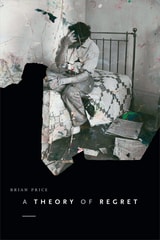
A Theory of Regret
Brian Price
Duke University Press, 2017

Assayas and Political Seriousness
Brian Price
Northwestern University Press, 2026
A cogent reconsideration of Assayas’s cinematic oeuvre and what it teaches us about the political today
The films of Olivier Assayas are widely celebrated for their complex responses to the many shifts that globalization has introduced in our time. Brian Price contends that they offer a different way of regarding the so-called problem of cultural and political enmeshment that Carl Schmitt and other conservative thinkers fear, including a contention that enmeshment is not a problem at all, in fact, but rather a different mode of social and political organization. Price puts Assayas’s films in dialogue not only with Schmitt’s theory of the political but also with the history of political philosophy after Schmitt, especially in the work of Hannah Arendt, Jacques Derrida, and Chantal Mouffe, all of whom have attempted to reckon with the friend/enemy dynamic at the core of the political.
At the heart of Assayas’s cinematic oeuvre, and of this book, is a reflection on what it means to be politically serious, which, Price shows, cannot be reduced to criteria that can simply be applied or repeated. The boundaries between the political and the varied forms of the social demand a sensitivity to change and the unknown, none of which can be accessed in the states of absolute certainty that are derived from crises that do not repeat in the same ways. The messiness and nuances of modern life are held together by moving images, which insist that we know why we value what we demand and seek to protect.
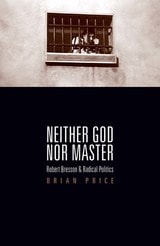
Neither God nor Master
Robert Bresson and Radical PoliticsBrian Price
University of Minnesota Press, 2010
Situating Bresson in radical and aesthetic political contexts, from surrealism to situationism, Neither God nor Master shows how his early style was a model for social resistance. We then see how, after May 1968, his films were in fact a series of reflections on the failure of revolution in France—especially as “failure” is understood in relation to Bresson’s chosen literary precursors, Dostoyevsky and Tolstoy, and Russian revolutionary culture of the nineteenth century.
Restoring Bresson to the radical political culture from which he emerged—and to which he remained faithful—Price offers a major revision of the reputation of one of the most celebrated figures in the history of French film. In doing so, he raises larger philosophical questions about the efficacy of revolutionary practices and questions about interpretation and metaphysical tendencies of film historical research that have, until now, gone largely untested.