Results by title
9 books match the query 'Primaries'
Before the Convention
Strategies and Choices in Presidential Nomination CampaignsJohn H. Aldrich
University of Chicago Press, 1980
Campaigns to win the Democratic and Republican presidential nominations are longer, more complex, and more confusing to the observer than the general election itself. The maze of delegate-selection procedures includes state primaries and caucuses as well as the traditional "smoke-filled room." Complicated federal election laws govern campaign financing. Sometimes many candidates enter and drop out of the race, while sometimes a stable two-way contest occurs: the 1976 nomination campaigns of Jimmy Carter and Gerald Ford exemplified each extreme. Is it possible to propose general principles to explain the apparent chaos of our presidential nomination system? Can those principles account for two such starkly different campaigns as occurred in 1976? In Before the Convention, political scientist John H. Aldrich presents a systematic analysis of presidential nomination politics, based on application of rational-choice models to candidate behavior. Aldrich views the candidates as decision makers with limited resources in a highly competitive environment. From this perspective, he seeks to determine why and how candidates choose to run, why some succeed and others fail, and what consequences the nomination process has for the general election and, later, for the President in office.
Aldrich begins with a brief history of the presidential selection process, focusing on the continuing shift of power from political elites to the mass electorate. He then turns to a detailed analysis of the 1976 nomination campaigns. Using data from a variety of sources, Aldrich demonstrates that the very different patterns in these races both conform to the rational-choice model. The analysis includes consideration of numerous questions of strategy. Is there a "momentum" to campaigns? How does a candidate identify and exploit this intangible quality? How do candidates decide where to contend and where not to contend? What is the nature of policy competition among candidates? When does a candidate prefer a "fuzzy" position to a clearly stated one? Other topics include reforms in campaign financing and the expanded and changed role of news coverage.
Before the Convention fills a significant gap in the literature on presidential politics, and therefore should be of particular importance to specialists in this area. It will be ofinterest also to everyone who is concerned with understanding the "rules of the game" for a complicated but vitally important exercise of American democracy.
Black Victory
The Rise and Fall of the White Primary in TexasDarlene Clark Hine & Essays by Darlene Clark Hine, Steven F. Lawson, & Merline Pitre
University of Missouri Press, 2003
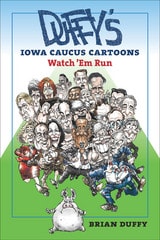
Duffy's Iowa Caucus Cartoons
Watch 'Em RunBrian Duffy
University of Iowa Press, 2015
Whether you’re anticipating or dreading the onset of another caucus season in 2016, this book will put it all into perspective. From Jimmy Carter’s innovative 1976 effort to Barack Obama’s come-from-behind win in 2008, from George H. W. Bush’s storming to victory in 1980 to George W. Bush’s coasting to his win in 2000, from Gary Hart’s peccadillos in 1988 to John Edwards’s missteps in 2008, from Elizabeth Dole’s determination to breach the White House boys’ club in 2000 to Hillary Clinton’s fall from frontrunner to third place in 2008, here is American presidential campaigning in all its glory. With pigs.

Learning by Voting
Sequential Choices in Presidential Primaries and Other ElectionsRebecca B. Morton and Kenneth C. Williams
University of Michigan Press, 2001
Does the movement to a large number of early presidential primaries reduce the ability of voters to learn about the candidates? Do voters who vote early miss important information by not following the entire campaign, or are they, as some argue, more partisan? In a unique study Rebecca B. Morton and Kenneth C. Williams investigate the impact these changes have on the choices voters make. The authors combine a formal, theoretical model to derive hypotheses with experiments, elections conducted in labs, to test the hypotheses.
Their analysis finds that sequence in voting does matter. In simultaneous voting elections well-known candidates are more likely to win, even if that candidate is the first preference of only a minority of the voters and would be defeated by another candidate, if that candidate were better known. These results support the concerns of policy makers that front-loaded primaries prevent voters from learning during the primary process. The authors also find evidence that in sequential elections those who vote on election day have the benefit of information received throughout the whole course of the campaign, thus supporting concerns with mail-in ballots and other early balloting procedures.
This book will interest scholars interested in elections, the design of electoral systems, and voting behavior as well as the use of formal modeling and experiments in the study of politics. It is written in a manner that can be easily read by those in the public concerned with presidential elections and voting.
Rebecca B. Morton is Associate Professor of Political Science, University of Iowa. Kenneth C. Williams is Associate Professor of Political Science, Michigan State University.
The First Primary
New Hampshire's Outsize Role in Presidential NominationsDavid W. Moore
University of New Hampshire Press, 2015
The Party Decides
Presidential Nominations Before and After ReformMarty Cohen, David Karol, Hans Noel, and John Zaller
University of Chicago Press, 2008
Tracing the evolution of presidential nominations since the 1790s, this volume demonstrates how party insiders have sought since America’s founding to control nominations as a means of getting what they want from government. Contrary to the common view that the party reforms of the 1970s gave voters more power, the authors contend that the most consequential contests remain the candidates’ fights for prominent endorsements and the support of various interest groups and state party leaders. These invisible primaries produce frontrunners long before most voters start paying attention, profoundly influencing final election outcomes and investing parties with far more nominating power than is generally recognized.
The Primary Rules
Parties, Voters, and Presidential NominationsCaitlin E. Jewitt
University of Michigan Press, 2019
Why Iowa?
How Caucuses and Sequential Elections Improve the Presidential Nominating ProcessDavid P. Redlawsk, Caroline J. Tolbert, and Todd Donovan
University of Chicago Press, 2010
If Barack Obama had not won in Iowa, most commentators believe that he would not have been able to go on to capture the Democratic nomination for president. Why Iowa? offers the definitive account of those early weeks of the campaign season: from how the Iowa caucuses work and what motivates the candidates’ campaigns, to participation and turnout, as well as the lingering effects that the campaigning had on Iowa voters. Demonstrating how “what happens in Iowa” truly reverberates throughout the country, five-time Iowa precinct caucus chair David P. Redlawsk and his coauthors take us on an inside tour of one of the most media-saturated and speculated-about campaign events in American politics.
Considering whether a sequential primary system, in which early, smaller states such as Iowa and New Hampshire have such a tremendous impact is fair or beneficial to the country as a whole, the authors here demonstrate that not only is the impact warranted, but it also reveals a great deal about informational elements of the campaigns. Contrary to conventional wisdom, this sequential system does confer huge benefits on the nominating process while Iowa’s particularly well-designed caucus system—extensively explored here for the first time—brings candidates’ arguments, strengths, and weaknesses into the open and under the media’s lens.
Wisconsin for Kennedy
The Primary That Launched a President and Changed the Course of HistoryB. J. Hollars
Wisconsin Historical Society Press, 2024
When John F. Kennedy ran for president in 1960, he did something no candidate had done before: he leveraged the power of state primaries to win his party’s nomination. Kennedy’s first battleground state? Wisconsin—a state that would prove more arduous, more exhausting, and more crucial to winning the presidency than any other.
Wisconsin for Kennedy brings to life the stories behind JFK’s history-making 1960 Wisconsin primary campaign, and how Kennedy’s team managed to outmaneuver his politically seasoned opponent, Hubert Humphrey. From Jackie Kennedy commandeering a supermarket loudspeaker in Kenosha, to the Wisconsin forklift driver who planned President Kennedy’s final trip to Dallas, this captivating book places readers at the heart of the action.
Author B.J. Hollars chronicles JFK’s nail-biting Wisconsin win by drawing on rarely cited oral histories from the eclectic team of people who worked together to make it happen: a cranberry farmer, a union leader, a mayor, an architect, and others. Wisconsin for Kennedy explores how Wisconsin helped propel JFK all the way to the White House in a riveting historical account that reads like a work of rollicking, page-turning fiction.
“In the spirit of Theodore H. White’s The Making of The President: 1960, B.J. Hollars offers a vivid account of the Wisconsin primary that launched JFK’s successful presidential campaign, inspiring voters to pass the torch to a new generation of leadership for our country. Anyone mesmerized by JFK’s legacy will enjoy this great read.”
—Former US Representative Ron Kind
“For generations, my family has had the great privilege of serving the people of Wisconsin. In Wisconsin for Kennedy, B.J. Hollars performs his own act of service, recounting the riveting and untold story of Wisconsin’s politically perilous 1960 primary. A poignant contribution to political history that reads like a page-turner.”
—Former Wisconsin Governor James Doyle Jr.
"A hopeful quality . . . pervades Wisconsin for Kennedy, written about a time and place when politics was conducted in a less severe and divisive way than it is now. Hollars further succeeds in showing how political history is made by a wide range of citizens. Wisconsinites, Midwesterners, and indeed Americans of all political persuasions can be grateful to B.J. Hollars for these important reminders."
— Middle West Review