Results by title
7 books match the query 'Princesses'
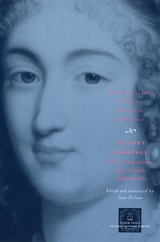
Against Marriage
The Correspondence of La Grande MademoiselleAnne-Marie-Louise d'Orléans, Duchesse de Montpensier
University of Chicago Press, 2002
In the daring letters presented in this bilingual edition, Montpensier condemns the alliance system of marriage, proposing instead to found a republic that she would govern, "a corner of the world in which . . . women are their own mistresses," and where marriage and even courtship would be outlawed. Her pastoral utopia would provide medical care and vocational training for the poor, and all the homes would have libraries and studies, so that each woman would have a "room of her own" in which to write books.
Joan DeJean's lively introduction and accessible translation of Montpensier's letters—four previously unpublished—allow us unprecedented access to the courageous voice of this extraordinary woman.
Love's Labour's Lost
William Shakespeare
Arizona Center for Medieval and Renaissance Studies, 2024
Love’s Labour’s Lost is a wacky comedy of disguise and mischief, following the King of Navarre and his companions as they attempt to swear off the company of women. Focusing on bringing new life into the musicality of Shakespeare’s language, Josh Wilder’s translation of Love’s Labour’s Lost brings out the play’s romp and sass for a contemporary audience.
This translation of Love’s Labour’s Lost was written as part of the Oregon Shakespeare Festival’s Play On! project, which commissioned new translations of thirty-nine Shakespeare plays. These translations present the work of “The Bard” in language accessible to modern audiences while never losing the beauty of Shakespeare’s verse. Enlisting the talents of a diverse group of contemporary playwrights, screenwriters, and dramaturges from diverse backgrounds, this project reenvisions Shakespeare for the twenty-first century. These volumes make these works available for the first time in print—a new First Folio for a new era.
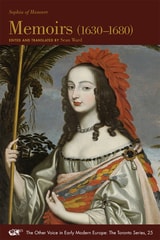
Memoirs (1630-1680)
Sophia of Hanover
Iter Press, 2013
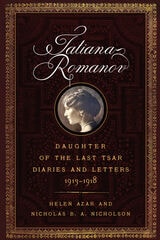
Tatiana Romanov, Daughter of the Last Tsar
Diaries and Letters, 1913–1918Helen Azar
Westholme Publishing, 2016
Grand Duchess Tatiana Nikolaevna of Russia was the second of the four daughters of Tsar Nicholas II and his wife, the Empress Alexandra Feodorovna. Long recognized by historians as the undisputed “beauty” of the family, Tatiana was acknowledged for her poise, her elegance, and her innate dignity within her own family. Helen Azar, translator of the diaries of Olga Romanov, and Nicholas B. A. Nicholson, Russian Imperial historian, have joined together to present a truly comprehensive picture of this extraordinarily gifted, complex, and intelligent woman in her own words. Tatiana Romanov, Daughter of the Last Tsar: Diaries and Letters, 1913–1918, presents translations of material never before published in Russian or in English, as well as materials never published in their entirety in the West.
The brisk, modern prose of Tatiana’s diary entries reveals the character of a young woman who was far more than the sheltered imperial beauty as she previously has been portrayed. While many historians and writers describe her as a cold, haughty, and distant aristocrat, this book shows instead a remarkably down-to-earth and humorous young woman, full of life and compassion. A detail-oriented and observant participant in some of the most important historical events of the early twentieth century, she left firsthand descriptions of the tercentenary celebrations of the House of Romanov, the early years of Russia’s involvement in World War I, and the road to her family’s final days in Siberian exile. Her writings reveal extraordinary details previously unknown or unacknowledged. Lavishly annotated for the benefit of the nonspecialist reader, this book is not only a reevaluation of Tatiana’s role as more than just one of four sisters, but also a valuable reference on Russia, the First World War, the Russian Revolution, and the people closest to the Grand Duchess and her family.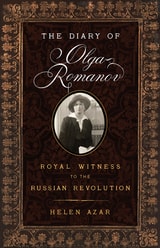
The Diary of Olga Romanov
Royal Witness to the Russian RevolutionHelen Azar
Westholme Publishing, 2014
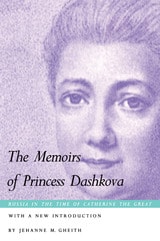
The Memoirs of Princess Dashkova
Ekaterina Romanovna Dashkova
Duke University Press, 1995
Originally written in French, first published in English, and long out of print, Dashkova’s Memoirs tell the story of a woman who at age eighteen played an important role in the coup that brought Catherine the Great to the throne. The relationship between these two women, often tense, is a central theme throughout this story. Dashkova, occupying the highly unusual position of both stateswoman and mother, also reveals her own path between the demands and limitations of the "private" and "public" spheres of her society. She provides a view of the expectations of Russian aristocratic women, the possibilities available to them, and the ways in which gender roles were conceived in the eighteenth century.
With a new introduction by Jehanne M Gheith, The Memoirs of Princess Dashkova will renew interest in the life of a fascinating woman for students of Russian history, women’s studies, and eighteenth-century studies. It will be a significant text for those engaged in the cross-cultural study of the traditions of women’s autobiographical writing.
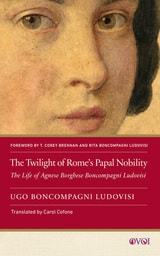
The Twilight of Rome's Papal Nobility
The Life of Agnese Borghese Boncompagni LudovisiUgo Boncompagni Ludovisi (1856–1935)
Rutgers University Press, 2025
First privately published in 1921, The Twilight of Rome's Papal Nobility provides an intimate look at a family who grew up accustomed to almost unimaginable wealth, power, and glamour. A descendant of two popes, Ugo Boncompagni Ludovisi recounts the life story of his mother Agnese, who was raised in a palace full of priceless artwork, including pieces by Caravaggio and Michelangelo. We get a window into Agnese's private life—her girlhood, marriage, and raising of several children—as her public life becomes increasingly tumultuous amid the family’s struggles to retain its property. A tender elegy to a bygone era, Boncompagni Ludovisi's story provides a unique perspective on Italian history and Rome’s urban redevelopment.