Results by title
4 books match the query 'Principe, Lawrence M.'
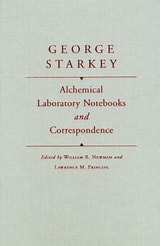
Alchemical Laboratory Notebooks and Correspondence
George Starkey
University of Chicago Press, 2004
George Starkey—chymistry tutor to Robert Boyle, author of immensely popular alchemical treatises, and probably early America's most important scientist—reveals in these pages the daily laboratory experimentation of a seventeenth-century alchemist.
The editors present in this volume transcriptions of Starkey's texts, their translations, and valuable commentary for the modern reader. Dispelling the myth that alchemy was an irrational enterprise, this remarkable collection of laboratory notebooks and correspondence reveals the otherwise hidden methodologies of one of the seventeenth century's most influential alchemists.
The editors present in this volume transcriptions of Starkey's texts, their translations, and valuable commentary for the modern reader. Dispelling the myth that alchemy was an irrational enterprise, this remarkable collection of laboratory notebooks and correspondence reveals the otherwise hidden methodologies of one of the seventeenth century's most influential alchemists.
[more]
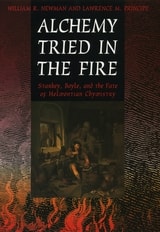
Alchemy Tried in the Fire
Starkey, Boyle, and the Fate of Helmontian ChymistryWilliam R. Newman and Lawrence M. Principe
University of Chicago Press, 2002
Winner of the 2005 Pfizer Prize from the History of Science Society.
What actually took place in the private laboratory of a mid-seventeenth century alchemist? How did he direct his quest after the secrets of Nature? What instruments and theoretical principles did he employ?
Using, as their guide, the previously misunderstood interactions between Robert Boyle, widely known as "the father of chemistry," and George Starkey, an alchemist and the most prominent American scientific writer before Benjamin Franklin as their guide, Newman and Principe reveal the hitherto hidden laboratory operations of a famous alchemist and argue that many of the principles and practices characteristic of modern chemistry derive from alchemy. By analyzing Starkey's extraordinary laboratory notebooks, the authors show how this American "chymist" translated the wildly figurative writings of traditional alchemy into quantitative, carefully reasoned laboratory practice—and then encoded his own work in allegorical, secretive treatises under the name of Eirenaeus Philalethes. The intriguing "mystic" Joan Baptista Van Helmont—a favorite of Starkey, Boyle, and even of Lavoisier—emerges from this study as a surprisingly central figure in seventeenth-century "chymistry." A common emphasis on quantification, material production, and analysis/synthesis, the authors argue, illustrates a continuity of goals and practices from late medieval alchemy down to and beyond the Chemical Revolution.
For anyone who wants to understand how alchemy was actually practiced during the Scientific Revolution and what it contributed to the development of modern chemistry, Alchemy Tried in the Fire will be a veritable philosopher's stone.
[more]
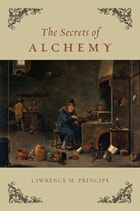
The Secrets of Alchemy
Lawrence M. Principe
University of Chicago Press, 2012
In The Secrets of Alchemy, Lawrence M. Principe, one of the world’s leading authorities on the subject, brings alchemy out of the shadows and restores it to its important place in human history and culture. By surveying what alchemy was and how it began, developed, and overlapped with a range of ideas and pursuits, Principe illuminates the practice. He vividly depicts the place of alchemy during its heyday in early modern Europe, and then explores how alchemy has fit into wider views of the cosmos and humanity, touching on its enduring place in literature, fine art, theater, and religion as well as its recent acceptance as a serious subject of study for historians of science. In addition, he introduces the reader to some of the most fascinating alchemists, such as Zosimos and Basil Valentine, whose lives dot alchemy’s long reign from the third century and to the present day. Through his exploration of alchemists and their times, Principe pieces together closely guarded clues from obscure and fragmented texts to reveal alchemy’s secrets, and—most exciting for budding alchemists—uses them to recreate many of the most famous recipes in his lab, including those for the “glass of antimony” and “philosophers’ tree.” This unique approach brings the reader closer to the actual work of alchemy than any other book.
[more]
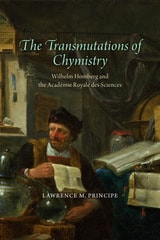
The Transmutations of Chymistry
Wilhelm Homberg and the Académie Royale des SciencesLawrence M. Principe
University of Chicago Press, 2020
This book reevaluates the changes to chymistry that took place from 1660 to 1730 through a close study of the chymist Wilhelm Homberg (1653–1715) and the changing fortunes of his discipline at the Académie Royale des Sciences, France’s official scientific body. By charting Homberg’s remarkable life from Java to France’s royal court, and his endeavor to create a comprehensive theory of chymistry (including alchemical transmutation), Lawrence M. Principe reveals the period’s significance and reassesses its place in the broader sweep of the history of science.
Principe, the leading authority on the subject, recounts how Homberg’s radical vision promoted chymistry as the most powerful and reliable means of understanding the natural world. Homberg’s work at the Académie and in collaboration with the future regent, Philippe II d’Orléans, as revealed by a wealth of newly uncovered documents, provides surprising new insights into the broader changes chymistry underwent during, and immediately after, Homberg. A human, disciplinary, and institutional biography, The Transmutations of Chymistry significantly revises what was previously known about the contours of chymistry and scientific institutions in the early eighteenth century.
Principe, the leading authority on the subject, recounts how Homberg’s radical vision promoted chymistry as the most powerful and reliable means of understanding the natural world. Homberg’s work at the Académie and in collaboration with the future regent, Philippe II d’Orléans, as revealed by a wealth of newly uncovered documents, provides surprising new insights into the broader changes chymistry underwent during, and immediately after, Homberg. A human, disciplinary, and institutional biography, The Transmutations of Chymistry significantly revises what was previously known about the contours of chymistry and scientific institutions in the early eighteenth century.
[more]