Results by title
8 books match the query 'Print Culture'
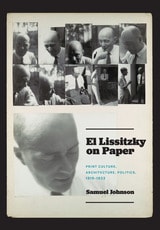
El Lissitzky on Paper
Print Culture, Architecture, Politics, 1919–1933Samuel Johnson
University of Chicago Press, 2024
Russian artist El Lissitzky’s work spans painting, photography, theatrical and exhibition design, architecture, graphic design, typography, and literature. He was active in the Jewish cultural renaissance, formed an artists’ collective with Kazimir Malevich, was a key figure in the dissemination of early Soviet art in Western Europe, and designed propaganda for the Stalin regime. With such a varied history and body of work, scholars have often struggled to identify the core principles that tied his diverse oeuvre together.
In El Lissitzky on Paper, Samuel Johnson argues that Lissitzky’s commitment to creating works on paper is a constant that unites his endeavors. Paper played a key role in the utopian projects that informed Lissitzky’s work, and the artist held a commitment to print as the premier medium of immediate public exchange. Johnson analyzes and contextualizes this idea against the USSR’s strict management of this essential resource and the growth of new media communications, including the telephone, telegraph, and film.
With this book, Johnson presents a significant contribution to scholarship on this major artist, revealing new connections between Lissitzky’s work in architecture and visual art and bringing to light sources from largely unstudied Russian archives.
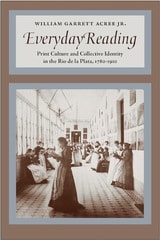
Everyday Reading
Print Culture and Collective Identity in the Rio de la Plata, 1780-1910William Garrett Acree
Vanderbilt University Press, 2011
Starting in the late nineteenth century, the region of South America known as the Rio de la Plata (containing modern-day Uruguay and Argentina) boasted the highest literacy rates in Latin America. In Everyday Reading, William Acree explores the history, events, and culture that gave rise to the region's remarkable progress. With a specific focus on its print culture, in the form of newspapers, political advertisements and documents, schoolbooks, and even stamps and currency, Acree creates a portrait of a literary culture that permeated every aspect of life.
Everyday Reading argues that the introduction of the printing press into the Rio de la Plata in the 1780s hastened the collapse of Spanish imperial control and played a major role in the transition to independence some thirty years later. After independence, print culture nurtured a new identity and helped sustain the region through the tumult of civil war in the mid-1800s. Acree concludes by examining the role of reading in formal education, which had grown exponentially by the early twentieth century as schoolchildren were taught to fulfill traditional roles in society.
Ultimately, Everyday Reading humanizes literary culture, demonstrating its unrecognized and unexpected influence in everyday lives.
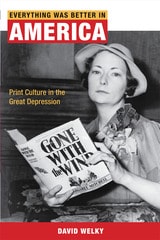
Everything Was Better in America
Print Culture in the Great DepressionDavid Welky
University of Illinois Press, 2007
Nothingism
Poetry at the End of Print CultureJason Schneiderman
University of Michigan Press, 2025
In this collection, the essays range from blistering manifesto to deep historical dives to gentle classroom guidance to considerations of the poems of James Merrill and Agha Shahid Ali, moving between the theoretical and the practical. Nothingism is both deeply personal and highly erudite, providing an engaging and scholarly account of reading, writing, and teaching poetry as our world continues its unsupervised lurch toward digital culture.

Print Culture in a Diverse America
Edited by James P. Danky and Wayne A. Wiegand
University of Illinois Press, 1998
In the modern era, there arose a prolific and vibrant print culture—books, newspapers, and magazines issued by and for diverse, often marginalized, groups. This long-overdue collection offers a unique foray into the multicultural world of reading and readers in the United States.
The contributors to this award-winning collection pen interdisciplinary essays that examine the many ways print culture functions within different groups. The essays link gender, class, and ethnicity to the uses and goals of a wide variety of publications and also explore the role print materials play in constructing historical events like the Titanic disaster.
Contributors: Lynne M. Adrian, Steven Biel, James P. Danky, Elizabeth Davey, Michael Fultz, Jacqueline Goldsby, Norma Fay Green, Violet Johnson, Elizabeth McHenry, Christine Pawley, Yumei Sun, and Rudolph J. Vecoli
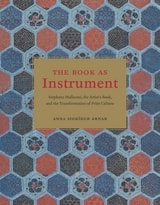
The Book as Instrument
Stéphane Mallarmé, the Artist's Book, and the Transformation of Print CultureAnna Sigrídur Arnar
University of Chicago Press, 2011
Stéphane Mallarmé (1842–98) was a French Symbolist poet, theorist, and teacher whose ideas and legendary salons set the stage for twentieth-century experimentation in poetry, music, theater and art. A canonical figure in the legacy of modernism, Mallarmé was also a lifelong champion of the book as both a literary endeavor and a carefully crafted material object.
In The Book as Instrument, Anna Sigrídur Arnar explores how this object functioned for Mallarmé and his artistic circle, arguing that the book became a strategic site for encouraging a modern public to actively partake in the creative act, an idea that informed later twentieth-century developments such as conceptual and performance art. Arnar demonstrates that Mallarmé was invested in creating radically empowering reading experiences, and the diverse modalities he proposed for both reading and looking anticipate interactive media prevalent in today’s culture. In describing the world of books, visual culture, and mass media of the late nineteenth century, Arnar touches upon an array of themes that continues to preoccupy us in our own moment, including speculations on the future of the book. Enhanced by gorgeous illustrations, The Book as Instrument is sure to fascinate anyone interested in the ever-vibrant experiment between word and image that makes the page and the multi-sensory pleasures of reading.
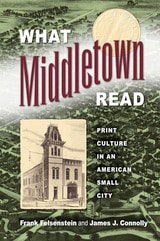
What Middletown Read
Print Culture in an American Small CityFrank Felsenstein
University of Massachusetts Press, 2015
The discovery of a large cache of circulation records from the Muncie, Indiana, Public Library in 2003 offers unprecedented detail about American reading behavior at the turn of the twentieth century. Frank Felsenstein and James J. Connolly have mined these records to produce an in-depth account of print culture in Muncie, the city featured in the famed “Middletown” studies conducted by Robert and Helen Lynd almost a century ago. Using the data assembled and made public through the What Middletown Read Database (www.bsu.edu/libraries/wmr), a celebrated new resource the authors helped launch, Felsenstein and Connolly analyze the borrowing choices and reading culture of social groups and individuals.
What Middletown Read is much more than a statistical study. Felsenstein and Connolly dig into diaries, meeting minutes, newspaper reports, and local histories to trace the library's development in relation to the city's cosmopolitan aspirations, to profile individual readers, and to explore such topics as the relationship between children's reading and their schooling and what books were discussed by local women's clubs. The authors situate borrowing patterns and reading behavior within the contexts of a rapidly growing, culturally ambitious small city, an evolving public library, an expanding market for print, and the broad social changes that accompanied industrialization in the United States. The result is a rich, revealing portrait of the place of reading in an emblematic American community.
Work Requirements
Race, Disability, and the Print Culture of Social WelfareTodd Carmody
Duke University Press, 2022