Results by title
5 books match the query 'Printing industry'

Benjamin Franklin's Printing Network
Disseminating Virtue in Early AmericaRalph Frasca
University of Missouri Press, 2005

Much Matter in a Penny Paper
Early Yoruba Print Culture in Lagos, 1910–1930Karin Barber
Ohio University Press, 2026
A groundbreaking study of Yoruba-language print culture in colonial Lagos
Much Matter in a Penny Paper offers the first in-depth exploration of the emergence of an African-language print culture in early twentieth-century Lagos, Nigeria. Focusing on the 1910s and 1920s—a period of rapid experimentation and innovation—Karin Barber examines the rise of Yoruba-language newspapers and the vibrant civic sphere they helped create.
The 1910s was notable for an upsurge of local Yoruba-language history books, and during the 1920s entrepreneurial editors and writers launched five Yoruba-language weeklies in quick succession. These publications drew in readers beyond the educated elite, expanding public discourse and experimenting with new genres of writing. From moralizing pamphlets and dramatic sketches to serialized narratives voiced by women, Yoruba print producers reimagined oral and written traditions, blending popular songs, anecdotes, and poetic forms into a dynamic new medium.
This book is about not only what was printed but also how and why. It investigates the material practices of print production, the motivations of its creators, and the expectations of its audiences. Drawing on editorials, reader correspondence, and other paratextual commentary, it reveals how Yoruba writers and readers understood the role of print in capturing the present, preserving the past, projecting the wisdom of the day forward for the benefit of future generations, and generating deep Yoruba texts rich in poetic energy.
Through detailed portraits of key figures—editors, pamphleteers, and a mysterious oral historian—Barber traces the interconnections between publications and genres, showing how they formed an active bilingual sphere of communication. The interplay between Yoruba- and English-language media, as well as the creative exploitation of both languages, emerges as a defining feature of this period’s print culture. By treating the Yoruba print archive as a “transcript of emergence,” this study offers new insights into how cultural innovations take shape. It is essential reading for scholars of African history, media studies, sociolinguistics, and print culture.
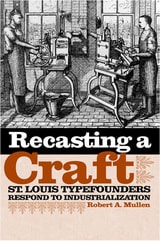
Recasting a Craft
St. Louis Typefounders Respond to IndustrializationRobert A. Mullen
Southern Illinois University Press, 2005
In the nineteenth and early twentieth centuries, type for newspapers and books was set one letter at a time, and the manufacturers of the metal type used in the printing trade were called typefounders. This prominent yet rarely documented industry was essential to the development of modern American publishing and was particularly prevalent in St. Louis. In Recasting a Craft: St. Louis Typefounders Respond to Industrialization, Robert A. Mullen recognizes the city’s significant contributions to typefounding and details how the craft fundamentally changed through mechanization, growth, and the creation of a large conglomerate.
Like many trades of the nineteenth and early twentieth centuries that were eventually lost to industrialization, the typefoundries of St. Louis grew from small shops to factories with organized labor. Mullen describes three distinct periods of the industry that emerged in St. Louis’s typefounding trade: the early struggles in establishing the industry there, the period of intense competition and creative enterprise, and the proliferation of new companies that appealed to those customers who felt alienated by the monopolizing older companies.
Mullen discusses at length the technological, social, and demographic foundations of the immense growth of the trade in the nineteenth century, identifying the changes in typographical design and the demand for it in the new era of advertising. He also profiles the workers, working conditions, and labor issues—such as the failed industry-wide strike of 1903—that emerged as the craft of typefounding entered the industrial age. More than two hundred type designs that originated with the St. Louis firms are listed in an appendix with examples of each face. The volume also contains a list of the catalogs of the St. Louis typefoundries known to exist in the public and academic libraries of the United States.
Some Degree of Power
From Hired Hand to Union Craftsman in the Preindustrial American Printing Trades 1778-1815Mark Lause
University of Arkansas Press, 1991

The Author's Due
Printing and the Prehistory of CopyrightJoseph Loewenstein
University of Chicago Press, 2002
As Loewenstein shows, copyright is a form of monopoly that developed alongside a range of related protections such as commercial trusts, manufacturing patents, and censorship, and cannot be understood apart from them. The regulation of the press pitted competing interests and rival monopolistic structures against one another—guildmembers and nonprofessionals, printers and booksellers, authors and publishers. These struggles, in turn, crucially shaped the literary and intellectual practices of early modern authors, as well as early capitalist economic organization.
With its probing look at the origins of modern copyright, The Author's Due will prove to be a watershed for historians, literary critics, and legal scholars alike.