Results by title
4 books match the query 'Privilege (Social psychology)'
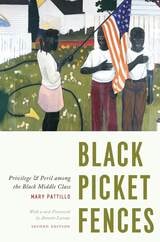
Black Picket Fences, Second Edition
Privilege and Peril among the Black Middle ClassMary Pattillo
University of Chicago Press, 2013
First published in 1999, Mary Pattillo’s Black Picket Fences explores an American demographic group too often ignored by both scholars and the media: the black middle class. Nearly fifteen years later, this book remains a groundbreaking study of a group still underrepresented in the academic and public spheres. The result of living for three years in “Groveland,” a black middle-class neighborhood on Chicago’s South Side, Black Picket Fences explored both the advantages the black middle class has and the boundaries they still face. Despite arguments that race no longer matters, Pattillo showed a different reality, one where black and white middle classes remain separate and unequal.
Stark, moving, and still timely, the book is updated for this edition with a new epilogue by the author that details how the neighborhood and its residents fared in the recession of 2008, as well as new interviews with many of the same neighborhood residents featured in the original. Also included is a new foreword by acclaimed University of Pennsylvania sociologist Annette Lareau.
[more]
Black Picket Fences
Privilege and Peril among the Black Middle ClassMary Pattillo-McCoy
University of Chicago Press, 1999
Black Picket Fences is a stark, moving, and candid look at a section of America that is too often ignored by both scholars and the media: the black middle class. The result of living for three years in "Groveland," a black middle-class neighborhood on Chicago's South Side, sociologist Mary Pattillo-McCoy has written a book that explores both the advantages and the boundaries that exist for members of the black middle class. Despite arguments that race no longer matters, Pattillo-McCoy shows a different reality, one where black and white middle classes remain separate and unequal.
"An insightful look at the socio-economic experiences of the black middle class. . . . Through the prism of a South Side Chicago neighborhood, the author shows the distinctly different reality middle-class blacks face as opposed to middle-class whites." —Ebony
"A detailed and well-written account of one neighborhood's struggle to remain a haven of stability and prosperity in the midst of the cyclone that is the American economy." —Emerge
[more]
Decentering Epistemologies and Challenging Privilege
Critical Care Ethics PerspectivesSophie Bourgault
Rutgers University Press, 2024
Care ethics first emerged as an attempt to decenter ethics; feminist scholars like Carol Gilligan argued that women’s moral experiences were not reflected in the dominant, masculinist approaches to ethics, which were centered on a rational, disembodied, atomistic moral subject. Care ethics challenged this model by positing ethics as relational, contextualized, embodied, and realized through practices rather than principles. Over the past decades, many care ethics scholars have sought to further this project by considering care politically and epistemologically, in relation to various intersecting hierarchies of power and knowledge.
This book advances this project by discussing the ways care ethics contributes to the decentering of dominant epistemologies and to the challenging of privilege and by considering how to decenter care ethics itself via an encounter with non-Western philosophical traditions and alternative epistemologies. Written by scholars from different countries, disciplines, and intellectual traditions, the volume offers original care ethics contributions on epistemic injustice, privileged irresponsibility, ecofeminism, settler colonialism, social movements such as BLM, and various racialized and gendered inequities tied to care work.
This book advances this project by discussing the ways care ethics contributes to the decentering of dominant epistemologies and to the challenging of privilege and by considering how to decenter care ethics itself via an encounter with non-Western philosophical traditions and alternative epistemologies. Written by scholars from different countries, disciplines, and intellectual traditions, the volume offers original care ethics contributions on epistemic injustice, privileged irresponsibility, ecofeminism, settler colonialism, social movements such as BLM, and various racialized and gendered inequities tied to care work.
[more]

Parenting Empires
Class, Whiteness, and the Moral Economy of Privilege in Latin AmericaAna Yolanda Ramos-Zayas
Duke University Press, 2020
In Parenting Empires, Ana Y. Ramos-Zayas focuses on the parenting practices of Latin American urban elites to analyze how everyday experiences of whiteness, privilege, and inequality reinforce national and hemispheric idioms of anti-corruption and austerity. Ramos-Zayas shows that for upper-class residents in the affluent neighborhoods of Ipanema (Rio de Janeiro) and El Condado (San Juan), parenting is particularly effective in providing moral grounding for neoliberal projects that disadvantage the overwhelmingly poor and racialized people who care for and teach their children. Wealthy parents in Ipanema and El Condado cultivate a liberal cosmopolitanism by living in multicultural city neighborhoods rather than gated suburban communities. Yet as Ramos-Zayas reveals, their parenting strategies, which stress spirituality, empathy, and equality, allow them to preserve and reproduce their white privilege. Defining this moral economy as “parenting empires,” she sheds light on how child-rearing practices permit urban elites in the Global South to sustain and profit from entrenched social and racial hierarchies.
[more]