Results by title

9 books match the query 'Probabilities'
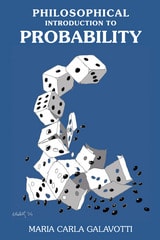
cover of A Philosophical Introduction to Probability

A Philosophical Introduction to Probability

Maria Carla Galavotti

CSLI, 2004
Not limited to merely mathematics, probability has a rich and controversial philosophical aspect. A Philosophical Introduction to Probability showcases lesser-known philosophical notions of probability and explores the debate over their interpretations. Galavotti traces the history of probability and its mathematical properties and then discusses various philosophical positions on probability, from the Pierre Simon de Laplace's “classical” interpretation of probability to the logical interpretation proposed by John Maynard Keynes. This book is a valuable resource for students in philosophy and mathematics and all readers interested in notions of probability.
[more]
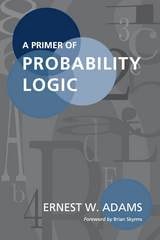
cover of A Primer of Probability Logic

A Primer of Probability Logic

Ernest W. Adams

CSLI, 1996

This book is meant to be a primer, that is, an introduction, to probability logic, a subject that appears to be in its infancy. Probability logic is a subject envisioned by Hans Reichenbach and largely created by Adams. It treats conditionals as bearers of conditional probabilities and discusses an appropriate sense of validity for arguments such conditionals, as well as ordinary statements as premisses.

This is a clear well-written text on the subject of probability logic, suitable for advanced undergraduates or graduates, but also of interest to professional philosophers. There are well-thought-out exercises, and a number of advanced topics treated in appendices, while some are brought up in exercises and some are alluded to only in footnotes. By this means, it is hoped that the reader will at least be made aware of most of the important ramifications of the subject and its tie-ins with current research, and will have some indications concerning recent and relevant literature.
[more]
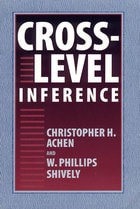
cover of Cross-Level Inference

Cross-Level Inference

Christopher H. Achen and W. Phillips Shively

University of Chicago Press, 1995

In the last several years, new disputes have erupted over the use of group averages from census areas or voting districts to draw inferences about individual social behavior. Social scientists, policy analysts, and historians often have little choice about using this kind of data, but statistical analysis of them is fraught with pitfalls. The recent debates have led to a new menu of choices for the applied researcher. This volume explains why older methods like ecological regression so often fail, and it gives the most comprehensive treatment available of the promising new techniques for cross-level inference.

Experts in statistical analysis of aggregate data, Christopher H. Achen and W. Philips Shively contend that cross-level inference makes unusually strong demands on substantive knowledge, so that no one method, such as Goodman's ecological regression, will fit all situations. Criticizing Goodman's model and some recent attempts to replace it, the authors argue for a range of alternate techniques, including estensions of cross-tabular, regression analysis, and unobservable variable estimators.
[more]
cover of Epistemology and Inference

Epistemology and Inference

Henry E. Kyburg, Jr.

University of Minnesota Press, 1983

Epistemology and Inference was first published in 1983. Minnesota Archive Editions uses digital technology to make long-unavailable books once again accessible, and are published unaltered from the original University of Minnesota Press editions.

Henry Kyburg has developed an original and important perspective on probabilistic and statistical inference. Unlike much contemporary writing by philosophers on these topics, Kyburg's work is informed by issues that have arisen in statistical theory and practice as well as issues familiar to professional philosophers. In two major books and many articles, Kyberg has elaborated his technical proposals and explained their ramifications for epistemology, decision-making, and scientific inquiry. In this collection of published and unpublished essays, Kyburg presents his novel ideas and their applications in a manner that makes them accessible to philosophers and provides specialists in probability and induction with a concise exposition of his system.
[more]
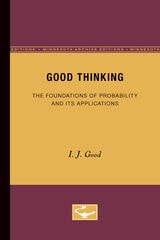
cover of Good Thinking: The Foundations of Probability and Its Applications

Good Thinking

The Foundations of Probability and Its Applications

I.J. Good

University of Minnesota Press, 1983
Good Thinking was first published in 1983.Good Thinking is a representative sampling of I. J. Good’s writing on a wide range of questions about the foundations of statistical inference, especially where induction intersects with philosophy. Good believes that clear reasoning about many important practical and philosophical questions is impossible except in terms of probability. This book collects from various published sources 23 of Good’s articles with an emphasis on more philosophical than mathematical.He covers such topics as rational decisions, randomness, operational research, measurement of knowledge, mathematical discovery, artificial intelligence, cognitive psychology, chess, and the nature of probability itself. In spite of the wide variety of topics covered, Good Thinking is based on a unified philosophy which makes it more than the sum of its parts. The papers are organized into five sections: Bayesian Rationality; Probability; Corroboration, Hypothesis Testing, and Simplicity; Information and Surprise; and Causality and Explanation. The numerous references, an extensive index, and a bibliography guide the reader to related modern and historic literature.This collection makes available to a wide audience, for the first time, the most accessible work of a very creative thinker. Philosophers of science, mathematicians, scientists, and, in Good’s words, anyone who wants “to understand understanding, to reason about reasoning, to explain explanation, to think about thought, and to decide how to decide” will find Good Thinking a stimulating and provocative look at probability.
[more]
cover of Orienting to Chance: Probabilism and the Future of Social Theory

Orienting to Chance

Probabilism and the Future of Social Theory

Michael Strand and Omar Lizardo

University of Chicago Press, 2025

Explores the implications of chance and uncertainty in social theory and offers a new interpretation of the sociological canon.
 
Since the founding of the discipline, sociologists have endeavored to understand the structures of groups, organizations, and societies, and how these entities condition our behavior. While some of the foundational theorists saw these processes as largely deterministic, sociological theory has increasingly insisted on the importance of culture in shaping our position in and responses to social groups. In Orienting to Chance, sociologists Michael Strand and Omar Lizardo aim to show that the social order bears an unmistakable link to chance and urge us to think about how it conditions our actions.

Strand and Lizardo provide a sweeping overview of a new social theory framework that they call probabilism. Using examples of probabilism in sociology, particularly in the work of Max Weber, W. E. B. Du Bois, and Pierre Bourdieu, they describe probabilism’s place in multiple fields of science. As the authors argue, their effort at redefinition and recovery helps position sociology as a field of the future, while also keeping it grounded in core issues of action, structure, culture, inequality, and inequity. By sharing these groundbreaking insights and revealing wider theoretical claims about mortality, fate, and technology in the contemporary era, Strand and Lizardo demonstrate how probabilism is an essential intervention for understanding the inevitable role of uncertainty in social life.
 
[more]
cover of Probable Justice: Risk, Insurance, and the Welfare State

Probable Justice

Risk, Insurance, and the Welfare State

Rachel Z. Friedman

University of Chicago Press, 2020

Decades into its existence as a foundational aspect of modern political and economic life, the welfare state has become a political cudgel, used to assign blame for ballooning national debt and tout the need for personal responsibility. At the same time, it affects nearly every citizen and permeates daily life—in the form of pension, disability, and unemployment benefits, healthcare and parental leave policies, and more. At the core of that disjunction is the question of how we as a society decide who should get what benefits—and how much we are willing to pay to do so.

Probable Justice​ traces a history of social insurance from the eighteenth century to today, from the earliest ideas of social accountability through the advanced welfare state of collective responsibility and risk. At the heart of Rachel Z. Friedman’s investigation is a study of how probability theory allows social insurance systems to flexibly measure risk and distribute coverage. The political genius of social insurance, Friedman shows, is that it allows for various accommodations of needs, risks, financing, and political aims—and thereby promotes security and fairness for citizens of liberal democracies.

[more]
cover of The Broken Dice, and Other Mathematical Tales of Chance

The Broken Dice, and Other Mathematical Tales of Chance

Ivar Ekeland

University of Chicago Press, 1993

Ivar Ekeland extends his consideration of the catastrophe theory of the universe begun in his widely acclaimed Mathematics and the Unexpected, by drawing on rich literary sources, particularly the Norse saga of Saint Olaf, and such current topics as chaos theory, information theory, and particle physics.

"Ivar Ekeland gained a large and enthusiastic following with Mathematics and the Unexpected, a brilliant and charming exposition of fundamental new discoveries in the theory of dynamical systems. The Broken Dice continues the same theme, and in the same elegant, seemingly effortless style, but focuses more closely on the implications of those discoveries for the rest of human culture. What are chance and probability? How has our thinking about them been changed by the discovery of chaos? What are all of these concepts good for? . . . Ah, but, I mustn't give the game away, any more than I should if I were reviewing a detective novel. And this is just as gripping a tale. . . . Beg, borrow, or preferably buy a copy. . . . I guarantee you won't be disappointed."—Ian Stewart, Science
[more]
cover of Unifying Political Methodology: The Likelihood Theory of Statistical Inference

Unifying Political Methodology

The Likelihood Theory of Statistical Inference

Gary King

University of Michigan Press, 1998

One of the hallmarks of the development of political science as a discipline has been the creation of new methodologies by scholars within the discipline--methodologies that are well-suited to the analysis of political data. Gary King has been a leader in the development of these new approaches to the analysis of political data. In his book, Unifying Political Methodology, King shows how the likelihood theory of inference offers a unified approach to statistical modeling for political research and thus enables us to better analyze the enormous amount of data political scientists have collected over the years. Newly reissued, this book is a landmark in the development of political methodology and continues to challenge scholars and spark controversy.
"Gary King's Unifying Political Methodology is at once an introduction to the likelihood theory of statistical inference and an evangelist's call for us to change our ways of doing political methodology. One need not accept the altar call to benefit enormously from the book, but the intellectual debate over the call for reformation is likely to be the enduring contribution of the work."
--Charles Franklin, American Political Science Review
"King's book is one of the only existing books which deal with political methodology in a clear and consistent framework. The material in it is now and will continue to be essential reading for all serious students and researchers in political methodology." --R. Michael Alvarez, California Institute of Tech-nology
Gary King is Professor of Government, Harvard University. One of the leading thinkers in political methodology, he is the author of A Solution to the Ecological Inference Problem: Reconstructing Individual Behavior from Aggregate Data and other books and articles.
[more]