Results by title
7 books match the query 'Process philosophy'
A Key to Whitehead's Process and Reality
Donald W. Sherburne
University of Chicago Press, 1981
"The Key renders Process and Reality pedagogically accessible for the first time."—Journal of Religion

Intensity
An Essay in Whiteheadian OntologyJudith A. Jones
Vanderbilt University Press, 1998
This important and provocative book on the work of Alfred North Whitehead (1861-1947) explores how his avowed atomism is consistent with his equally essential commitment to a view of reality as a thoroughly interconnected sphere of relations. Judith Jones challenges Whitehead's readers to reconsider certain prevailing interpretations of his organic philosophy. To Jones, a rereading of Whitehead's overall philosophic project is essential to evaluating his contributions to metaphysics and ontology. SinceWhitehead's basic worldview is holistic, a return to viewing Whitehead's work as a whole helps clarify his ontological intentions and contributions to metaphysics.
For this purpose, the concept of "intensity," which Jones defines as the quality and form of feeling involved in subjective experience, is basic to Whitehead's thinking about process at all naturalistic levels and is therefore particularly useful as a lens through which to view his entire system. "Intensity" is at once Whitehead's most basic metaphysical idea and a notion useful in deciphering the overall unity of purpose in his writings. A central aim of this book is to develop an aesthetically sensitive sense of being that demonstrates the profound and original contributions of process philosophy to realism.
Jones shows that a thorough understanding of the concept of intensity yields modes of thought that help overcome knotty problems in conceiving Whitehead's distinction between the private experience of individuals and the public relations those individuals experience in relationship to other entities. Drawing frequently on poetic allusions to aid her interpretations, she focuses specifically on the status of intensity in intellectual and moral experience and develops an ethics of "attention" as an elaboration of Whitehead's aesthetic metaphysics.
The result is a book that should be enthusiastically greeted and debated by scholars of Whitehead and by all who are interested in the field of process thought, including students of theology, literature, and feminist studies. Jones's unorthodox conclusions, backed up with scrupulous attention to both the Whitehead canon and related secondary literature, present challenges to accepted interpretations that cannot be ignored.
Matterphorics
On the Laws of TheoryDaniela Gandorfer
Duke University Press, 2026
Process-Relational Philosophy
An Introduction to Alfred North WhiteheadC. Robert Mesle
Templeton Press, 2008
Process thought is the foundation for studies in many areas of contemporary philosophy, theology, political theory, educational theory, and the religion-science dialogue. It is derived from Alfred North Whitehead's philosophy, known as process theology, which lays a groundwork for integrating evolutionary biology, physics, philosophy of mind, theology, environmental ethics, religious pluralism, education, economics, and more.
In Process-Relational Philosophy, C. Robert Mesle breaks down Whitehead's complex writings, providing a simple but accurate introduction to the vision that underlies much of contemporary process philosophy and theology. In doing so, he points to a "way beyond both reductive materialism and the traps of Cartesian dualism by showing reality as a relational process in which minds arise from bodies, in which freedom and creativity are foundational to process, in which the relational power of persuasion is more basic than the unilateral power of coercion."
Because process-relational philosophy addresses the deep intuitions of a relational world basic to environmental and global thinking, it is being incorporated into undergraduate and graduate courses in philosophy, educational theory and practice, environmental ethics, and science and values, among others. Process-Relational Philosophy: A Basic Introduction makes Whitehead's creative vision accessible to all students and general readers.
The Archetypal Process
Self and Divine and Whitehead, Jung, and HillmanDavid Ray Griffin
Northwestern University Press, 1989
Archetypal Process examines the importance of cosmological thinking and the need to ground archetypal psychology in a metaphysical, philosophical framework. It treats the necessity for symbol and myth, the nature of the spirit, and language as a metaphorical vehicle of thought, and finally, it adds a much-needed feminist perspective to the debate.
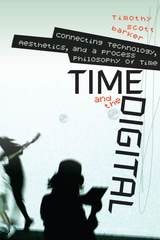
Time and the Digital
Connecting Technology, Aesthetics, and a Process Philosophy of TimeTimothy Scott Barker
Dartmouth College Press, 2012
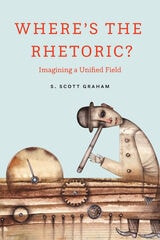
Where's the Rhetoric?
Imagining a Unified FieldS. Scott Graham
The Ohio State University Press, 2020
Building on this foundation, Graham then argues for a more unified approach to contemporary rhetorical inquiry—one that eschews disciplinary demarcations between rhetoric’s various subareas. Specifically, Graham uses his unified field theory to explore 1) the rise of the “tweetorial” as a parascientific genre, 2) inventional practices in new media design, 3) statistical approaches to understanding biomedical discourse, and 4) American electioneering rhetorics. The book overall demonstrates how seemingly disparate intellectual approaches within rhetoric can be made to speak productively to one another in the pursuit of shared scholarly goals around questions of genre, media, and political discourse—thereby providing a foundation for imagining a more unified field.