Results by title
5 books match the query 'Processes'
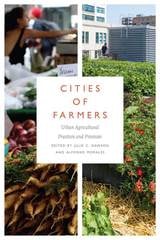
Cities of Farmers
Urban Agricultural Practices and ProcessesJulie C. Dawson and Alfonso Morales
University of Iowa Press, 2016
Implementing urban agriculture often requires change in the physical, political, and social-organizational landscape. Beginning with a look at how and why city people grew their own food in the early twentieth century, the contributors to Cities of Farmers examine the role of local and regional regulations and politics, especially the creation of food policy councils, in making cities into fertile ground for farming. The authors describe how food is produced and distributed in cities via institutions as diverse as commercial farms, community gardens, farmers’ markets, and regional food hubs. Growing food in vacant lots and on rooftops affects labor, capital investment, and human capital formation, and as a result urban agriculture intersects with land values and efforts to build affordable housing. It also can contribute to cultural renewal and improved health.
This book enables readers to understand and contribute to their local food system, whether they are raising vegetables in a community garden, setting up a farmers’ market, or formulating regulations for farming and composting within city limits.
CONTRIBUTORS
Catherine Brinkley, Benjamin W. Chrisinger, Nevin Cohen, Michèle Companion, Lindsey Day-Farnsworth, Janine de la Salle, Luke Drake, Sheila Golden, Randel D. Hanson, Megan Horst, Nurgul Fitzgerald, Becca B. R. Jablonski, Laura Lawson, Kara Martin, Nathan McClintock, Alfonso Morales, Jayson Otto, Anne Pfeiffer, Anne Roubal, Todd M. Schmit, Erin Silva, Michael Simpson, Lauren Suerth, Dory Thrasher, Katinka Wijsman
Integration and Disintegration in NATO
Processes of Alliance Cohesion and Prospects for Atlantic CommunityFrancis A. Beer
The Ohio State University Press, 1969
Francis A. Beer’s classic study of NATO, first published in 1969 at the critical time of French withdrawal, focuses on processes of Atlantic alliance cohesion and implications for cross-Atlantic relationships. At the present time, as NATO faces existential threats in the form of fresh attacks and skepticism, Beer’s foundational analysis remains essential. He surveys five key areas of alliance activity: political consultation, military forces, armaments, infrastructure, and science. Across each, he identifies a recurring pattern: nationalism, self-interest, and state-level dominance repeatedly constrain and often work against collective action, even in areas where technical logic might otherwise unify coalition members.
Significant support for cooperation, Beer argues, can emerge during periods of international crisis, when member states are pressed to set aside individual concerns for common security. International crises are challenging but need not be destructive. To the contrary, crises provide opportunities for creative institutional leadership. As the book shows, a well-articulated ideology, connected to variable coalitions in different issue areas, can bring members together to maintain and build collective political-military institutions.
Processes of Collective Action
Edited by Lorenzo Bosi and Stefan Malthaner
Temple University Press, 2027
Whether collective action takes the form of protest campaigns, social movements, political violence or strikes, there is a dynamic nature to the shared goal of effecting change. But whereas most studies look at when collective action begins, the editors and contributors to Processes of Collective Action take a processual approach, looking at how collective action emerges, proceeds, what is achieved, and how different collective actors react to what unfolds.
Bringing together leading scholars of contentious politics, this volume seeks to explore and advance process analysis across different forms of political conflicts, types of actors, and varieties of collective action. Featuring theoretical concepts, methodological tools, and global cutting-edge research, Processes of Collective Action offers a series of case studies and conceptual essays that reflect on crucial issues in and current transformations of collective action.
Contributors: Irina Aguiari, Kenneth T. Andrews, Javier Auyero, Mark R. Beissinger, Kathleen Blee, Donatella della Porta, Mario Diani, Jennifer Earl, Olivier Fillieule, Sarah Gaby, Thomas Hoebel, Chaeyoon Lim, James M. Jasper, Doug McAdam, Anna Milewski, Pamela Oliver, elena pavan, Anastasia Shesterinina, Katherine Sobering, Mary Ellen Stitt, Sidney Tarrow, Katrin Uba, Mattias Wahlström
Rules and Processes
John L. Comaroff and Simon Roberts
University of Chicago Press, 1986
"A work of impressive scholarship in which theoretical sophistication and ethnographic richness are convincingly matched."—Ian Hamnett, Times Higher Education Supplement.

The Future of Social Movement Research
Dynamics, Mechanisms, and ProcessesJacquelien van Stekelenburg
University of Minnesota Press, 2013
Are the dynamics of contention changing? This is the question confronted by the contributors of this volume, among the most influential scholars in the field of social movements. The answers, arriving at a time of extraordinary worldwide turmoil, not only provide a wide-ranging and varied understanding of how social movements arise and persist, but also engender unanswered questions, pointing to new theoretical strands and fields of research.
The Future of Social Movement Research asks: How are the dynamics of contention shaped by globalization? By societies that are becoming increasingly more individualized and diverse? By the spread of new communication technologies such as social media, cell phones, and the Internet? Why do some movements survive while others dissipate? Do local and global networks differ in nature? The authors’ essays explore such questions with reference to changes in three domains of contention: the demand of protest (changes in grievances and identities), the supply of protest (changes in organizations and networks), and how these changes affect the dynamics of mobilization. In doing so, they theorize and make empirically insightful how globalization, individualization, and virtualization create new grievances, new venues for action, new action forms, and new structures of contention.
The resulting work—brought together through engaging discussions and debates between the contributors—is interdisciplinary and unusually broad in scope, constituting the most comprehensive overview of the dynamics of social movements available today.
Contributors: Marije Boekkooi, VU-U, Amsterdam; Pang Ching Bobby Chen, U of California, Merced; Donatella della Porta, European U Institute; Mario Diani, U of Trento, Italy; Jan Willem Duyvendak, U of Amsterdam; Myra Marx Ferree, U of Wisconsin–Madison; Beth Gharrity Gardner; Ashley Gromis; Swen Hutter, U of Munich; Ruud Koopmans, WZB, Berlin; Hanspeter Kriesi, U of Zurich; Nonna Mayer, National Centre for European Studies; Doug McAdam, Stanford U; John D. McCarthy, Pennsylvania State U; Debra Minkoff, Barnard College, Columbia U; Alice Motes; Pamela E. Oliver, U of Wisconsin–Madison; Francesca Polletta, U of California, Irvine; Jacomijne Prins, VU-U, Amsterdam; Patrick Rafail, Tulane U; Christopher Rootes, U of Kent, Canterbury; Dieter Rucht, Free U of Berlin; David A. Snow, U of California, Irvine; Sarah A. Soule, Stanford U; Suzanne Staggenborg, U of Pittsburgh; Sidney Tarrow, Cornell U; Verta Taylor, U of California, Santa Barbara; Marjoka van Doorn; Martijn van Zomeren, U of Groningen; Stefaan Walgrave, U of Antwerp; Saskia Welschen.