Results by title
3 books match the query 'Processions'
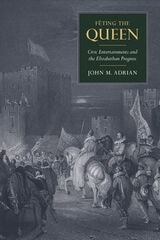
Fêting the Queen
Civic Entertainments and the Elizabethan ProgressJohn M Adrian
University of Massachusetts Press, 2021
While previous scholars have studied Elizabeth I and her visits to the homes of influential courtiers, Fêting the Queen places a new emphasis on the civic communities that hosted the monarch and their efforts to secure much needed support. Case studies of the cities of Oxford, Canterbury, Sandwich, Bristol, Worcester, and Norwich focus on the concepts of hospitality and space—including the intimate details of the built environment.
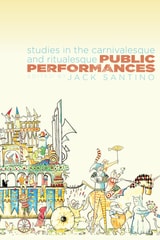
Public Performances
Studies in the Carnivalesque and RitualesqueJack Santino
Utah State University Press, 2024
Public Performances offers a deep and wide-ranging exploration of relationships among genres of public performance and of the underlying political motivations they share. Illustrating the connections among three themes—the political, the carnivalesque, and the ritualesque—this volume provides rich and comprehensive insight into public performance as an assertion of political power.
Contributors consider how public genres of performance express not only celebration but also dissent, grief, and remembrance; examine the permeability of the boundaries between genres; and analyze the approval or regulation of such events by municipalities and other institutions. Where the particular use of public space is not sanctioned or where that use meets with hostility from institutions or represents a critique of them, performers are effectively reclaiming public space to make public statements on their own terms—an act of popular sovereignty.
Through these concepts, Public Performances distinguishes the sometimes overlapping dimensions of public symbolic display. Carnival, and thus the carnivalesque, is understood to possess tacit social permission for unconventional or even deviant performance, on the grounds that normal social order will resume when the performance concludes. Ritual, and the ritualesque, leverages a deeper symbolic sensibility, one believed—or at least intended—by the participants to effect transformative, longer-term change.
Contributors: Roger D. Abrahams, John Borgonovo, Laurent Sébastien Fournier, Lisa Gilman, Barbara Graham, David Harnish, Samuel Kinser, Scott Magelssen, Elena Martinez, Pamela Moro, Beverly J. Stoeltje, Daniel Wojcik, Dorothy L. Zinn
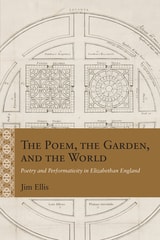
The Poem, the Garden, and the World
Poetry and Performativity in Elizabethan EnglandJim Ellis
Northwestern University Press, 2023
How an early modern understanding of place and movement are embedded in a performative theory of literature
How is a garden like a poem? Early modern writers frequently compared the two, and as Jim Ellis shows, the metaphor gained strength with the arrival of a spectacular new art form—the Renaissance pleasure garden—which immersed visitors in a political allegory to be read by their bodies’ movements. The Poem, the Garden, and the World traces the Renaissance-era relationship of place and movement from garden to poetry to a confluence of both. Starting with the Earl of Leicester’s pleasure garden for Queen Elizabeth’s 1575 progress visit, Ellis explores the political function of the entertainment landscape that plunged visitors into a fully realized golden world—a mythical new form to represent the nation. Next, he turns to one of that garden’s visitors: Philip Sidney, who would later contend that literature’s golden worlds work to move us as we move through them, reorienting readers toward a belief in English empire. This idea would later be illustrated by Edmund Spenser’s Faerie Queen; as with the pleasure garden, both characters and readers are refashioned as they traverse the poem’s dreamlike space. Exploring the artistic creations of three of the era’s major figures, Ellis argues for a performative understanding of literature, in which readers are transformed as they navigate poetic worlds.