Results by title
4 books match the query 'Product counterfeiting'
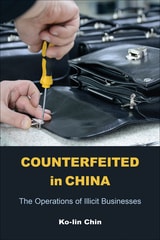
Counterfeited in China
The Operations of Illicit BusinessesKo-lin Chin
Temple University Press, 2025
In his illuminating study, Counterfeited in China, Ko-lin Chin investigates this lucrative industry and its emergence in China. His face-to-face interviews with counterfeiters — business owners, workers, facilitators, and key informants — in the hub of Guangzhou, China reveal how businesses that design, produce, and distribute fake and unauthorized luxury goods manage the risks inherent in their business.
Counterfeited in China examines the individual and group characteristics of counterfeiters and their relationships with organized crime; analyzes the economic aspects of counterfeiting; assesses the relationships among counterfeiting, violence, and corruption; and seeks to understand the demand for counterfeit goods. Chin also discusses the role of Chinese authorities and other parties in the war against counterfeiting.
Assessing the state of the industry and its future, Chin provides fascinating new insights into the modus operandi of counterfeiters.
Fashioning China
Precarious Creativity and Women Designers in Shanzhai CultureSara Liao
Pluto Press, 2020
Broadening the digital labor debate beyond typical masculine and techno-utopic readings, Sara Liao studies the precarious practices of women trying to create sustainable and creative lives, vividly illustrating a fashion culture that exists online as a significant part of the digital economy.
Drawing on material from interviews, participant observation, archives, policy documents, films and advertisements, Liao takes a multi-disciplinary approach to the topic, charting out the politics of intellectual property rights, globalization, technocracy, patriarchy and nationalism in a non-Western context.
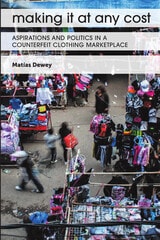
Making It at Any Cost
Aspirations and Politics in a Counterfeit Clothing MarketplaceBy Matías Dewey
University of Texas Press, 2020
La Salada is South America’s largest marketplace for fraudulently labeled clothing, a sprawling and dangerous bazaar on the fringes of Buenos Aires where counterfeit goods are bought and sold, armed thieves roam the nearby streets, and corrupt police and politicians turn a blind eye to widespread unlawful behaviors. Despite conditions traditionally considered inhospitable to economic growth—including acute interpersonal distrust, pervasive personal insecurity, and rampant violence—business in La Salada is booming under an established order completely detached from the state.
Matías Dewey dives deep into the world of La Salada to examine how market exchanges function outside the law and how agreements and norms develop in the economy for counterfeit clothing. Drawing on seven months of ethnographic research and more than a hundred interviews, Dewey argues that aspirations for a better future shape garment workers’ everyday practices, from their home-based sweatshops to the market stalls. The book unearths a new configuration of garment production and commercialization detached from global supply chains, submerged in the shadows of informality and illegality, and rooted in aspiration and opportunity.
Underglobalization
Beijing's Media Urbanism and the Chimera of LegitimacyJoshua Neves
Duke University Press, 2020