Results by title
5 books match the query 'Products liability'
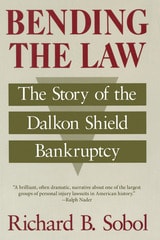
Bending the Law
The Story of the Dalkon Shield BankruptcyRichard B. Sobol
University of Chicago Press, 1991
Winner of the American Bar Association's 1992 Silver Gavel Award "in recognition of an outstanding contribution to public understanding of the American system of law and justice."
"Mr. Sobol has produced a readable yet fully researched and detailed study of the operation of the bankruptcy and its effects upon all concerned—the women who were injured, the swarms of lawyers who represented parties in the bankruptcy, and the court which oversaw the bankruptcy in Richmond. . . . This book adds greatly to the current debate about how strong a managerial federal judge our system should have."—Paul D. Rheingold, New York Law Journal
"Bending the Law is polemical and relentless. It is also minutely researched, fluidly written, and persuasive."—Paul Reidinger, ABA Journal
"Bending the Law is a must read for bankruptcy practitioners, and for anyone else concerned about the use of bankruptcy law to deal with mass torts. Although its author is a civil rights lawyer, he details the subtle art of practicing bankruptcy law with a discerning eye, and is a gifted storyteller as well."—Joryn Jenkins, Federal Bar News and Journal
"This is an accessible history of the case by a veteran civil-rights lawyer."—Washington Post Book World
[more]
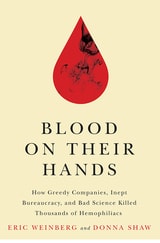
Blood on Their Hands
How Greedy Companies, Inept Bureaucracy, and Bad Science Killed Thousands of HemophiliacsWeinberg, Eric
Rutgers University Press, 2017
A few short years after HIV first entered the world blood supply in the late 1970s and early 1980s, over half the hemophiliacs in the United States were infected with the virus. But this was far more than just an unforeseeable public health disaster. Negligent doctors, government regulators, and Big Pharma all had a hand in this devastating epidemic.
Blood on Their Hands is an inspiring, firsthand account of the legal battles fought on behalf of hemophiliacs who were unwittingly infected with tainted blood. As part of the team behind the key class action litigation filed by the infected, young New Jersey lawyer Eric Weinberg was faced with a daunting task: to prove the negligence of a powerful, well-connected global industry worth billions. Weinberg and journalist Donna Shaw tell the dramatic story of how idealistic attorneys and their heroic, mortally-ill clients fought to achieve justice and prevent further infections. A stunning exposé of one of the American medical system’s most shameful debacles, Blood on Their Hands is a rousing reminder that, through perseverance, the victims of corporate greed can sometimes achieve great victory.
Blood on Their Hands is an inspiring, firsthand account of the legal battles fought on behalf of hemophiliacs who were unwittingly infected with tainted blood. As part of the team behind the key class action litigation filed by the infected, young New Jersey lawyer Eric Weinberg was faced with a daunting task: to prove the negligence of a powerful, well-connected global industry worth billions. Weinberg and journalist Donna Shaw tell the dramatic story of how idealistic attorneys and their heroic, mortally-ill clients fought to achieve justice and prevent further infections. A stunning exposé of one of the American medical system’s most shameful debacles, Blood on Their Hands is a rousing reminder that, through perseverance, the victims of corporate greed can sometimes achieve great victory.
[more]
Products Liability in the Automobile Industry
A Study in Strict Liability and Social ControlCornelius Gillam
University of Minnesota Press, 1960
Products Liability in the Automobile Industry was first published in 1960.This is a study of the products liability of automobile manufacturers, the legal and economic basis of this liability, its meaning to business management, and measures which could be taken fore refinement of the concept. The phrase “products liability” refers to the legal responsibility of sellers to compensate buyers for losses suffered because of defects in the goods purchased.The author traces the development of modern products liability with primary reference to the automobile industry. He discusses or cites every American court decisions dealing with products liability of manufacturers of automobiles or automobile accessories, or analogous goods such as tractors, farm implements, trucks, tires, or engines. He points out that court decisions in automobile cases have been second only to those in food cases in formulating principles of products liability.This work offers the first complete appraisal of the automobile cases and of products liability in the automobile industry in general, provides a statement of the managerial implications of products liability, and, for the first time, relates the principles of products liability to an industry’s overall economic structure. The conclusions are significant to wide areas of law, economics, business, and sociology, and are of special importance to the insurance industry.
[more]
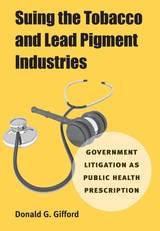
Suing the Tobacco and Lead Pigment Industries
Government Litigation as Public Health PrescriptionDonald G. Gifford
University of Michigan Press, 2010
"The topic, how tort law evolved over time into a system that allowed, for a moment at least, a parens patriae form of massive litigation against corporations, is exceedingly interesting and important. Gifford's treatment of this topic is highly informative, engaging, insightful, very current, and wise."
---David Owen, Carolina Distinguished Professor of Law, and Director of Tort Law Studies, University of South Carolina
---David Owen, Carolina Distinguished Professor of Law, and Director of Tort Law Studies, University of South Carolina
In Suing the Tobacco and Lead Pigment Industries, legal scholar Donald G. Gifford recounts the transformation of tort litigation in response to the challenge posed by victims of 21st-century public health crises who seek compensation from the product manufacturers. Class action litigation promised a strategy for documenting collective harm, but an increasingly conservative judicial and political climate limited this strategy. Then, in 1995, Mississippi attorney general Mike Moore initiated a parens patriae action on behalf of the state against cigarette manufacturers. Forty-five other states soon filed public product liability actions, seeking both compensation for the funds spent on public health crises and the regulation of harmful products.
Gifford finds that courts, through their refusal to expand traditional tort claims, have resisted litigation as a solution to product-caused public health problems. Even if the government were to prevail, the remedy in such litigation is unlikely to be effective. Gifford warns, furthermore, that by shifting the powers to regulate products and to remediate public health problems from the legislature to the state attorney general, parens patriae litigation raises concerns about the appropriate allocation of powers among the branches of government.
Donald G. Gifford is the Edward M. Robertson Research Professor of Law at the University of Maryland School of Law.
[more]

The Harmonization of Civil and Commercial Law in Europe
Gian Antonio Benacchio
Central European University Press, 2005
The "Europeanization" of European private law has recently received much scrutiny and attention. Harmonizing European systems of law represents one of the greatest challenges of the 21st century. In effect, it is the adaptation of national laws into a new supra-national law, a process that signifies the beginning of a new age in Europe. This volume seeks to frame the creation of a new European Common Law in the context of recent events in European integration.Engaged in timely and cutting edge research, the authors cast into fine relief the building of a European Common Law. The work is envisioned as a guide and written in a research friendly style that includes text inserts and an extensive bibliography. In particular, this book seeks to orient lawmakers, as well as those individuals interested in EU law, in the intricacies of consumer protection, contractual law, timesharing, and other important aspects in the harmonization of domestic and EU law books. The detailed analysis and research this volume accomplishes is invaluable to those scholars and lawmakers who are the next generation of European leaders.
[more]