Results by title
6 books match the query 'Profile'

A Profile of Twentieth-Century American Poetry
Edited by Jack Myers and David Wojahn
Southern Illinois University Press, 1991
Seven chronologically arranged essays—each covering roughly a decade from 1908 through 1988—plus two special-focus essays on black and female poets, an introduction by Ed Folsom, and a preface by editors Jack Myers and David Wojahn, outline the critical, creative, aesthetic, and cultural forces at work in the American poetry of this century. Several contributors, including Michael Heller, Richard Jackson, and Jonathan Holden, have recently published important book-length critical studies in their essay area; all have published well-regarded collections of their own poetry.
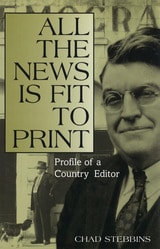
All the News Is Fit to Print
Profile of a Country EditorChad Stebbins
University of Missouri Press, 1998
For nearly half a century, Arthur Aull captivated a rural Missouri town and a national audience with his sensationalistic, all-the- news-is-fit-to-print approach to journalism. As editor and publisher of the Lamar Democrat from 1900 to 1948, he disregarded most of the traditional rules of news coverage. Every scandal and piece of gossip he could turn up helped fill the pages of his newspaper, an afternoon daily in a town of about 2,300. His tales of grisly accidents, murders, rapes, juvenile crime, suicides, and sensational divorces reminded skeptics of the earlier yellow journalism era.
Aull embellished nearly all of his stories with a personal, homespun flavor, and that's what caught the attention of syndicated columnists O. O. McIntyre and Ted Cook in the late 1920s. They started sprinkling their columns with curious items from the Democrat, and soon after unusual stories from the paper began showing up in the New York Times, the New York World-Telegram, the New Yorker, and even the Journal of the American Medical Association. Feature stories about Aull appeared in Publishers' Auxiliary, the Chicago Daily News, Life, Time, Newsweek, American Magazine, and Harper's. Aull became known coast to coast as one of the most colorful figures in country journalism, and the Democrat attracted subscribers in all forty-eight states plus Canada and England. Even President Truman, who was born in Lamar, noted Aull's death on May 7, 1948, declaring that an "able and picturesque figure in American journalism has passed on."
Despite the national acclaim, Aull remained an unpretentious small- town editor. He had his own code of ethics, which he refused to modify to reflect the changing times. He was sued for libel three times, assaulted with a club, threatened with other kinds of bodily harm, and cursed by many. Yet, he persisted in scouring the town of Lamar for any news that would help him sell a few more copies of the Democrat.
Although the influence of country journalism on American society cannot be disputed, relatively little has been written on the vital role country journalists play. All the News Is Fit to Print, which traces Aull's transformation from a struggling schoolteacher to one of the best-known small-town newspapermen in America, will help remedy that oversight. Anyone with an interest in the history of journalism or small-town life will find this work fascinating.

Formerly British Honduras
A Profile Of The New Nation Of BelizeWilliam David Setzerkorn
Ohio University Press, 1981
A mixture of Africans, Mestizos, East Indians, Europeans, Syrians, Lebanese, Mayans, and Chinese; Belize has grown into a heterogenous mosaic of a strong and brave country which is no bigger than Cambridge, Massachusetts. Studying the influences of British domination and Spanish intimidation up to the recent movements for self-government and independence, Setzekorn presents to the reader an accounting of Belizean social and political vicissitudes—a long and tortuous, yet coherent, struggle for national and cultural identity.

Minorities in Phoenix
A Profile of Mexican American, Chinese American, and African American Communities, 1860-1992Bradford Luckingham
University of Arizona Press, 1994
Settled in the mid-nineteenth century by Anglo and Mexican pioneers, Phoenix emerged as an Anglo-dominated society that presented formidable obstacles to minorities seeking access to jobs, education, housing, and public services. It was not until World War II and the subsequent economic boom and civil rights era that opportunities began to open up. Drawing on a variety of sources, from newspaper files to statistical data to oral accounts, Luckingham profiles the general history of each community, revealing the problems it has faced and the progress it has made. His overview of the public life of these three ethnic groups shows not only how they survived, but how they contributed to the evolution of one of America's fastest-growing cities.
Profile of Man and Culture in Mexico
By Samuel Ramos
University of Texas Press, 1962
Profile of Man and Culture in Mexico, originally written in 1934, is addressed to the author’s compatriots, but it speaks to people, wherever they are, who are interested in enriching their own lives and in elevating the cultural level of their countries. And it speaks with a peculiar timeliness to citizens of the United States who would understand their neighbors to the south.
Samuel Ramos’s avowed purpose is to assist in the spiritual reform of Mexico by developing a theory that might explain the real character of Mexican culture. His approach is not flattering to his fellow citizens. After an analysis of the historical forces that have molded the national psychology, Ramos concludes that the Mexican sense of inferiority is the basis for most of the Mexican’s spiritual troubles and for the shortcomings of the Mexican culture.
Ramos subscribes to neither of the two major opposing schools of thought as to what norms should direct the development of Mexican culture. He agrees neither with the nationalists, who urge a deliberate search for originality and isolation from universal culture, nor with the “Europeanizers,” who advocate abandonment of the life around them and a withdrawal into the modes of foreign cultures. Ramos thinks that Mexico’s hope lies in a respect for the good in native elements and a careful selection of those foreign elements that are appropriate to Mexican life. Such a sensible choice of foreign elements will result not in imitation, but in assimilation. Combined with the nurturing of desirable native elements, it will result in an independent cultural unit, “a new branch grafted onto world culture.”
Ramos finds in Mexico no lack of intelligence or vitality: “It needs only to learn.” And he believes that the future is Mexico’s, that favorable destinies await a Mexico striving for the elevation of humanity, for the betterment of life, for the development of all the national capacities.

Senhora
Profile of a WomanBy José de Alencar
University of Texas Press, 1994
"It is a truth universally acknowledged . . ." that a single woman in possession of a good character but no fortune must be in want of a wealthy husband—that is, if she is the heroine of a nineteenth-century novel. Senhora, by contrast, turns the tables on this familiar plot. Its strong-willed, independent heroine Aurélia uses newly inherited wealth to "buy back" and exact revenge on the fiancé who had left her for a woman with a more enticing dowry.
This exciting Brazilian novel, originally published in 1875 and here translated into English for the first time, raises many questions about traditional gender relationships, the commercial nature of marriage, and the institution of the dowry. While conventional marital roles triumph in the end, the novel still offers realistic insights into the social and economic structure of Rio de Janeiro in the mid-1800s. With its unexpected plot, it also opens important new perspectives on the nineteenth-century Romantic novel.