Results by title
6 books match the query 'Pronunciation'
Discourse Intonation
A Discourse-Pragmatic Approach to Teaching the Pronunciation of EnglishLucy Pickering
University of Michigan Press, 2018
This textbook is an accessible introduction to discourse intonation for ESL/EFL instructors, whether practicing or in pre-service graduate programs. Because intonation is used to form impressions about a speaker’s attitude, it is crucial that instructors understand the details of the underlying linguistic system so that they can help students avoid the more common intonation-related pitfalls they experience when communicating in an academic setting.
This textbook relies heavily on the Brazil model; chapters are organized around different parts of that model and how they can be most effectively taught. Readers will learn the conventions underlying, for example, how we group words in prosodic units, how we understand turn-taking cues in conversation, and how we assess whether someone is feeling angry or sad.
This text features Check Your Learning sections, discussion questions, and hands-on activities at the end of every chapter. Chapters 3-9 also include a section on pedagogical implications. Some of the example sentences that illustrate intonation have accompanying short audio (MP3) files, which can be found online at www.press.umich.edu/elt/compsite/DI.
[more]
New Perspectives on Language Variety in the South
Historical and Contemporary ApproachesMichael D. Picone
University of Alabama Press, 2015
The third installment in the landmark LAVIS (Language Variety in the South) series, New Perspectives on Language Variety in the South: Historical and Contemporary Approaches brings together essays devoted to the careful examination and elucidation of the rich linguistic diversity of the American South, updating and broadening the work of the earlier volumes by more fully capturing the multifaceted configuration of languages and dialects in the South.
Beginning with an introduction to American Indian languages of the Southeast, five fascinating essays discuss indigenous languages, including Caddo, Ofo, and Timucua, and evidence for the connection between the Pre-Columbian Southeast and the Caribbean.
Five essays explore the earlier Englishes of the South, covering topics such as the eighteenth century as the key period in the differentiation of Southern American English and the use of new quantitative methods to trace the transfer of linguistic features from England to America. They examine a range of linguistic resources, such as plantation overseers’ writings, modern blues lyrics, linguistic databases, and lexical and locutional compilations that reveal the region’s distinctive dialectal traditions.
New Perspectives on Language Variety in the South: Historical and Contemporary Approaches widens the scope of inquiry into the linguistic influences of the African diaspora as evidenced in primary sources and records. A comprehensive essay redefines the varieties of French in Louisiana, tracing the pathway from Colonial Louisiana to the emergence of Plantation Society French in a diglossic relationship with Louisiana Creole. A further essay maps the shift from French to English in family documents.
An assortment of essays on English in the contemporary South touch on an array of compelling topics from discourse strategies to dialectal emblems of identity to stereotypes in popular perception.
Essays about recent Latino immigrants to the South bring the collection into the twenty-first century, taking into account the dramatic increase in the population of Spanish speakers and illuminating the purported role of “Spanglish,” the bilingual lives of Spanish-speaking Latinos in Mississippi, and the existence of regional Spanish dialectal diversity.
[more]
Practical Pronunciation
Pronunciation Strategies in PracticeDJ Kaiser
University of Michigan Press, 2026
Practical Pronunciation offers an easy-to-follow road map for English learners to incorporate pronunciation into their everyday and professional speaking. With more than two decades of practice and expertise in teaching advanced English pronunciation and public speaking skills, DJ Kaiser guides readers through a series of hands-on strategies that bring pronunciation practice to life. Carefully ordered lessons cover segmentals, word stress, phrase rhythm and melody, the phrase focus syllable, and intonation. Balancing more advanced topics in pronunciation (like stress on compound nouns, intonation on various question types, and using gestures to bring focus to relevant content) with accessible language and practical strategies makes reaching pronunciation goals more attainable. The book includes access to video content and more than 4.5 hours of audio content. Practical Pronunciation is perfect for classroom instruction, small-group tutorials, and one-on-one tutoring sessions, or as a self-study tool for advanced independent learners.
CEFR Level: C1
Key Features
CEFR Level: C1
Key Features
- A series of 210 audio recordings provides opportunities for learners to listen for key aspects of pronunciation and practice items from the book on their own.
- Twenty-nine videos provide short explanations and visual demonstrations of many of the strategies included throughout the book.
- Recommendations on ways to integrate digital tools into pronunciation exploration and practice provide learners and teachers with multiple ways to customize pronunciation practice to meet varied professional speaking contexts, academic goals, and personal interests.
- Practice items and exercises incorporate higher-frequency words from the Corpus of Contemporary American English.
- A glossary and several quick-reference charts make it easy to look up or clarify key terms and linguistic terminology or to visually review consonant and vowel charts.
[more]
Teaching the Pronunciation of English
Focus on Whole CoursesJohn Murphy, Editor
University of Michigan Press, 2017
This volume fills a gap by introducing readers to whole courses focused on teaching the pronunciation of English as a second, foreign, or international language. This collection is designed to support more effective pronunciation teaching in as many language classrooms in as many different parts of the world as possible and to serve as a core text in a teacher development course dedicated to preparing teachers of ESL pronunciation.
Teaching the Pronunciation of English illustrates that pronunciation teaching is compatible with communicative, task-based, post-method, and technology-mediated approaches to language teaching. This theme permeates the volume as a whole and is well represented in Chapters 3-12, which are dedicated to specialist-teachers’ firsthand depictions of pronunciation-centered courses. Each of these ten chapters features a set of innovative teaching strategies and contemporary course design structures developed by the chapter contributor(s).
To prepare readers to more fully appreciate the substance and quality of Chapters 3-12, the volume’s two initial chapters are more foundational. Chapters 1 and 2 provide an overview of core topics language teachers need to know about to become pronunciation teachers: suprasegmentals (thought groups, prominence, word stress, intonation, and pitch jumps) and the English consonants and vowel sounds.
[more]
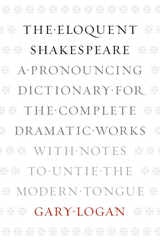
The Eloquent Shakespeare
A Pronouncing Dictionary for the Complete Dramatic Works with Notes to Untie the Modern TongueGary Logan
University of Chicago Press, 2008
An actor’s deepest desire is to be understood. But when asked to pronounce such words as “chanson,” “phantasime,” or “quaestor,” many otherwise unflappable actors can be rendered speechless.
The Eloquent Shakespeare aims to untie those tongues and help anyone speak Shakespeare’s language with ease. More than 17,500 entries make it the most comprehensive pronunciation guide to Shakespeare’s words, from the common to the arcane. Each entry is written in the International Phonetic Alphabet (IPA) and represents standard American pronunciations, making this dictionary perfect for North American professionals or non-native speakers of American English.
Renowned Shakespearean voice and text coach Gary Logan has spent years teaching Shakespeare’s works to some of the best actors in the world. His book includes proper names, foreign words and phrases, as well as an extensive introduction that covers everything from how to interpret the entries to scansion dynamics. Designed especially for actors, directors, stage managers, and teachers, The Eloquent Shakespeare is a one-of-a-kind resource for performing Shakespeare’s dramatic works.
[more]
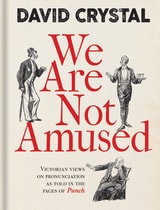
We Are Not Amused
Victorian Views on Pronunciation as Told in the Pages of PunchDavid Crystal
Bodleian Library Publishing, 2017
Have you ever cringed while hearing someone mispronounce a word—or, worse, been tripped up by a wily silent letter yourself? Consider yourself lucky that you do not live in Victorian England, when the way you pronounced a word was seen as a sometimes-damning index of who you were and how you should be treated. No wonder then that jokes about English usage provided one of Punch magazine’s most fruitful veins of humor for sixty years, from its first issue in 1841 to 1900.
For We Are Not Amused, renowned English-language expert David Crystal has explored the most common pronunciation-related controversies during the reign of Queen Victoria and brought together the cartoons and articles that poked fun at them, adding insightful commentary on the context of the times. The collection brings to light a society where class distinctions ruled. Crystal explains why people felt so strongly about accents and identifies which accents were the main sources of jokes, from the dropped h’s of the Cockney working class to the upper-class tendency to drop the final g in words like “huntin’” and “fishin’.”
In this fascinating and highly entertaining book, Crystal shows that outrage over proper pronunciation is nothing new—our feelings today have their origins in the ways our Victorian predecessors thought about the subject.
[more]