Results by title
5 books match the query 'Pronunciation by foreign speakers'
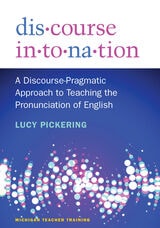
Discourse Intonation
A Discourse-Pragmatic Approach to Teaching the Pronunciation of EnglishLucy Pickering
University of Michigan Press, 2018
This textbook is an accessible introduction to discourse intonation for ESL/EFL instructors, whether practicing or in pre-service graduate programs. Because intonation is used to form impressions about a speaker’s attitude, it is crucial that instructors understand the details of the underlying linguistic system so that they can help students avoid the more common intonation-related pitfalls they experience when communicating in an academic setting.
This textbook relies heavily on the Brazil model; chapters are organized around different parts of that model and how they can be most effectively taught. Readers will learn the conventions underlying, for example, how we group words in prosodic units, how we understand turn-taking cues in conversation, and how we assess whether someone is feeling angry or sad.
This text features Check Your Learning sections, discussion questions, and hands-on activities at the end of every chapter. Chapters 3-9 also include a section on pedagogical implications. Some of the example sentences that illustrate intonation have accompanying short audio (MP3) files, which can be found online at https://www.fulcrum.org/concern/monographs/9c67wr362.

Indian Accents
Brown Voice and Racial Performance in American Television and FilmShilpa S. Dave
University of Illinois Press, 2013
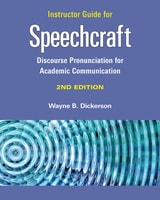
Instructor Guide for Speechcraft
Discourse Pronunciation for Academic CommunicationWayne B. Dickerson
University of Michigan Press, 2027
Instructor Guide for Speechcraft helps shoulder time-consuming, non-teaching tasks so that instructors can focus on working directly with their students. Four-part lesson plans are adaptable for instructors who want to insert critical pronunciation topics into a non-pronunciation ESL/EFL course. To aid in professional development, each lesson plan includes a commentary on the order of topics in the syllabus and common student questions. Appendices provide pre- and post-tests to make sure that instructors have the resources they need to teach confidently. In addition to the 232 audio recordings for the textbook, instructors can access 37 additional recordings that can be used for class preparation or for in-class progress checks. With the Instructor Guide for Speechcraft, teachers will be able to help their students achieve the clear, intelligible speech they need to pursue their studies in their chosen discipline, to serve as international teaching assistants, and to interact well in their chosen professions.
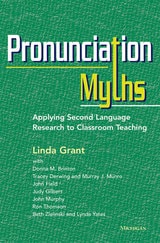
Pronunciation Myths
Applying Second Language Research to Classroom TeachingLinda Grant with Donna M. Brinton, Tracey Derwing and Murray J. Munro, John Field, Judy Gilbert, John Murphy, Ron Thomson, Beth Zielinski and Lynda Yates
University of Michigan Press, 2014
This volume was conceived as a "best practices" resource for pronunciation and speaking teachers in the way that Vocabulary Myths by Keith S. Folse is one for reading and vocabulary teachers. Like others in the Myths series, this book combines research with good pedagogical practices.
The book opens with a Prologue by Linda Grant (author of the Well Said textbook series), which reviews the last four decades of pronunciation teaching, the differences between accent and intelligibility, the rudiments of the English sound system, and other factors related to the ways that pronunciation is learned and taught.
The myths challenged in this book are:
§ Once you’ve been speaking a second language for years, it’s too late to change your pronunciation. (Derwing and Munro)
§ Pronunciation instruction is not appropriate for beginning-level learners. (Zielinski and Yates)
§ Pronunciation teaching has to establish in the minds of language learners a set of distinct consonant and vowel sounds. (Field)
§ Intonation is hard to teach. (Gilbert)
§ Students would make better progress if they just practiced more. (Grant)
§ Accent reduction and pronunciation instruction are the same thing. (Thomson)
§ Teacher training programs provide adequate preparation in how to teach pronunciation (Murphy).
The book concludes with an Epilogue by Donna M. Brinton, who synthesizes some of the best practices explored in the volume.
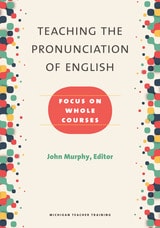
Teaching the Pronunciation of English
Focus on Whole CoursesJohn Murphy, Editor
University of Michigan Press, 2017
Teaching the Pronunciation of English illustrates that pronunciation teaching is compatible with communicative, task-based, post-method, and technology-mediated approaches to language teaching. This theme permeates the volume as a whole and is well represented in Chapters 3-12, which are dedicated to specialist-teachers’ firsthand depictions of pronunciation-centered courses. Each of these ten chapters features a set of innovative teaching strategies and contemporary course design structures developed by the chapter contributor(s).
To prepare readers to more fully appreciate the substance and quality of Chapters 3-12, the volume’s two initial chapters are more foundational. Chapters 1 and 2 provide an overview of core topics language teachers need to know about to become pronunciation teachers: suprasegmentals (thought groups, prominence, word stress, intonation, and pitch jumps) and the English consonants and vowel sounds.