Results by title
12 books match the query 'Proof'
Aquinas
God and ActionDavid B. Burrell C.S.C.
University of Scranton Press, 2008

Evidence for God from Physics and Philosophy
Extending the Legacy of Monsignor George Lemaître and St. Thomas AquinasRobert J. Spitzer, S.J.
St. Augustine's Press, 2015
History, Rhetoric, and Proof
Carlo Ginzburg
Brandeis University Press, 1999
Language, Proof, and Logic
Second EditionDave Barker-Plummer, Jon Barwise, and John Etchemendy
CSLI, 2011
Language Proof and Logic is available as a physical book with the software included and as a downloadable package of software plus the book in PDF format. The all-electronic version is available from Openproof at gradegrinder.net.
The textbook/software package covers first-order language in a method appropriate for first and second courses in logic. An on-line grading services instantly grades solutions to hundred of computer exercises. It is designed to be used by philosophy instructors teaching a logic course to undergraduates in philosophy, computer science, mathematics, and linguistics.
Introductory material is presented in a systematic and accessible fashion. Advanced chapters include proofs of soundness and completeness for propositional and predicate logic, as well as an accessible sketch of Godel's first incompleteness theorem. The book is appropriate for a wide range of courses, from first logic courses for undergraduates (philosophy, mathematics, and computer science) to a first graduate logic course.
The software package includes four programs:
Tarski's World, a new version of the popular program that teaches the basic first-order language and its semantics;
Fitch, a natural deduction proof environment for giving and checking first-order proofs;
Boole, a program that facilitates the construction and checking of truth tables and related notions (tautology, tautological consequence, etc.);
Submit, a program that allows students to submit exercises done with the above programs to the Grade Grinder, the automatic grading service.
Grade reports are returned to the student and, if requested, to the student's instructor, eliminating the need for tedious checking of homework. All programs are available for Windows and Macintosh systems. Instructors do not need to use the programs themselves in order to be able to take advantage of their pedagogical value. More about the software can be found at gradegrinder.net.
The price of a new text/software package includes one Registration ID, which must be used each time work is submitted to the grading service. Once activated, the Registration ID is not transferable.
Last Works
Moses Mendelssohn. Translated by Bruce Rosenstock
University of Illinois Press, 2012

Nature and Nature's God
A Philosophical and Scientific Defense of Aquinas' Unmoved Mover ArgumentDaniel Shields
Catholic University of America Press, 2023
Presumptions and Burdens of Proof
An Anthology of Argumentation and the LawEdited by Hans V. Hansen, Fred J. Kauffeld, James B. Freeman, and Lilian Bermejo-Luque
University of Alabama Press, 2019
An anthology of the most important historical sources, classical and modern, on the subjects of presumptions and burdens of proof
In the last fifty years, the study of argumentation has become one of the most exciting intellectual crossroads in the modern academy. Two of the most central concepts of argumentation theory are presumptions and burdens of proof. Their functions have been explicitly recognized in legal theory since the middle ages, but their pervasive presence in all forms of argumentation and in inquiries beyond the law—including politics, science, religion, philosophy, and interpersonal communication—have been the object of study since the nineteenth century.
However, the documents and essays central to any discussion of presumptions and burdens of proof as devices of argumentation are scattered across a variety of remote sources in rhetoric, law, and philosophy. Presumptions and Burdens of Proof: An Anthology of Argumentation and the Law brings together for the first time key texts relating to the history of the theory of presumptions along with contemporary studies that identify and give insight into the issues facing students and scholars today.
The collection’s first half contains historical sources and begins with excerpts from Aristotle’s Topics and goes on to include the locus classicus chapter from Bishop Whately’s crucial Elements of Rhetoric as well as later reactions to Whately’s views. The second half of the collection contains contemporary essays by contributors from the fields of law, philosophy, rhetoric, and argumentation and communication theory. These essays explore contemporary understandings of presumptions and burdens of proof and their role in numerous contexts today. This anthology is the definitive resource on the subject of these crucial rhetorical modes and will be a vital resource to all scholars of communication and rhetoric, as well as legal scholars and practicing jurists.
Proof
Inaugural Poem SuiteCornelius Eady
Tupelo Press, 2026
Cornelius Eady turns the inaugural poem into an instrument of reckoning.
First delivered to mark the historic inauguration of New York City’s mayor Zohran Mamdani on January 1, 2026, the title poem is not ceremony—it is summons. “You have to imagine it,” Eady insists, and from that insistence rises a chorus: those called too dark, too queer, too poor, too loud; those renamed invisible; those told “not now.” What if joy could wear down the rock of no? What if imagination were not escape, but evidence?
Moving from Robert Frost squinting into winter glare, to Elizabeth Alexander straightening her back before history, to Aretha Franklin beneath her church-crown hat, Eady braids civic pageantry with private memory. He summons the Colored Conventions of 1830, the 911 call that ricocheted through racial panic, the mock rifles on a Brooklyn rooftop, the “knife in sheep’s clothes.” Each poem widens the frame. Each poem refuses to look away.
Proof
Photographs from Four Generations of a Texas FamilyByrd M. Williams IV
University of North Texas Press, 2016
Questions of Evidence
Proof, Practice, and Persuasion across the DisciplinesEdited by James Chandler, Arnold I. Davidson, and Harry D. Harootunian
University of Chicago Press, 1994
The essays and rejoinders are by Terry Castle, Lorraine Daston, Carlo Ginzburg, Ian Hacking, Mark Kelman, R. C. Lewontin, Pierre Vidal-Naquet, Mary Poovey, Donald Preziosi, Simon Schaffer, Joan W. Scott, Eve Kosofsky Sedgwick, and Barbara Herrnstein Smith.
The critical responses are by Lauren Berlant, James Chandler, Jean Comaroff, Arnold I. Davidson, Harry D. harootunian, Elizabeth Helsinger, Thomas C. Holt, Francoise Meltzer, Robert J. Richards, Lawrence Rothfield, Joel Snyder, Cass R. Sunstein, and William Wimsatt.
Stoic Theology
Proof for the Existence of the Cosmic God and of the Traditional GodsP. A. Meijer
Eburon Academic Publishers, 2008
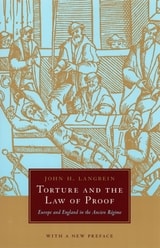
Torture and the Law of Proof
Europe and England in the Ancien RégimeJohn H. Langbein
University of Chicago Press, 2006
The book has recently taken on an eerie relevance as a consequence of controversial American and British interrogation practices in the Iraq and Afghanistan wars. In a new introduction, Langbein contrasts the "new" law of torture with the older European law and offers some pointed lessons about the difficulty of reconciling coercion with accurate investigation. Embellished with fascinating illustrations of torture devices taken from an eighteenth-century criminal code, this crisply written account will engage all those interested in torture's remarkable grip on European legal history.