Results by title
2 books match the query 'Propaganda in art'
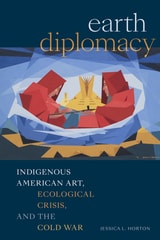
Earth Diplomacy
Indigenous American Art, Ecological Crisis, and the Cold WarJessica L. Horton
Duke University Press, 2024
In Earth Diplomacy, Jessica L. Horton reveals how Native American art in the mid-twentieth century mobilized Indigenous cultures of diplomacy to place the earth itself at the center of international relations. She focuses on a group of artists, including Pablita Velarde, Darryl Blackman, and Oscar Howe, who participated in exhibitions and lectures abroad as part of the United States’s Cold War cultural propaganda. Horton emphasizes how their art modeled a radical alternative to dominant forms of statecraft, a practice she calls “earth diplomacy”: a response to extractive colonial capitalism grounded in Native ideas of deep reciprocal relationships between humans and other beings that govern the world. Horton draws on extensive archival research and oral histories as well as analyses of Indigenous creative work, including paintings, textiles, tipis, adornment, and artistic demonstrations. By interweaving diplomacy, ecology, and art history, Horton advances Indigenous frameworks of reciprocity with all beings in the cosmos as a path to transforming our broken system of global politics.
[more]

Picturing the Cosmos
A Visual History of Early Soviet Space EndeavorIina Kohonen
Intellect Books, 2017
Space is the ultimate canvas for the imagination, and in the 1950s and ’60s, as part of the space race with the United States, the solar system was the blank page upon which the Soviet Union etched a narrative of exploration and conquest. In Picturing the Cosmos, drawing on a comprehensive corpus of rarely seen photographs and other visual phenomena, Iina Kohonen maps the complex relationship between visual propaganda and censorship during the Cold War.
Kohonen ably examines each image, elucidating how visual media helped to anchor otherwise abstract political and intellectual concepts of the future and modernization within the Soviet Union. The USSR mapped and named the cosmos, using new media to stake a claim to this new territory and incorporating it into the daily lives of its citizens. Soviet cosmonauts, meanwhile, were depicted as prototypes of the perfect Communist man, representing modernity, good taste, and the aesthetics of the everyday. Across five heavily illustrated chapters, Picturing the Cosmos navigates and critically examines these utopian narratives, highlighting the rhetorical tension between propaganda, censorship, art, and politics.
Kohonen ably examines each image, elucidating how visual media helped to anchor otherwise abstract political and intellectual concepts of the future and modernization within the Soviet Union. The USSR mapped and named the cosmos, using new media to stake a claim to this new territory and incorporating it into the daily lives of its citizens. Soviet cosmonauts, meanwhile, were depicted as prototypes of the perfect Communist man, representing modernity, good taste, and the aesthetics of the everyday. Across five heavily illustrated chapters, Picturing the Cosmos navigates and critically examines these utopian narratives, highlighting the rhetorical tension between propaganda, censorship, art, and politics.
[more]