Results by title
2 books match the query 'Prose literature'
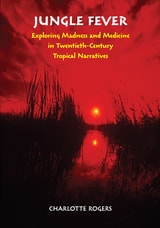
Jungle Fever
Exploring Madness and Medicine in Twentieth-Century Tropical NarrativesCharlotte Rogers
Vanderbilt University Press, 2012
The sinister "jungle"—that ill-defined and amorphous place where civilization has no foothold and survival is always in doubt—is the terrifying setting for countless works of the imagination. Films like Apocalypse Now, television shows like Lost, and of course stories like Heart of Darkness all pursue the essential question of why the unknown world terrifies adventurer and spectator alike. In Jungle Fever, Charlotte Rogers goes deep into five books that first defined the jungle as a violent and maddening place. The reader finds urban explorers venturing into the wilderness, encountering and living among the "native" inhabitants, and eventually losing their minds.
The canonical works of authors such as Joseph Conrad, Andre Malraux, Jose Eustasio Rivera, and others present jungles and wildernesses as fundamentally corrupting and dangerous. Rogers explores how the methods these authors use to communicate the physical and psychological maladies that afflict their characters evolved symbiotically with modern medicine. While the wilderness challenges Conrad's and Malraux's European travelers to question their civility and mental stability, Latin American authors such as Alejo Carpentier deftly turn pseudoscientific theories into their greatest asset, as their characters transform madness into an essential creative spark.
Ultimately, Jungle Fever suggests that the greatest horror of the jungle is the unknown regions of the character's own mind.
[more]
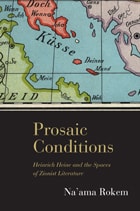
Prosaic Conditions
Heinrich Heine and the Spaces of Zionist LiteratureNa'ama Rokem
Northwestern University Press, 2013
In her penetrating new study, Na’ama Rokem observes that prose writing—more than poetry, drama, or other genres—came to signify a historic rift that resulted in loss and disenchantment. In Prosaic Conditions, Rokem treats prose as a signifying practice—that is, a practice that creates meaning. During the nineteenth and twentieth centuries, prose emerges in competition with other existing practices, specifically, the practice of performance. Using Zionist literature as a test case, Rokem examines the ways in which Zionist authors put prose to use, both as a concept and as a literary mode. Writing prose enables these authors to grapple with historical, political, and spatial transformations and to understand the interrelatedness of all of these changes.
[more]