Results by title
2 books match the query 'Prose poems, American'
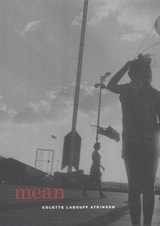
Mean
Colette LaBouff Atkinson
University of Chicago Press, 2008
In the appropriately titled Mean, Colette LaBouff Atkinson’s speakers confront a series of cruel lovers, estranged ex-husbands and ex-ex-wives, neglectful parents, disrespectful children, menacing drunks, would-be rapists, well-meaning but ineffectual teachers, and that annoying kid in first grade who wouldn’t leave you alone. Managing to “say” what most of us would only think but never dare speak out loud, this stunning debut collection reveals that the horrors and cruelty we experience in everyday life can turn out to be very real indeed. But Atkinson does not merely rake her subjects across the coals: she deftly exposes, instead, how the world mirrors back to us our own meanness, lending it a truth and a history. In forty-three deadpan, often merciless prose poems that are masterpieces of the form, Mean lays bare the darkness within the narrator’s heart as well as in ours.
"Colette Labouff Atkinson’s artful laconicism attains the force of a shout, without ever raising its voice. The intelligent, merciless narrative cool arrays a sad comedy, with an unemphatic but penetrating 'and then . . . and then': accounts of love pursued far more often than it is glimpsed or realized."—Robert Pinsky
[more]

You Can Tell the Horse Anything
Mary A. Koncel
Tupelo Press, 2003
You Can Tell the Horse Anything is a debut collection of prose poems that explores the many manifestations of longing-true love, spiritual redemption, a good night’s sleep, the list is long and varied. Using humor and lyricism, they give voice to an array of animals as well as human characters who inhabit the sometimes rocky terrain between the common place and the absurd. Ultimately, these poems — these tightly packed mini-dramas — are microcosms of our own everyday lives. They challenge our sense of self, our sense of belonging and comfort. They ask us to tread carefully in a world that is easily turned on its side. Yet, ironically, they also encourage us to be hopeful, to realize that solace and small joy can be found talking to a horse or raising worms on a moonlit mountain.
[more]