Results by title
6 books match the query 'Prospect'
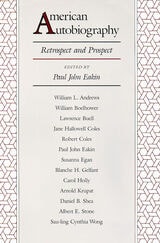
American Autobiography
Retrospect And ProspectPaul John Eakin
University of Wisconsin Press, 1991
The first four essays review the major historical periods of American autobiography, placing the classic texts of American autobiographical literature from Captain John Smith to Malcolm X in the illuminating context of lesser-known contemporary narratives. Daniel B. Shea writes on colonial America, Lawrence Buell on the American Renaissance, Susanna Egan on the years after the Civil War, and Albert E. Stone on the twentieth century.
The second part of American Autobiography shows the diversity of voices, forms, audiences, and modes of identity in the literature of American autobiography. Provocative essays by William Boelhower and Sau-Ling Cynthia Wong on immigrant autobiography discuss the changes in the sense of self that occur when strangers come to a strange land. Arnold Krupat writes about how American Indians conceptualize the self and about the relationship between oral and written discourse. William L. Andrews evaluates the strong body of critical theory that has grown up around African-American autobiography, showing how both the genre and its criticism have responded to contemporary historical pressures. Carol Holly explores the model of personal identity that underlies nineteenth-century women’s autobiographies, and Blanche Gelfant examines the narrative and political strategies of Emma Goldman’s autobiography, especially her use of popular romance and melodrama.
The last essay offers a more personal perspective on contemporary autobiography: a “dialogue” between Robert and Jane Coles about how they developed their method of eliciting first-person oral narratives for their famous Children of Crisis and Women of Crisis series.
These essays raise theoretical issues that are examined in Paul John Eakin’s incisive introduction: How do we define a literary genre of protean shape and perplexing cultural multiplicity? How do we approach the special problems created by documents that are both historical and literary texts, ones that pose difficult questions about truth and representation? Most important, how is the canon of American autobiography to be constructed, and how is its history to be written? Tracing that critical history, Eakin explains how changing ideas about “the mainstream” and “the marginal” have revitalized our retrospective view of American autobiography and opened up new and exciting prospects for today’s reader.
Education in Ethiopia
Prospect and RetrospectTeshome G. Wagaw
University of Michigan Press, 2025
Prospect Of Cities
John Friedmann
University of Minnesota Press, 2002

Rural Development in China
Prospect and RetrospectHsiao-tung Fei
University of Chicago Press, 1989
Returning to Kaixian'gong in 1957 and again in the 1980s, Fei examined the changes that had occurred since his initial research. Three essays that resulted from these follow-up studies are included in this collection, providing a rare summary and analysis of developments in the village between 1936 and 1986. Also included here are four articles based on Fei's 1983-84 research in other areas of Jiangsu province. His explorations of the contrast between the wealth of southern Jiangsu and the long-standing poverty of the northern half of the province address key issues of public policy in China today. Useful to students of rural sociology as well as of Chinese history, politics, economics, and anthropology, this collection will provide an overview not only of developments in the small towns of China but also of Fei's thought.
South American Indian Languages
Retrospect and ProspectEdited by Harriet E. Manelis Klein and Louisa R. Stark
University of Texas Press, 1985
This book fills the crucial need for a single volume that gives broad coverage and synthesizes findings for both the general reader and the specialist. This collection of twenty-two essays from fifteen well-known scholars presents linguistic research on the indigenous languages of South America, surveying past research, providing data and analysis gathered from past and current research, and suggesting prospects for future investigation.
Of interest not only to linguists but also to anthropologists, historians, and geographers, South American Indian Languages offers a wide perspective, both temporal and regional, on an area noted for its enormous linguistic diversity and for the lack of knowledge of its indigenous languages. An invaluable source book and reference tool, its appearance is especially timely when exploitation of the rich natural resources in a number of areas in South America must surely result in the demise and/or acculturation of some indigenous groups.
The World Economy
History & ProspectBy W. W. Rostow
University of Texas Press, 1978
This monumental study is an account of the world economy from the eighteenth century to the twentieth, an analysis and prescription for the future, and a challenge to the neo-Keynesian theories of income determination and growth. It is based on some forty years of research and teaching.
Originally published in 1978, the volume looks back over the nineteenth and twentieth centuries. It includes an analysis of how the world's population expanded from about 1 billion in 1800 to 4 billion in 1976, with some 6.5 billion in sight for the year 2000; an account of the expansion and distribution of industrial production and trade during this period; and an analysis of price and relative price movements since the eighteenth century. Rostow gives a detailed description of the Kondratieff long cycles in the relative scarcity and abundance of food and raw materials and reasons that the world economy entered the fifth Kondratieff upswing at the close of 1972. He also examines the changing pattern of business cycles over the whole sweep of modern economic growth and the failure of the post-1945 world economy to control inflation. The volume also includes short economic histories of twenty national economies responsible for 80 percent of the world's production, based on a collection of computerized aggregate and sectoral data.
Each historical section leads naturally into one or more of the major problems dealt with in the final portion of the book, which looks to the future of the world economy: food, population, energy, raw materials, the environment, and the tasks of national and international policy. Rostow argued, counter to the Limits to Growth doctrine, that the critical period for industrial civilization lay in the last twenty-five years of the twentieth century, rather than in the twenty-first century, and that what we did or failed to do in that generation would determine the shape of the longer future.
No other economic history of this depth and breadth exists. It is a reference for economists, economic historians, and other social scientists as well as the informed lay reader.