Results by title

6 books match the query 'Province'

cover of In the Province of the Gods

In the Province of the Gods

Kenny Fries

University of Wisconsin Press, 2021
Kenny Fries embarks on a journey of profound self-discovery as a disabled foreigner in Japan, a society historically hostile to difference. As he visits gardens, experiences Noh and butoh, and meets artists and scholars, he also discovers disabled gods, one-eyed samurai, blind chanting priests, and A-bomb survivors. When he is diagnosed as HIV positive, all his assumptions about Japan, the body, and mortality are shaken, and he must find a way to reenter life on new terms.
[more]
cover of Pueblos, Plains, and Province: New Mexico in the Seventeenth Century

Pueblos, Plains, and Province

New Mexico in the Seventeenth Century

Joseph P. Sánchez

University Press of Colorado, 2024

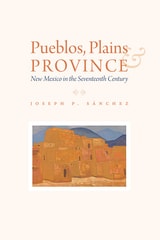
In Pueblos, Plains, and Province Joseph P. Sánchez offers an in-depth examination of sociopolitical conflict in seventeenth-century New Mexico, detailing the effects of Spanish colonial policies on settlers’, missionaries’, and Indigenous peoples’ struggle for economic and cultural control of the region. Sánchez explores the rich archival documentation that provides cultural, linguistic, and legal perspectives of the values of the period.

Spanish dual Indian policies for Pueblo and Plains tribes challenged Indigenous political and social systems to conform to the imperial structure for pacification purposes. Meanwhile, missionary efforts to supplant Indigenous religious beliefs with a Christian worldview resulted, in part, in a syncretism of the two worlds. Indigenous resentment of these policies reflected the contentious disagreements between Spanish clergymen and civil authorities, who feuded over Indigenous labor and encroachment on tribal sovereignties with demands for sworn loyalty to Spanish governance. The little-studied “starvation period” adversely affected Spanish-Pueblo relationships for the remainder of the century and contributed significantly to the battle at Acoma, the Jumano War, and the Pueblo Revolt of 1680.

Pueblos, Plains, and Province shows how history, culture, and tradition in New Mexico shaped the heritage shared by Spain, Mexico, the United States, and Native American tribes and will be of interest to scholars and students of Indigenous, colonial, and borderlands history.
[more]
cover of Reconstituting Authority: American Fiction in the Province of the Law, 1880-1920

Reconstituting Authority

American Fiction in the Province of the Law, 1880-1920

William E. Moddelmog

University of Iowa Press, 2000

In Reconstituting Authority, William Moddelmog explores the ways in which American law and literature converged in the late nineteenth and early twentieth centuries. Through close readings of significant texts from the era, he reveals not only how novelists invoked specific legal principles and ideals in their fictions but also how they sought to reconceptualize the boundaries of law and literature in ways that transformed previous versions of both legal and literary authority.
Moddelmog does not assume a sharp distinction between literary and legal institutions and practices but shows how writers imagined the two fields as engaged in the same cultural process. He argues that because the law was instrumental in setting the terms by which concepts such as race, gender, nationhood, ownership, and citizenship were defined in the nineteenth century, authors challenging those definitions had to engage the law on its own terrain: to place their work in a dialogue with the law by telling stories that were already authorized (though perhaps suppressed) by legal institutions.
The first half of the book is devoted in separate chapters to William Dean Howells, Helen Hunt Jackson, and Pauline Hopkins. The focus shifts from large theoretical concerns to questions of contract and native sovereignty, to issues of African American citizenship and racial entitlement. In each case the discussion is rooted in a larger consideration of the rule (or misrule) of law.
The second half of the book turns from the rule of law to the issue of property, specifically the Lockean version of the self that tied identity to legal conceptions of property and economic value. In separate discussions of Charles Chesnutt, Edith Wharton, and Theodore Dreiser, Reconstituting Authority reveals authors as closely engaged with those changing perspectives on property and identity, in ways that challenged the racial, gendered, and economic consequences of America's possessive individualism.

[more]
cover of Sonora: A Description of the Province

Sonora

A Description of the Province

Ignaz Pfefferkorn; Foreword by Bernard L. Fontana; Translated and Annotated by Theodore E. Treutlein

University of Arizona Press, 1989

"The bloodsucking bat, construction of bows and arrows, the punishment for adultery among the Apaches... all was grist that dropped into the industrious mill of Father Pfefferkorn's eyes, ears, and brain."—Saturday Review

"To be read for enjoyment; nevertheless, the historian will find in it a wealth of information that has been shrewdly appraised, carefully sifted, and creditably related."—Catholic Historical Review

"Of interest not only to the historian but to the geographer and anthropologist."—Pacific Historical Review
 
[more]
cover of The Province of Affliction: Illness and the Making of Early New England

The Province of Affliction

Illness and the Making of Early New England

Ben Mutschler

University of Chicago Press, 2020
In The Province of Affliction, Ben Mutschler explores the surprising roles that illness played in shaping the foundations of New England society and government from the late seventeenth century through the early nineteenth century. Considered healthier than people in many other regions of early America, and yet still riddled with disease, New Englanders grappled steadily with what could be expected of the sick and what allowances were made to them and their providers. Mutschler integrates the history of disease into the narrative of early American social and political development, illuminating the fragility of autonomy, individualism, and advancement . Each sickness in early New England created its own web of interdependent social relations that could both enable survival and set off a long bureaucratic struggle to determine responsibility for the misfortune. From families and households to townships, colonies, and states, illness both defined and strained the institutions of the day, bringing people together in the face of calamity, yet also driving them apart when the cost of persevering grew overwhelming. In the process, domestic turmoil circulated through the social and political world to permeate the very bedrock of early American civic life.
[more]
cover of The Province of Piety: Moral History in Hawthorne's Early Tales

The Province of Piety

Moral History in Hawthorne's Early Tales

Michael J. Colacurcio

Duke University Press, 1995

In this celebrated analysis of Nathaniel Hawthorne, Michael J. Colacurcio presents a view of the author as America’s first significant intellectual historian. Colacurcio shows that Hawthorne’s fiction responds to a wide range of sermons, pamphlets, and religious tracts and debates—a variety of moral discourses at large in the world of provincial New England.
Informed by comprehensive historical research, the author shows that Hawthorne was steeped in New England historiography, particularly the sermon literature of the seventeenth century. But, as Colacurcio shows, Hawthorne did not merely borrow from the historical texts he deliberately studied; rather, he is best understood as having written history. In The Province of Piety, originally published in 1984 (Harvard University Press), Hawthorne is seen as a moral historian working with fictional narratives—a writer brilliantly involved in examining the moral and political effects of Puritanism in America and recreating the emotional and cultural contexts in which earlier Americans had lived.
[more]