Results by title
4 books match the query 'Provinces'
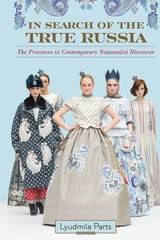
In Search of the True Russia
The Provinces in Contemporary Nationalist DiscourseLyudmila Parts
University of Wisconsin Press, 2020
Surveying a largely unexplored body of Russian journalism, literature, and film from the late twentieth and early twenty-first centuries, Parts finds that the harshest portrayals of the provinces arise within "high" culture. Popular culture, however, has increasingly turned from the newly prosperous, multiethnic, and westernized Moscow to celebrate the hinterlands as repositories of national traditions and moral strength. This change, she argues, has directed debate about Russia's identity away from its loss of imperial might and global prestige and toward a hermetic national identity based on the opposition of "us vs. us" rather than "us vs. them." She offers an intriguing analysis of the contemporary debate over what it means to be Russian and where "true" Russians reside.

Provinces of the Mind
The Modern Novel on Provincial TimeVictoria Baena
University of Chicago Press, 2027
How the provinces, rather than cities or capitals, became the key setting dramatized in—but also transformed by—modern novels in English and French.
To be provincial is to mistake one’s narrow milieu for the world: it is to fall prey to an error of scale. But it is also to feel behind, belated, and excluded from the possibilities of the modern world. In this elegant study of the novel “on provincial time,” Victoria Baena argues that the literary geography of “the provinces” played a key role in forging European narratives of modernity.
In the wake of French revolutionaries’ suppression of older provincial identities and as Britain expanded its imperial reach, the provinces were reinvented on various scales: from countryside to small town, from domestic region to faraway colony. Baena brings together Marxist and feminist spatial theory with close attention to the politics of narrative form in order to show how the remarkably mobile concept of the provinces developed across social and cultural frameworks from 1800 to 1933. Offering new interpretations of novels of the realist tradition—by Honoré de Balzac, George Eliot, Emily Brontë, George Sand, Thomas Hardy, Marcel Proust, Alain-Fournier, James Joyce, and Claude McKay—she shows how the question of representing the provinces transformed the modern novel.
Provinces of the Mind illuminates some of the more pernicious fictions of provincialism. But it also describes, often movingly, the desire no longer to be provincial, along with the ambivalence and alienation that can entail. Ultimately, the book shows how literary critics can use the provinces to translate questions of literary geography across borders. By interrogating the provincialisms of our own time and place, Baena suggests, critics might make a better case for those worth retaining and have a better grasp of those to be left behind.
Valorizing the Barbarians
Enemy Speeches in Roman HistoriographyBy Eric Adler
University of Texas Press, 2011
With the growth of postcolonial theory in recent decades, scholarly views of Roman imperialism and colonialism have been evolving and shifting. Much recent discussion of the topic has centered on the ways in which ancient Roman historians consciously or unconsciously denigrated non-Romans. Similarly, contemporary scholars have downplayed Roman elite anxiety about their empire's expansion.
In this groundbreaking new work, Eric Adler explores the degree to which ancient historians of Rome were capable of valorizing foreigners and presenting criticisms of their own society. By examining speeches put into the mouths of barbarian leaders by a variety of writers, he investigates how critical of the empire these historians could be.
Adler examines pairs of speeches purportedly delivered by non-Roman leaders so that the contrast between them might elucidate each writer's sense of imperialism. Analyses of Sallust's and Trogus's treatments of the Eastern ruler Mithradates, Polybius's and Livy's speeches from Carthage's Hannibal, and Tacitus's and Cassius Dio's accounts of the oratory of the Celtic warrior queen Boudica form the core of this study. Adler supplements these with examinations of speeches from other characters, as well as contextual narrative from the historians. Throughout, Adler wrestles with broader issues of Roman imperialism and historiography, including administrative greed and corruption in the provinces, the treatment of gender and sexuality, and ethnic stereotyping.

Young Man From The Provinces
A Gay Life Before StonewallAlan Helms
University of Minnesota Press, 2003
An insider’s account of gay high society in pre-Stonewall New York City—now back in print!
Young, intelligent, and handsome, Alan Helms left a brutal midwestern childhood for New York City in 1955. Denied a Rhodes scholarship because of his sexual orientation, he soon became an object of desire in a gay underground scene frequented by, among many others, Noel Coward, Leonard Bernstein, and Marlene Dietrich. In this unusually vivid and sensitive account, Helms describes the business of being a sex object and its psychological and physical toll.