Results by title
4 books match the query 'Provincetown (Mass.)'
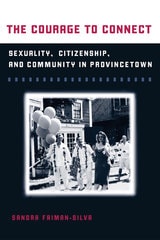
The Courage to Connect
Sexuality, Citizenship, and Community in ProvincetownSandra L. Faiman-Silva
University of Illinois Press, 2003
Based on over six years of fieldwork, Sandra L. Faiman-Silva's The Courage to Connect traces the transformation of the Cape Cod community of Provincetown from its nineteenth-century origins as a fishing town where Portuguese immigrants settled to its present status as a welcoming, sexually diverse tourist enclave. Faiman-Silva examines the community’s history and economy as well as how gay and straight cultures intersect in areas such as public education, local government, and law enforcement. Using queer and critical culture theory to deconstruct day-to-day local encounters, Faiman-Silva describes the causes of social conflicts and how these conflicts can be resolved. Capturing the pathos and joy of a community that has struggled to accommodate radical social changes, The Courage to Connect yields understanding of the ways in which communities can construct themselves to overcome differences.

The Off Season
Amy Hoffman
University of Wisconsin Press, 2019
In the damp, windy winter, Nora contends with heartbreak, aging, and local environmental worries, while painting what she hopes will be her masterpiece. Along the way, she encounters the chain-smoking, motor scooter–driving landlady Miss Ruby; Reverend Patsy, the vegan minister of the Unitarian church; and Brunhilde, barista extraordinaire and rival for Baby's affections. As the first tourists begin to arrive in June, Nora must decide what she really wants from life.
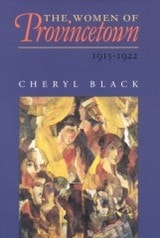
The Women of Provincetown, 1915–1922
Cheryl Black
University of Alabama Press, 2001
In this fascinating work, Cheryl Black reveals that, in addition to its role in developing an American tradition of non-commercial theatre, Provincetown has another, largely unacknowledged claim to fame as one of the first theatre companies in America in which women achieved prominence in every area of operation. At a time when women playwrights were rare, women directors rarer, and women scenic designers unheard of, Provincetown’s female members excelled in all of these roles.
In addition to the well-known playwright Susan Gaspell, the company’s female membership included luminaries such poets Edna St. Vincent Millay, Mina Loy, and Djuna Barnes; journalists Louise Bryant and Mary Heaton Vorce; novelists Neith Boyce and Evelyn Scott; and painter Marguerite Zorach. Illuminating a fascinating chapter in the history of one of the world's most picturesque and beloved artist colonies, The Women of Provincetown is an engaging work of social history, offering new insights into the relationship between gender and theatre. This work includes 40 images of the key artists in the book.
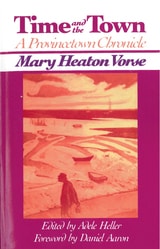
Time and the Town
A Provincetown ChronicleAdele Heller
Rutgers University Press, 1991
Time and the Town was the last of Mary Heaton Vorse's books. It is about many things —a town and its people, the author, a certain kind of idyllic life. As much as anything else, it is the biography of the house Vorse bought in 1907 and lived in, off and on, for the next thirty-six years. The moods of the house mirrored her own. "Our houses," she wrote, "are our biographies, the stories of our defeats and victories."
Tinged with nostalgia and disenchantment, the book describes a Provincetown that has changed, a place on the verge of modernity. It is no longer a major fishing port. It has become a place whose business is tourism. Contrasting the old and the new, Vorse celebrates the enduring character of the town itself. She tells stories that are engaging and charming, droll and fabulous. The wrinkled Mrs. Mary Mooncusser who, though drunk and stark naked, conducts herself with great decorum when Vorse pays her a call, might have stepped out of the pages of Sherwood Anderson or Eudora Welty. In another anecdote, the townspeople scour the beaches for cases of booze dumped into the sea by rumrunners and are briefly inflated with the spirit of ancestral smugglers and buccaneers.
Vorse herself remained something of an outsider in Provincetown, despite her evident affection for the place and its inhabitants. They surely regarded her as simply another of those artist-intellectuals--many of whom appear in the pages of this book. The "off-Cape" outsiders put the town in the national limelight but took no interest in local matters. Vorse here ponders local matters exclusively, almost, one suspects, as a way of forgetting the more complex matters that occupied her--her agonies of parental guilt, her resentment of domestic obligations, her third marriage, her depressions and breakdowns. The town is in that sense beyond time.