Results by title
3 books match the query 'Pryse, Marjorie'
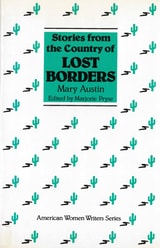
Stories from the Country of Lost Borders by Mary Austin
Pryse, Marjorie
Rutgers University Press, 1987
Mary Austin's The Land of Little Rain (1903) and Lost Borders (1909), both set in the California desert, make intimate connections between animals, people, and the land they inhabit. For Austin, the two indispensable conditions of her fiction were that the region must enter the story "as another character, as the instigator of plot," and that the story must reflect "the essential qualities of the land."
In The Land of Little Rain, Austin's attention to natural detail allows her to write prose that is geologically, biologically, and botanically accurate at the same time that it offers metaphorical insight into human emotional and spiritual experience. In Lost Borders, Austin focuses on both white and Indian women's experiences in the desert, looks for the sources of their deprivation, and finds them in the ways life betrays them, usually in the guise of men. She offers several portraits of strong women characters but ultimately identifies herself with the desert, which she personifies as a woman.
In The Land of Little Rain, Austin's attention to natural detail allows her to write prose that is geologically, biologically, and botanically accurate at the same time that it offers metaphorical insight into human emotional and spiritual experience. In Lost Borders, Austin focuses on both white and Indian women's experiences in the desert, looks for the sources of their deprivation, and finds them in the ways life betrays them, usually in the guise of men. She offers several portraits of strong women characters but ultimately identifies herself with the desert, which she personifies as a woman.
[more]

The Mark and the Knowledge
Social Stigma in Classic American FictionMarjorie Pryse
The Ohio State University Press, 1900
[more]
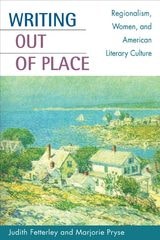
Writing out of Place
Regionalism, Women, and American Literary CultureJudith Fetterley and Marjorie Pryse
University of Illinois Press, 2002
In Writing out of Place, Judith Fetterley and Marjorie Pryse explore a countertradition of nineteenth–century writing previously ignored by American literary history that challenged the definition of nation and literature that emerged after the Civil War.
Regionalist writers such as Alice Cary, Mary E. Wilkins Freeman, Sarah Orne Jewett, Grace King, Alice Dunbar–Nelson, Sui Sin Far, and Mary Austin present narrators who serve as cultural interpreters for persons often considered "out of place" by urban readers. Critiquing the approaches to regional subjects characteristic of local color, this book gives contemporary readers a vantage point from which to approach regions and regional people in the global economy of our own time.
Reclaiming the ground of "close" reading for texts that have been insufficiently read, Fetterley and Pryse situate textual analyses within larger questions such as the ideology of form, feminist standpoint epistemology, queer theory, intersections of race and class, and narrative empathy. In its combination of the critical and the visionary, Writing out of Place proposes regionalism as a model for narrative connection between texts and readers that has the potential to transform American literary culture. Arguing the need for other models for human development than those produced in heroic stories about men and boys, the authors offer regionalism as a source of unconventional and counterhegemonic fictions that should be passed on to future generations of readers.
[more]