Results by title
2 books match the query 'Psychological warfare'
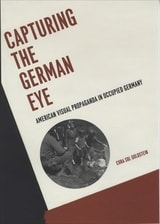
Capturing the German Eye
American Visual Propaganda in Occupied GermanyCora Sol Goldstein
University of Chicago Press, 2009
Shedding new light on the American campaign to democratize Western Germany after World War II, Capturing the German Eye uncovers the importance of cultural policy and visual propaganda to the U.S. occupation.
Cora Sol Goldstein skillfully evokes Germany’s political climate between 1945 and 1949, adding an unexpected dimension to the confrontation between the United States and the USSR. During this period, the American occupiers actively vied with their Soviet counterparts for control of Germany’s visual culture, deploying film, photography, and the fine arts while censoring images that contradicted their political messages. Goldstein reveals how this U.S. cultural policy in Germany was shaped by three major factors: competition with the USSR, fear of alienating German citizens, and American domestic politics. Explaining how the Americans used images to discredit the Nazis and, later, the Communists, she illuminates the instrumental role of visual culture in the struggle to capture German hearts and minds at the advent of the cold war.
Human Programming
Brainwashing, Automatons, and American UnfreedomScott Selisker
University of Minnesota Press, 2016
Do our ways of talking about contemporary terrorism have a history in the science, technology, and culture of the Cold War? Human Programming explores this history in a groundbreaking work that draws connections across decades and throughout American culture, high and low. Scott Selisker argues that literary, cinematic, and scientific representations of the programmed mind have long shaped conversations in U.S. political culture about freedom and unfreedom, and about democracy and its enemies.
Selisker demonstrates how American conceptions of freedom and of humanity have changed in tandem with developments in science and technology, including media technology, cybernetics, behaviorist psychology, and sociology. Since World War II, propagandists, scientists, and creative artists have adapted visions of human programmability as they sought to imagine the psychological manipulation and institutional controls that could produce the inscrutable subjects of totalitarian states, cults, and terrorist cells. At the same time, writers across the political spectrum reimagined ideals of American freedom, democracy, and diversity by way of contrast with these posthuman specters of mental unfreedom. Images of such “human automatons” circulated in popular films, trials, travelogues, and the news media, giving form to the nebulous enemies of the postwar and contemporary United States: totalitarianism, communism, total institutions, cult extremism, and fundamentalist terrorism.
Ranging from discussions of The Manchurian Candidate and cyberpunk science fiction to the cases of Patty Hearst and the “American Taliban” John Walker Lindh, Human Programming opens new ways of understanding the intertwined roles of literature, film, science, and technology in American culture.