Results by title
4 books match the query 'Psychology, Pathological'

Alterity
Jean-Michel Oughourlian
Michigan State University Press, 2023
Through the lens of mimetic theory, distinguished French psychiatrist Jean-Michel Oughourlian shows how to spot and address rivalry in our lives and become open to healthier, more genuine relationships. This important study demonstrates the toxic and pathogenic mechanisms at work in physical ailments and mental disturbances and reveals a common cause: alterity, the other. Oughourlian maintains that the real question in attempting to resolve issues of rivalry is not “What is your problem?” but rather “Who is your problem?” This type of discord with the other—be it a friend, colleague, or family member—becomes visible through generalized stress. This stress manifests in psychosomatic symptoms and may even contribute to the development of organic diseases. The most important factor in healing these maladies, then, is to recognize the other with whom we are in rivalry.
[more]
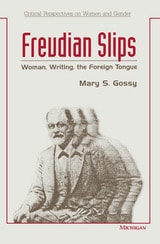
Freudian Slips
Woman, Writing, the Foreign TongueMary S. Gossy
University of Michigan Press, 1995
In Freudian Slips: Woman, Writing, the Foreign Tongue, Mary Gossy provides an original and provocative critique of language, sexuality, and the female body in Freud's The Psychopathology of Everyday Life.
Gossy believes that Freud's most popular statement of a theory of the unconscious is written over foreign and feminized texts, bodies, and places, by way of anecdotes that range from the Dora case to menstruation to travel phobias. Freudian Slips: Woman, Writing, the Foreign Tongue does a feminist psychoanalytic reading of Freud's book and shows how slippery- textually, erotically, and historically- the writing of theory can be, and also how much we can learn from our slips when we are willing to admit that we have made them.
Bringing together autobiography, psychoanalysis, close readings, pedagogy, and politics in provocative and innovative ways, Gossy discusses Freud's work from both textual and theoretical perspectives and asks what his writing can teach us about authority, theory, home, and the foreign. Arguing that the dominant metaphor in the Psychopathology is that of the female body as foreign text, and that this body, writing, and the foreign tongue are identified with a feminized unconscious that threatens authoritative discourse, Freudian Slips moves toward fashioning a feminist theory that is both "slippery and (para)practical" and constantly searches for ways of writing theory that free, rather than sacrifice, the bodies of women.
"The readings of individual slips are often highly productive; the argument is both hardworking and playful. Freudian Slips is a book that people will enjoy reading and from which they will learn a great deal."-- Helena Michie, Rice University
Mary S. Gossy is Associate Professor of Spanish and Comparative Literature, Rutgers University. She is the author of The Untold Story: Women and Theory in Golden Age Texts.
[more]

Person Schemas and Maladaptive Interpersonal Patterns
Edited by Mardi J. Horowitz
University of Chicago Press, 1991
This fresh exploration of the utility of “person schemas” for understanding interpersonal
behavior and intrapsychic conflict brings together psychoanalytic researchers, social learning
theorists, and cognitive scientists. The contributors show that a fuller conceptualization of
person schemas can begin to close the gap between psychodynamic and cognitive science
research, providing new methods for understanding disorders of personality.
“There are many strengths in this volume beyond the clear presentation of the person schema
as a concept linking cognitive and psychodynamic perspectives. . . . Students will have an
opportunity for comparison of perspectives while those working in the field will have an
opportunity to follow the shift from concept to method to case application to theoretical
context for understanding personality change.”—Bertram J. Cohler, University of Chicago
Contributors are Lorna Smith Benjamin, Paul Crits-Christoph, Randolph L. Cunningham, Roy
D'Andrade, Amy Demorest, Mary Ewert, Scott H. Friedman, Frances J. Friedrich, Jess H.
Ghannam, Dianna Hartley, Mardi J. Horowitz, John F. Kihlstrom, Peter H. Knapp, Lester
Luborsky, David Mark, Thomas V. Merluzzi, Stephen E. Palmer, Carol Popp, Peter Salovey,
Pamela Schaffler, Jerome L. Singer, Charles H. Stinson, and Sandra L. Tunis.
[more]

Psychodynamics and Cognition
Edited by Mardi J. Horowitz
University of Chicago Press, 1988
Psychodynamics and Cognition outlines ways that methods and ideas from cognitive and information science can be used to reformulate psychoanalytic concepts and to test them outside the psychoanalytic situation. Based on a 1984 conference sponsored by the Health Program of the John D. and Catherine T. MacArthur Foundation, this book presents a series of papers by distinguished scholars in psychoanalysis, cognitive psychology, neuroscience, and linguistics.
[more]