Results by title
2 books match the query 'Psychotherapist and patient'

Doing Psychotherapy Effectively
Mona Sue Weissmark and Daniel A. Giacomo
University of Chicago Press, 1997
Mona Sue Weissmark and Daniel A. Giacomo offer a unique mode of evaluation that focuses not on a particular school of therapy but on the relationship between therapist and patient. Their approach, the "Harvard Psychotherapy Coding Method," begins with the assumption that good therapeutic relationships are far from intuitive. Successful relationships follow a pattern of behaviors that can be identified and quantified, as the authors demonstrate through clinical research and videotaped sessions of expert therapists. Likewise, positive changes in the patient, observed through client feedback and case studies, can be described operationally; they involve the process of overcoming feelings of detachment, helplessness, and rigidity and becoming more involved, effective, and adaptable.
Weissmark and Giacomo explain and ground these principles in the practice of psychotherapy, making Doing Psychotherapy Effectively an accessible and pragmatic work which will give readers a tool for measuring therapeutic effectiveness and further understanding human transformation. For the first time, successful therapy is described in a way that can be practiced and communicated.
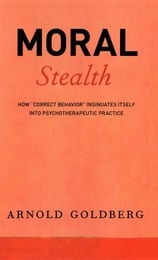
Moral Stealth
How "Correct Behavior" Insinuates Itself into Psychotherapeutic PracticeArnold Goldberg
University of Chicago Press, 2007
A psychiatrist writes a letter to a journal explaining his decision to marry a former patient. Another psychiatrist confides that most of his friends are ex-patients. Both practitioners felt they had to defend their behavior, but psychoanalyst Arnold Goldberg couldn’t pinpoint the reason why. What was wrong about the analysts’ actions?
In Moral Stealth, Goldberg explores and explains that problem of “correct behavior.” He demonstrates that the inflated and official expectations that are part of an analyst’s training—that therapists be universally curious, hopeful, kind, and purposeful, for example—are often of less help than simple empathy amid the ambiguous morality of actual patient interactions. Being a good therapist and being a good person, he argues, are not necessarily the same.
Drawing on case studies from his own practice and from the experiences of others, as well as on philosophers such as John Dewey, Slavoj Žižek, and Jürgen Habermas, Goldberg breaks new ground and leads the way for therapists to understand the relationship between private morality and clinical practice.