Results by title
2 books match the query 'Ptolemy'

50 Maps That Can't Explain the World
A Cartographic Tour from Ptolemy to TrumpNicholas Danforth
University of Chicago Press, 0
An eye-opening journey through fifty maps that ask what, exactly, the people who made our world were thinking, and what that says about our past and future.
Everyone loves a good map. As writer Nicholas Danforth is keen to remind us, maps tell stories about the world and its history—but not always the ones their makers intend. In 50 Maps That Can't Explain the World, Danforth gives us a whirlwind tour of a wide variety of maps, illustrating what they can—and can't—teach us about the world.
Witty and irreverent, the pieces take on many cartographic topics of current political interest, including Russian imperialism, the misunderstood appeal of Greenland, and where Canada came from. Others concern mapmaking itself, exploring why north is “up” and how to map time. In doing so, these pieces show that places as varied as Khiva, Atlantis, and even Arkansas matter for addressing big questions, including the best way to draw borders or the future of America’s foreign policy. Featuring a wide array of unique and forgotten maps, all these pieces regale readers with their interesting tales, such as how the Near East became the Middle East or what the US would look like if it lost World War I.
Throughout, Danforth’s entertaining, thoughtful commentary reveals that while maps may not solve all the world’s woes, they can show us where we’ve been and point us to where we’re trying to go.
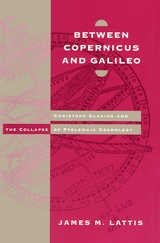
Between Copernicus and Galileo
Christoph Clavius and the Collapse of Ptolemaic CosmologyJames M. Lattis
University of Chicago Press, 1994
Though relatively unknown today, Clavius was enormously influential throughout Europe in the late sixteenth and early seventeenth centuries through his astronomy books—the standard texts used in many colleges and universities, and the tools with which Descartes, Gassendi, and Mersenne, among many others, learned their astronomy. James Lattis uses Clavius's own publications as well as archival materials to trace the central role Clavius played in integrating traditional Ptolemaic astronomy and Aristotelian natural philosophy into an orthodox cosmology. Although Clavius strongly resisted the new cosmologies of Copernicus and Tycho, Galileo's invention of the telescope ultimately eroded the Ptolemaic world view.
By tracing Clavius's views from medieval cosmology the seventeenth century, Lattis illuminates the conceptual shift from Ptolemaic to Copernican astronomy and the social, intellectual, and theological impact of the Scientific Revolution.