Results by title
3 books match the query 'Puberty rites'
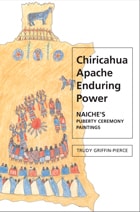
Chiricahua Apache Enduring Power
Naiche's Puberty Ceremony PaintingsTrudy Griffin-Pierce, foreword by J. Jefferson Reid and Stephanie M. Whittlesey
University of Alabama Press, 2006
A gripping story of the cultural resilience of the descendants of Geronimo and Cochise
This book reveals the conflicting meanings of power held by the federal government and the Chiricahua Apaches throughout their history of interaction. When Geronimo and Naiche, son of Cochise, surrendered in 1886, their wartime exploits came to an end, but their real battle for survival was only beginning. Throughout their captivity in Florida, Alabama, and Oklahoma, Naiche kept alive Chiricahua spiritual power by embodying it in his beautiful hide paintings of the Girl’s Puberty Ceremony—a ritual at the very heart of tribal cultural life and spiritual strength.
This narrative is a tribute to the Chiricahua people, who survive today, despite military efforts to annihilate them, government efforts to subjugate them, and social efforts to destroy their language and culture. Although federal policy makers brought to bear all the power at their command, they failed to eradicate Chiricahua spirit and identity nor to convince them that their lower status was just part of the natural social order. Naiche, along with many other Chiricahuas, believed in another kind of power. Although not known to have Power of his own in the Apache sense, Naiche’s paintings show that he believed in a vital source of spiritual strength. In a very real sense, his paintings were visual prayers for the continuation of the Chiricahua people. Accessible to individuals for many purposes, Power helped the Chiricahuas survive throughout their history.
Griffin-Pierce explores Naiche’s artwork through the lens of current anthropological theory on power, hegemony, resistance, and subordination. As she retraces the Chiricahua odyssey during 27 years of incarceration and exile by visiting their internment sites, she reveals how the Power was with them throughout their dark period. As it was when the Chiricahua warriors and their families struggled to stay alive, Power remains the centering focus for contemporary Chiricahua Apaches. Although never allowed to return to their beloved homeland, not only are the Chiricahua Apaches surviving today, they are keeping their traditions alive and their culture strong and vital.
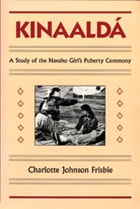
Kinaalda
Charlotte J Frisbie
University of Utah Press, 1993
Kinaaldá, the ceremony associated with the onset of a girl’s puberty, is an important Navajo rite within the Blessingway complex. Derived from the experiences of Changing Woman, the puberty ceremony has been passed through generations and continues to be observed throughout Navajoland.
An acknowledged classic, Kinaaldá remains the most complete "outsider" account of this important ceremony. Charlotte Frisbie’s lucid description takes the reader through the four-day ritual, describing sequence, daily activities, restrictions, observances that include the girl’s race toward the east, and an analysis of the ceremonial music, complete with notations and translation.
To give readers a better sense of why, Frisbie relates the beliefs and practices expressed in Kinaaldá to origin accounts conveyed by medicine people and to explanations and discussions with other Navajos.
The Age of Sex
Custom, Law, and Ritual in Twentieth-Century East AfricaCorrie Decker
University of Wisconsin Press, 2025
In The Age of Sex, Decker demonstrates how maturation became defined as the hypothetical moment when a girl becomes a woman capable of engaging in heterosexual activity and a boy becomes a man imbued with the right and responsibility to have heterosexual intercourse. Colonial ethnographic studies reduced complex precolonial rites of passage to “puberty rites” fixated on these sexual transformations. The resulting stereotypes influenced, in turn, how colonial and postcolonial court officials decided age-of-consent and other sex crime cases. Court rituals thus legally transformed girls into women by ruling on their sexual maturity and boys into men by sentencing them to corporal punishment, marking their acceptance of heterosexual responsibilities.