Results by title
9 books match the query 'Public Memory'
American Relics and the Politics of Public Memory
Matthew Dennis
University of Massachusetts Press, 2023
The gold epaulettes that George Washington wore into battle. A Union soldier’s bloody shirt in the wake of the Civil War. A crushed wristwatch after the 9/11 attacks. The bullet-riddled door of the Pulse nightclub. Volatile and shape-shifting, relics have long played a role in memorializing the American past, acting as physical reminders of hard-won battles, mass tragedies, and political triumphs.
Surveying the expanse of U.S. history, American Relics and the Politics of Public Memory shows how these objects have articulated glory, courage, and national greatness as well as horror, defeat, and oppression. While relics mostly signified heroism in the nation’s early years, increasingly, they have acquired a new purpose—commemorating victimhood. The atrocious artifacts of lynching and the looted remains of Native American graves were later transformed into shameful things, exposing ongoing racial violence and advancing calls for equality and civil rights. Matthew Dennis pursues this history of fraught public objects and assesses the emergence of new venues of memorialization, such as virtual and digital spaces. Through it all, relics continue to fundamentally ground and shape U.S. public memory in its uncertain present and future.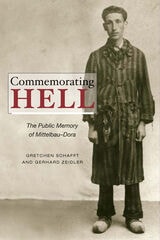
Commemorating Hell
The Public Memory of Mittelbau-DoraGretchen Schafft and Gerhard Zeidler
University of Illinois Press, 2011
Prisoners at Mittelbau-Dora built the V-1 and V-2 missiles, some of them coming into direct contact with Wernher von Braun and Arthur Rudolph, who later became leading engineers in the U.S. space program. Through the continuing story of Mittelbau-Dora, from its operation as a labor camp to its social construction as a monument, Schafft and Zeidler reflect an abiding interest in the memory and commemoration of notorious national events. In extending the analysis of Mittelbau-Dora into post-war and present-day Germany, Commemorating Hell uncovers the intricate relationship between the politics of memory and broader state and global politics, revealing insights about the camp's relationship to the American space pioneers and the fate of the nearby city of Nordhausen.
Dead Last
The Public Memory of Warren G. Harding’s Scandalous LegacyPhillip G. Payne
Ohio University Press, 2008
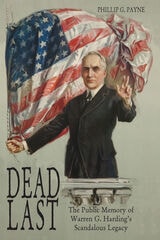
If George Washington and Abraham Lincoln are the saints in America’s civil religion, then the twenty-ninth president, Warren G. Harding, is our sinner. Prior to the Nixon administration, the Harding scandals were the most infamous of the twentieth century. Harding is consistently judged a failure, ranking dead last among his peers.
By examining the public memory of Harding, Phillip G. Payne offers the first significant reinterpretation of his presidency in a generation. Rather than repeating the old stories, Payne examines the contexts and continued meaning of the Harding scandals for various constituencies. Payne explores such topics as Harding’s importance as a midwestern small-town booster, his rumored black ancestry, the role of various biographers in shaping his early image, the tension between public memory and academic history, and, finally, his status as an icon of presidential failure in contemporary political debates. Harding was a popular president and was widely mourned when he died in office in 1923; but with his death began the construction of his public memory and his fall from political grace.
In Dead Last, Payne explores how Harding’s name became synonymous with corruption, cronyism, and incompetence and how it is used to this day as an example of what a president should not be.
Experiencing War Memorials
Environment, Affect, and Public MemoryEdited by Jennifer K. Ladino
University of Alabama Press, 2026
Examines the emotional, formal, and environmental dimensions of war commemoration
Experiencing War Memorials is a compelling edited collection of essays that examines how war is commemorated through public memorials and the powerful emotions and ideologies these sites generate. Drawing on fields such as war studies, affect studies, public memory studies, and the environmental humanities, the volume demonstrates that commemoration is not only an intellectual act but an embodied, affective experience.
Through diverse case studies, contributors analyze how memorials shape public feelings about fast and slow violence, including battles, massacres, and incarceration. The essays reveal how materials, landscapes, narrative conventions, and innovative memorial forms guide emotional responses such as grief, pride, ambivalence, and outrage while making injustice perceptible. Against the backdrop of ongoing debates over heritage and violence, the collection insists on the importance of attending to the messy and disordered emotional dimensions of public memory. Some essays explore varied human and animal experiences, including military working dogs; scrutinize unsettling sites such as Confederate monuments and overlooked Holocaust locations; and consider digital, ecological, and pandemic-era memorials that expand the boundaries of commemoration.
Edited by Jennifer K. Ladino, Experiencing War Memorials offers nuanced insights into how memorial practices shape national identities, ethical understanding, and the possibilities for social change, illuminating the profound ways public remembrance influences how societies feel, remember, and reckon with violence in all its forms. This volume will appeal to scholars and students of memory studies, war and cultural studies, environmental humanities, and American studies, as well as museum professionals, artists, and readers interested in the politics and emotions of public commemoration.
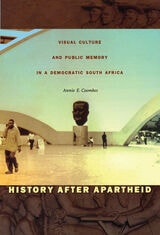
History after Apartheid
Visual Culture and Public Memory in a Democratic South AfricaAnnie E. Coombes
Duke University Press, 2003
History after Apartheid explores the dilemmas posed by a wide range of visual and material culture including key South African heritage sites. How prominent should Nelson Mandela and the African National Congress be in the museum at the infamous political prison on Robben Island? How should the postapartheid government deal with the Voortrekker Monument mythologizing the Boer Trek of 1838? Coombes highlights the contradictory investment in these sites among competing constituencies and the tensions involved in the rush to produce new histories for the “new” South Africa.
She reveals how artists and museum officials struggled to adequately represent painful and difficult histories ignored or disavowed under apartheid, including slavery, homelessness, and the attempted destruction of KhoiSan hunter-gatherers. Describing how contemporary South African artists address historical memory and the ambiguities uncovered by the Truth and Reconciliation Commission, Coombes illuminates a body of work dedicated to the struggle to simultaneously remember the past and move forward into the future.
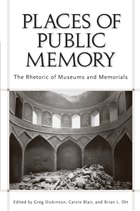
Places of Public Memory
The Rhetoric of Museums and MemorialsEdited by Greg Dickinson, Carole Blair, and Brian L. Ott
University of Alabama Press, 2010
A sustained and rigorous consideration of the intersections of memory, place, and rhetoric
Though we live in a time when memory seems to be losing its hold on communities, memory remains central to personal, communal, and national identities. And although popular and public discourses from speeches to films invite a shared sense of the past, official sites of memory such as memorials, museums, and battlefields embody unique rhetorical principles.
Places of Public Memory: The Rhetoric of Museums and Memorials is a sustained and rigorous consideration of the intersections of memory, place, and rhetoric. From the mnemonic systems inscribed upon ancient architecture to the roadside accident memorials that line America’s highways, memory and place have always been deeply interconnected. This book investigates the intersections of memory and place through nine original essays written by leading memory studies scholars from the fields of rhetoric, media studies, organizational communication, history, performance studies, and English. The essays address, among other subjects, the rhetorical strategies of those vying for competing visions of a 9/11 memorial at New York City’s Ground Zero; rhetorics of resistance embedded in the plans for an expansion of the National Civil Rights Museum; representations of nuclear energy—both as power source and weapon—in Cold War and post–Cold War museums; and tours and tourism as acts of performance.
By focusing on “official” places of memory, the collection causes readers to reflect on how nations and local communities remember history and on how some voices and views are legitimated and others are minimized or erased.
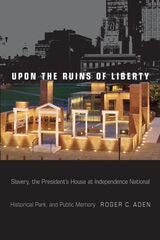
Upon the Ruins of Liberty
Slavery, the President's House at Independence National Historical Park, and Public MemoryRoger C. Aden
Temple University Press, 2014
In Upon the Ruins of Liberty, Roger Aden offers a compelling account that explores the development of this important historic site and how history, space, and public memory intersected with contemporary racial politics. Aden constructs this engrossing tale by drawing on archival material and interviews with principal figures in the controversy-including historian Ed Lawler, site activist Michael Coard, and site designer Emanuel Kelly.
Upon the Ruins of Liberty chronicles the politically-charged efforts to create a fitting tribute to the place where George Washington (and later, John Adams) shaped the presidency while denying freedom to the nine enslaved Africans in his household. From design to execution, the plans prompted advocates to embrace stories informed by race, and address difficulties that included how to handle the results of the site excavation. As such, this landmark project raised concerns and provided lessons about the role of public memory and how places are made to shape the nation's identity.
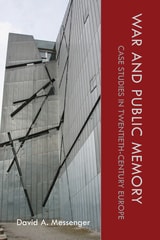
War and Public Memory
Case Studies in Twentieth-Century EuropeDavid A. Messenger
University of Alabama Press, 2020
In order to understand the history of twentieth-century Europe, we must first appreciate and accept how different societies and cultures remember their national conflicts. We must also be aware of the ways that those memories evolve over time. In War and Public Memory: Case Studies in Twentieth-Century Europe, Messenger outlines the relevant history of war and its impact on different European nations and assesses how and where the memory of these conflicts emerges in political and public discourse and in the public sphere and public spaces of Europe.
The case studies presented emphasize the major wars fought on European soil as well as the violence perpetrated against civilian populations. Each chapter begins with a brief overview of the conflict and then proceeds with a study of how memory of that struggle has entered into public consciousness in different national societies. The focus throughout is on collective social, cultural, and public memory, and in particular how memory has emerged in public spaces throughout Europe, such as parks, museums, and memorial sites.
Messenger discusses memories of the First World War for both the victors and the vanquished as well as their successor states. Other events discussed include the Bolshevik Revolution and subsequent conflicts in the former Soviet Union, the Armenian genocide, the collapse of Yugoslavia, the legacy of the civil war in Spain, Germanys reckoning with its Nazi past, and the memory of occupation and the Holocaust in France and Poland.
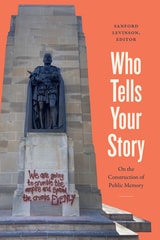
Who Tells Your Story
On the Construction of Public MemorySanford Levinson, editor
Duke University Press, 2026
Contributors: Zachary Bray, Deborah R. Gerhardt, Emily Bradley Greenfield, Randall Kennedy, Aleksandra Kuczyńska-Zonik, Larysa Kurylas, Sanford Levinson, Kimberly Probolus, Kermit Roosevelt III, Anna Saunders, Bruce Scates, Richard C. Schragger, and Agata Tatarenko