Results by title
7 books match the query 'Public broadcasting'

Air Wars
Fight To Reclaim Public BroadcastingJerold Starr
Temple University Press, 2001
These citizens believed strongly in public television's unique mission to serve the diverse social and cultural needs of local communities. When their own station neglected this mission in the search for national prestige and bigger revenues, they felt profoundly betrayed.
Jerold Starr exposes the political and commercial pressures that made strange bedfellows of the top officials of public broadcasting, the Democratic Party establishment, Pat Robertson and the Christian Coalition, home-shopping and "infomall" king Lowell "Bud" Paxson, and billionaire right-wing publisher/philanthropist Richard Mellon Scaife.
What began as a bitterly contested local struggle that disturbed the serenity of Mister Rogers' Neighborhood later became front-page national news with revelations of presidential candidate John McCain's influence-peddling scandal on behalf of media mogul Paxson. This was followed by congressional resolutions attacking the FCC's authority to regulate noncommercial educational broadcast licenses. The "Pittsburgh case" promises to be in the news for some time to come.
Far beyond Pittsburgh, Starr looks at how the reform movement has spread to major cities like Chicago, Phoenix, Jacksonville, and San Francisco, where citizen activists have successfully challenged public stations to be more community responsive.
Finally, he outlines an innovative plan for restructuring the public broadcasting service as an independently funded public trust. Joining this vision with a practical strategy, Starr describes the formation of Citizens for Independent Public Broadcasting, a national membership organization with a grassroots approach to putting the public back into public broadcasting.
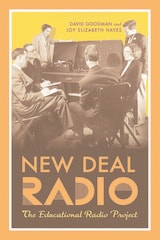
New Deal Radio
The Educational Radio ProjectDavid Goodman
Rutgers University Press, 2022
Contextualizing the different series aired by the Educational Radio Project as part of a unified project about radio and citizenship is crucial to understanding them. New Deal Radio argues that this distinctive government commercial partnership amounted to a critical intervention in US broadcasting and an important chapter in the evolution of public radio in America.

RTE and the Globalisation of Irish Television
Farrel Corcoran
Intellect Books, 1995
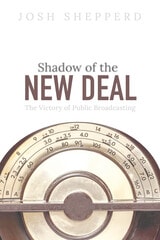
Shadow of the New Deal
The Victory of Public BroadcastingJosh Shepperd
University of Illinois Press, 2023
- Winner of the 2024 BEA Book Award
- Runner-up in the History Division of the Association for Education in Journalism and Mass Communication (AEJMC)
- Runner-up for the AJHA Book of the Year (American Journalism Historians Association).
Despite uncertain beginnings, public broadcasting emerged as a noncommercial media industry that transformed American culture. Josh Shepperd looks at the people, institutions, and influences behind the media reform movement and clearinghouse the National Association of Educational Broadcasters (NAEB) in the drive to create what became the Public Broadcasting Service and National Public Radio.
Founded in 1934, the NAEB began as a disorganized collection of undersupported university broadcasters. Shepperd traces the setbacks, small victories, and trial and error experiments that took place as thousands of advocates built a media coalition premised on the belief that technology could ease social inequality through equal access to education and information. The bottom-up, decentralized network they created implemented a different economy of scale and a vision of a mass media divorced from commercial concerns. At the same time, they transformed advice, criticism, and methods adopted from other sectors into an infrastructure that supported public broadcasting in the 1960s and beyond.
The Media Welfare State
Nordic Media in the Digital EraTrine Syvertsen, Gunn Enli, Ole J. Mjøs, and Hallvard Moe
University of Michigan Press, 2014
The Media Welfare State: Nordic Media in the Digital Era comprehensively addresses the central dynamics of the digitalization of the media industry in the Nordic countries—Sweden, Norway, Denmark, Finland, and Iceland—and the ways media organizations there are transforming to address the new digital environment. Taking a comparative approach, the authors provide an overview of media institutions, content, use, and policy throughout the region, focusing on the impact of information and communication technology/internet and digitalization on the Nordic media sector. Illustrating the shifting media landscape the authors draw on a wide range of cases, including developments in the press, television, the public service media institutions, and telecommunication.
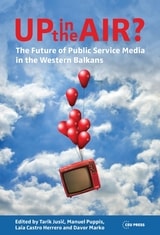
Up in the Air?
The Future of Public Service Media in the Western BalkansTarik Jusic
Central European University Press, 2021
The agenda for transition after the demise of communism in the Western Balkans made the conversion of state radio and television into public service broadcasters a priority, converting mouthpieces of the regime into public forums in which various interests and standpoints could be shared and deliberated. There is general agreement that this endeavor has not been a success. Formally, the countries adopted the legal and institutional requirements of public service media according to European standards. The ruling political elites, however, retained their control over the public media by various means.
Can this trend be reversed? Instead of being marginalized or totally manipulated, can public service media become vehicles of genuine democratization?
A comparison of public service media in seven countries (Albania, Bosnia & Herzegovina, Croatia, Kosovo, Montenegro, North Macedonia, and Serbia) addresses these important questions.
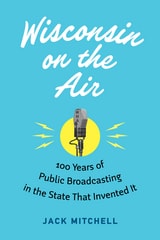
Wisconsin on the Air
100 Years of Public Broadcasting in the State That Invented ItJack Mitchell
Wisconsin Historical Society Press, 2016
On a wintry evening in 1917, university professor Earle Terry listened with guests as the popular music of the day filtered from a physics laboratory in Science Hall into a receiving set in his living room. Little did they know that one hundred years of public service broadcasting had just begun. Terry’s radio experiment blossomed into a pioneering endeavor to carry out the "Wisconsin Idea," a promise to make the university’s knowledge accessible to all Wisconsinites, in their homes, statewide, a Progressive-era principle that still guides public broadcasting in Wisconsin and throughout the nation. In 1947, television was added to this public service model with Channel 21 in Madison, produced, like radio, from the University of Wisconsin campus. By 1967, when the Public Broadcasting Act created the Public Broadcasting System (PBS) and National Public Radio (NPR), the Wisconsin stations had been broadcasting for fifty years. A history one hundred years in the making, Wisconsin on the Air introduces readers to the personalities and philosophies, the funding challenges and legislation, the original Wisconsin programming and pioneering technology that gave us public radio and television. Author Jack Mitchell, who developed All Things Considered for NPR before becoming the head of Wisconsin Public Radio, deftly maps public broadcasting’s hundred-year journey by charting Wisconsin’s transition from the early days of radio and television to educational broadcasting to the news, information, and music of Wisconsin Public Radio and Wisconsin Public Television.