Results by title
4 books match the query 'Public buildings'
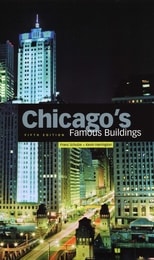
Chicago's Famous Buildings
Franz Schulze and Kevin Harrington
University of Chicago Press, 2003
Chicago's Famous Buildings, fifth edition, completely updated and revised by Franz Schulze and Kevin Harrington, covers more than a decade of extraordinary new architecture and takes a fresh look back at the city's classical legacy of Adler, Sullivan, Burnham, Root, Wright, and Mies van der Rohe. The authors have added many new descriptions and images of the most important projects in Chicago since the fourth edition, including the massive reconstruction of Grant Park around Frank Gehry's Music Pavilion, and they cover as well the current status of older buildings—some destroyed, others, such as Burnham's Reliance Building, marvelously restored and brought back to life. Chicago's Famous Buildings, fifth edition, also includes expanded sections on the city's future and the development of its diverse neighborhoods, presented with new maps to serve as an even more effective walking guide. A glossary of architectural terms, an extensive index, and more than sixty new photographs of both old and new buildings bring this guide completely up-to-date.
Authoritative, informative, and easier to use than ever before, this fifth edition of Chicago's Famous Buildings will serve tourists and residents alike as the leading architectural guide to the treasures of this marvelous city.
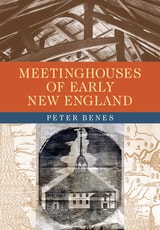
Meetinghouses of Early New England
Peter Benes
University of Massachusetts Press, 2012
Today few of these once ubiquitous buildings survive. Based on site visits and meticulous documentary research, Meetinghouses of Early New England identifies more than 2,200 houses of worship in the region during the period from 1622 to 1830, bringing many of them to light for the first time.
Within this framework Peter Benes addresses the stunning but ultimately impermanent blossoming of a New England "vernacular" tradition of ecclesiastical/ municipal architecture. He pinpoints the specific European antecedents of the seventeenth-century New England meetinghouse and traces their evolution through the eighteenth and early nineteenth centuries into Congregational, Presbyterian, and Baptist churches heavily influenced by an Anglican precedent that made a place of worship a "house of God." Undertaking a parish-by-parish examination, Benes draws on primary sources—original records, diaries, and contemporary commentators—to determine which religious societies in the region advocated (or resisted) this evolution, tying key shifts in meetinghouse architecture to the region's shifting liturgical and devotional practices.
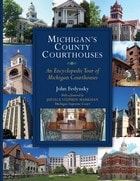
Michigan's County Courthouses
John Fedynsky
University of Michigan Press, 2011
John Fedynsky documents in narrative and photos every county courthouse of Michigan's eighty-three counties, as well as the Michigan Hall of Justice. These buildings are symbols: physically they stand, but figuratively they speak. They embody the purposes for which they were created: law, order, justice, and the promise of a better tomorrow.
Fedynsky tells the story of each building. For Michigan, the typical evolution begins in the cabin, tavern, or hotel of a prominent local settler and progresses through incarnations of simple log or wooden clapboard, and then opulent stone or brick, before the structure arrives in modern and utilitarian form. But there are myriad exceptions to this rule, and they add to the diversity of Michigan's county courthouses.
In Fedynsky's descriptions, verifiable facts and local lore weave together in dramatic tales of outrageous crime, courtroom intrigue, backroom dealing, jury determination, and judicial prerogative. Released jail inmates assist with evacuating and extinguishing a courthouse fire, residents during a natural disaster seek and find physical refuge behind the sure walls of the courthouse, and vigilant legions of homebound defenders are stationed in wartime throughout the courthouse towers scanning the skies for signs of foreign aircraft.
Then there are the homey touches that emphasize the "house" half of Michigan's courthouses: local folks dropping off plants in the courthouse atrium to use it as a winter greenhouse, cows grazing on the public square, county fairs in or near the courthouse, and locally made artwork hanging in public hallways. The courthouses bear within their walls a richness of soul endowed by the good people who make each one special.
Cover design by Heidi Dailey
Cover photos: John Fedynsky

The History of Development of Building Construction in Chicago
Frank A. Randall
University of Illinois Press, 1999
Generations have relied on the Randall book as the most authoritative and comprehensive guide to buildings in the Chicago central area. This edition is updated with information about fifty additional buildings from the time frame of the original text, 1830-1949; new data for four hundred buildings from the period 1950-98; and a number of additional plates from the rare Rand McNally Views of Chicago.
The second edition of The History of the Development of Building Construction in Chicago is a tribute to Frank Randall's vision and an indispensable resource to Chicago area architects, engineers, preservation specialists, and other members of the building industry.