Results by title
3 books match the query 'Public health nursing'
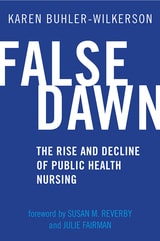
False Dawn
The Rise and Decline of Public Health NursingKaren Buhler-Wilkerson
Rutgers University Press, 2021
Since its initial publication in 1989 by Garland Publishing, Karen Buhler Wilkerson’s False Dawn: The Rise and Decline of Public Health Nursing remains the definitive work on the creation, work, successes, and failures of public health nursing in the United States. False Dawn explores and answers the provocative question: why did a movement that became a significant vehicle for the delivery of comprehensive health care to individuals and families fail to reach its potential? Through carefully researched chapters, Wilkerson details what she herself called the “rise and fall” narrative of public health nursing: rising to great heights in its patients' homes in the struggle to control infectious diseases, assimilate immigrants, and tame urban areas -- only to flounder during the later growth of hospitals, significant immigration restrictions, and the emergence of chronic diseases as endemic in American society.
[more]
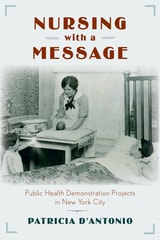
Nursing with a Message
Public Health Demonstration Projects in New York CityD'Antonio, Patricia
Rutgers University Press, 2017
Mandated by the Affordable Care Act, public health demonstration projects have been touted as an innovative solution to the nation’s health care crisis. Yet, such projects actually have a long but little-known history, dating back to the 1920s. This groundbreaking new book reveals the key role that these local health programs—and the nurses who ran them—influenced how Americans perceived both their personal health choices and the well-being of their communities.
Nursing with a Message transports readers to New York City in the 1920s and 1930s, charting the rise and fall of two community health centers, in the neighborhoods of East Harlem and Bellevue-Yorkville. Award-winning historian Patricia D’Antonio examines the day-to-day operations of these clinics, as well as the community outreach work done by nurses who visited schools, churches, and homes encouraging neighborhood residents to adopt healthier lifestyles, engage with preventive physical exams, and see to the health of their preschool children. As she reveals, these programs relied upon an often-contentious and fragile alliance between various healthcare providers, educators, social workers, and funding agencies, both public and private. Assessing both the successes and failures of these public health demonstration projects, D’Antonio also traces their legacy in shaping both the best and worst elements of today’s primary care system.
This book is also freely available online as an open access digital edition.
Download the open access ebook here.
This book is also freely available online as an open access digital edition.
Download the open access ebook here.
[more]
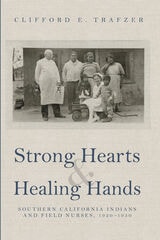
Strong Hearts and Healing Hands
Southern California Indians and Field Nurses, 1920–1950Clifford E. Trafzer
University of Arizona Press, 2021
In 1924, the United States began a bold program in public health. The Indian Service of the United States hired its first nurses to work among Indians living on reservations. This corps of white women were dedicated to improving Indian health. In 1928, the first field nurses arrived in the Mission Indian Agency of Southern California. These nurses visited homes and schools, providing public health and sanitation information regarding disease causation and prevention.
Over time, field nurses and Native people formed a positive working relationship that resulted in the decline of mortality from infectious diseases. Many Native Americans accepted and used Western medicine to fight pathogens, while also continuing Indigenous medicine ways. Nurses helped control tuberculosis, measles, influenza, pneumonia, and a host of gastrointestinal sicknesses. In partnership with the community, nurses quarantined people with contagious diseases, tested for infections, and tracked patients and contacts. Indians turned to nurses and learned about disease prevention. With strong hearts, Indians eagerly participated in the tuberculosis campaign of 1939–40 to x-ray tribal members living on twenty-nine reservations. Through their cooperative efforts, Indians and health-care providers decreased deaths, cases, and misery among the tribes of Southern California.
Over time, field nurses and Native people formed a positive working relationship that resulted in the decline of mortality from infectious diseases. Many Native Americans accepted and used Western medicine to fight pathogens, while also continuing Indigenous medicine ways. Nurses helped control tuberculosis, measles, influenza, pneumonia, and a host of gastrointestinal sicknesses. In partnership with the community, nurses quarantined people with contagious diseases, tested for infections, and tracked patients and contacts. Indians turned to nurses and learned about disease prevention. With strong hearts, Indians eagerly participated in the tuberculosis campaign of 1939–40 to x-ray tribal members living on twenty-nine reservations. Through their cooperative efforts, Indians and health-care providers decreased deaths, cases, and misery among the tribes of Southern California.
[more]