Results by title
3 books match the query 'Public policy (Law)'
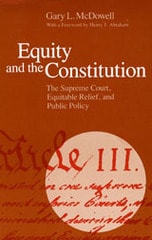
Equity and the Constitution
The Supreme Court, Equitable Relief, and Public PolicyGary L. McDowell
University of Chicago Press, 1982
Since the landmark desegregation decisions in the Brown vs. Board of Education cases, the proper role of the federal judiciary has been hotly debated. Has the federal judiciary, in its attempt to legislate social policy, overstepped its constitutional boundaries?
In this volume, Gary McDowell considers the equity power created by Article III of the Constitution, on which the most controversial decisions of the Supreme Court have rested. He points out the equity was originally understood as an extraordinary means of offering relief to individuals in cases of fraud, accident, mistake, or trust and as a means of "confining the operation of unjust and partial laws." It has now been stretched to offer relief to broadly defined social classes. This "sociological" understanding, in McDowell's view, has undermined equity as a substantive body of law. He urges a return to the former definition as a means of restraining the reach of federal jurisdiction.
In this volume, Gary McDowell considers the equity power created by Article III of the Constitution, on which the most controversial decisions of the Supreme Court have rested. He points out the equity was originally understood as an extraordinary means of offering relief to individuals in cases of fraud, accident, mistake, or trust and as a means of "confining the operation of unjust and partial laws." It has now been stretched to offer relief to broadly defined social classes. This "sociological" understanding, in McDowell's view, has undermined equity as a substantive body of law. He urges a return to the former definition as a means of restraining the reach of federal jurisdiction.
[more]

Fraternal Critique
The Politics of Muslim Community in FranceKirsten Wesselhoeft
University of Chicago Press, 2025
An exploration of ways that discord binds rather than divides communal life, through an ethnography of French Muslim activism.
The conversation about Islam in France is framed by the presumption that Muslim communities are a threat to secular solidarity or fraternité. In the face of state repression, French Muslims have not closed ranks around a narrow range of voices; instead, Kirsten Wesselhoeft finds that young Muslim activists have continued to purposefully spark debate about the values that anchor community life. Wesselhoeft argues that such disagreements, far from dividing communities, actually constitute a form of belonging. Some activists call this ethic “fraternal critique,” and Wesselhoeft finds in it profound insights about the place for critique in civic life. The French state has reacted to Muslim solidarity with repression, but Wesselhoeft argues that unity need not come at the expense of dissent. Instead, fraternal critique can teach us how to build communities that are worth fighting over and fighting for.
The conversation about Islam in France is framed by the presumption that Muslim communities are a threat to secular solidarity or fraternité. In the face of state repression, French Muslims have not closed ranks around a narrow range of voices; instead, Kirsten Wesselhoeft finds that young Muslim activists have continued to purposefully spark debate about the values that anchor community life. Wesselhoeft argues that such disagreements, far from dividing communities, actually constitute a form of belonging. Some activists call this ethic “fraternal critique,” and Wesselhoeft finds in it profound insights about the place for critique in civic life. The French state has reacted to Muslim solidarity with repression, but Wesselhoeft argues that unity need not come at the expense of dissent. Instead, fraternal critique can teach us how to build communities that are worth fighting over and fighting for.
[more]
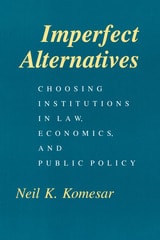
Imperfect Alternatives
Choosing Institutions in Law, Economics, and Public PolicyNeil K. Komesar
University of Chicago Press, 1994
Major approaches to law and public policy, ranging from law and economics to the fundamental rights approach to constitutional law, are based on the belief that the identification of the correct social goals or values is the key to describing or prescribing law and public policy outcomes. In this book, Neil Komesar argues that this emphasis on goal choice ignores an essential element—institutional choice. Indeed, as important as determining our social goals is deciding which institution is best equipped to implement them—the market, the political process, or the adjucative process.
Pointing out that all three institutions are massive, complex, and imperfect, Komesar develops a strategy for comparative institutional analysis that assesses variations in institutional ability. He then powerfully demonstrates the value of this analytical framework by using it to examine important contemporary issues ranging from tort reform to constitution-making.
Pointing out that all three institutions are massive, complex, and imperfect, Komesar develops a strategy for comparative institutional analysis that assesses variations in institutional ability. He then powerfully demonstrates the value of this analytical framework by using it to examine important contemporary issues ranging from tort reform to constitution-making.
[more]