Results by title
12 books match the query 'Public universities and colleges'

A History of the University of Wisconsin System
Patricia A. Brady
University of Wisconsin Press, 2020
The UW System serves as a powerful case study for how broad, national trends in higher education take shape on the ground. Brady illustrates the ways culture wars have played out on campuses and the pressures that have mounted as universities have shifted to a student-as-consumer approach. This is the essential, unvarnished story of the unique collection of institutions that serve Wisconsin and the world—and a convincing argument for why recognizing and reinvesting in the System is critically important for the economic and civic future of the state and its citizens.
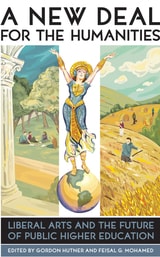
A New Deal for the Humanities
Liberal Arts and the Future of Public Higher EducationHutner, Gordon
Rutgers University Press, 2015
The contributors offer spirited and thought-provoking debates on a diverse range of topics. For instance, they deplore the push by administrations to narrow learning into quantifiable outcomes as well as the demands of state governments for more practical, usable training. Indeed, for those who suggest that a college education should be “practical”—that it should lean toward the sciences and engineering, where the high-paying jobs are—this book points out that while a few nations produce as many technicians as the United States does, America is still renowned worldwide for its innovation and creativity, skills taught most effectively in the humanities. Most importantly, the essays in this collection examine ways to make the humanities even more effective, such as offering a broader array of options than the traditional major/minor scheme, options that combine a student’s professional and intellectual interests, like the new medical humanities programs.
A democracy can only be as energetic as the minds of its citizens, and the questions fundamental to the humanities are also fundamental to a thoughtful life. A New Deal for the Humanities takes an intrepid step in making the humanities—and our citizens—even stronger in the future.
As Far as the Eye Can See
Stephen Pradarelli
University of Iowa Press, 2019

Back in School
How Student Parents Are Transforming College and FamilyA. Fiona Pearson
Rutgers University Press, 2019
Broke
The Racial Consequences of Underfunding Public UniversitiesLaura T. Hamilton and Kelly Nielsen
University of Chicago Press, 2021
In Broke, Laura T. Hamilton and Kelly Nielsen examine virtually all aspects of campus life to show how the new economic order in public universities, particularly at two campuses in the renowned University of California system, affects students. For most of the twentieth century, they show, less affluent families of color paid with their taxes for wealthy white students to attend universities where their own offspring were not welcome. That changed as a subset of public research universities, some quite old, opted for a “new” approach, making racially and economically marginalized youth the lifeblood of the university. These new universities, however, have been particularly hard hit by austerity. To survive, they’ve had to adapt, finding new ways to secure funding and trim costs—but ultimately it’s their students who pay the price, in decreased services and inadequate infrastructure.
The rise of new universities is a reminder that a world-class education for all is possible. Broke shows us how far we are from that ideal and sets out a path for how we could get there.
Divided Conversations
Identities, Leadership, and Change in Public Higher EducationKristin G. Esterberg
Vanderbilt University Press, 2013
Many faculty believe that one of their own who becomes an administrator has gone over to "the dark side." One provost recalled going for a beer with a faculty colleague and hearing the colleague complain about the latest memo "from the administration." He had to remind his friend of many years that he was the author of the offending document. Now he was "the administration." He realized that former colleagues now appeared in his office wearing suits and ties and referring to him by his title rather than his first name.
The disciplines serve as the tribes into which individual scholars are organized; the discipline is where a faculty member finds his community and identity. Administrators, on the other hand, identify with each other in trying to get the tribes to work together. Though most administrators came from the faculty ranks, their career paths take a different shape, especially in terms of mobility to another institution. It's not surprising that the two groups talk past each other.
A chapter is devoted to chairs of departments, who occupy an interesting middle ground. To their faculty, they can come across as a nurturing parent or a petty bureaucrat. The authors recommend training for chairs and administrative internships offered by the American Council on Education and other organizations.
The men and women on the campuses of the public universities described in the book make clear the challenges that universities face in terms of budgets, legislative politics, collective bargaining, rankings, and control of academic programs. If public institutions are truly to serve a public purpose, faculty and administrators must find ways to engage each other in shared conversation and management and find ways of engaging the university with the community.
Private Sectors in Higher Education
Structure, Function, and Change in Eight CountriesRoger L. Geiger
University of Michigan Press, 1986

Saving Alma Mater
A Rescue Plan for America's Public UniversitiesJames C. Garland
University of Chicago Press, 2009
America’s public universities educate 80% of our nation’s college students. But in the wake of rising demands on state treasuries, changing demographics, growing income inequality, and legislative indifference, many of these institutions have fallen into decline. Tuition costs have skyrocketed, class sizes have gone up, the number of courses offered has gone down, and the overall quality of education has decreased significantly.
Here James C. Garland draws on more than thirty years of experience as a professor, administrator, and university president to argue that a new compact between state government and public universities is needed to make these schools more affordable and financially secure. Saving Alma Mater challenges a change-resistant culture in academia that places too low a premium on efficiency and productivity. Seeing a crisis of campus leadership, Garland takes state legislators to task for perpetuating the decay of their public university systems and calls for reforms in the way university presidents and governing boards are selected. He concludes that the era is long past when state appropriations can enable public universities to keep their fees low and affordable. Saving Alma Mater thus calls for the partial deregulation of public universities and a phase-out of their state appropriations. Garland’s plan would tie university revenues to their performance and exploit the competitive pressures of the academic marketplace to control costs, rein in tuition, and make schools more responsive to student needs.
A much-needed blueprint for reform based on Garland’s real-life successes as the head of Miami University of Ohio, Saving Alma Mater will be essential for anyone concerned with the costs and quality of higher education in America today.

Son of Southern Illinois
Glenn Poshard’s Life in Politics and EducationCarl Walworth with Glenn Poshard
Southern Illinois University Press, 2023
A life of principles, service, and faith
This first biography of Glenn Poshard traces the life of a young man who rose from rural poverty in Southern Illinois to become a United States congressman and president of the Southern Illinois University system. This profound portrait unveils a life and career dedicated to making higher education affordable and improving the quality of life for the community of Southern Illinois.
Beginning with his childhood in a two-room home near Herald, Illinois and the early, tragic loss of his sister, this biography navigates Poshard’s service in the military, his time as a state senator and United States congressman, his run for governor, his years at Southern Illinois University, and the establishment of the Poshard Foundation for Abused Children. Intimacies of his personal life are disclosed, such as his struggles with and treatment for depression, his passion for education, and the lasting bonds he formed with his teachers. His unpopular decision to refuse PAC donations is also highlighted, along with the work that went into sponsoring the Illinois Wilderness Act, and his relationship with civil rights activist John Lewis. Glenn Poshard’s efforts for the Wilderness Act designated Southern Illinois’s famous Garden of the Gods as a National Wilderness Preservation System, which continues to attract visitors from around the world.
Poshard’s path from poverty was riddled with hardship, but his perseverance and family values ultimately allowed for longstanding personal and civic growth. From an admirable work ethic to a steadfast commitment to problem-solving, this biography illuminates the life and accomplishments of an impressive and generous leader.
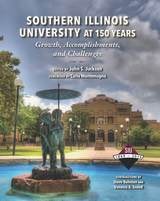
Southern Illinois University at 150 Years
Growth, Accomplishments, and ChallengesEdited by John S. Jackson with a Foreword by Carlo Montemagno and Contributions by Steve Buhman and Vanessa A. Sneed
Southern Illinois University Press, 2019
Chapters reflect on SIU’s successful athletics program, the various colleges and departments within the university, the diverse holdings and collections of the library, the unique innovative research enterprises, and special programs such as the Paul Simon Public Policy Institute and Touch of Nature Environmental Center.
Although SIU may be a typical large public university in many ways, its unique location, history, and culture have made it a distinct institution of higher education. Located close to the Shawnee National Forest and Giant City State Park, the landscape is an indelible part of SIU, contributing to both the beauty of the university grounds and the campus culture.
The university’s sesquicentennial provides a wonderful opportunity to revisit all that makes SIU amazing. Illustrated with 306 photographs of theater and music performances, art, sports, past and present students, faculty, staff, administration, politicians, community members, successful alums, distinguished visitors, and patrons of the university buildings, and landscapes, Southern Illinois University at 150 Years captures the university’s story in all its vivid color.
The University and the People
Envisioning American Higher Education in an Era of Populist ProtestScott M. Gelber
University of Wisconsin Press, 2011
The University and the People chronicles the influence of Populism—a powerful agrarian movement—on public higher education in the late nineteenth century. Revisiting this pivotal era in the history of the American state university, Scott Gelber demonstrates that Populists expressed a surprising degree of enthusiasm for institutions of higher learning. More fundamentally, he argues that the mission of the state university, as we understand it today, evolved from a fractious but productive relationship between public demands and academic authority.
Populists attacked a variety of elites—professionals, executives, scholars—and seemed to confirm academia’s fear of anti-intellectual public oversight. The movement’s vision of the state university highlighted deep tensions in American attitudes toward meritocracy and expertise. Yet Populists also promoted state-supported higher education, with the aims of educating the sons (and sometimes daughters) of ordinary citizens, blurring status distinctions, and promoting civic engagement. Accessibility, utilitarianism, and public service were the bywords of Populist journalists, legislators, trustees, and sympathetic professors. These “academic populists” encouraged state universities to reckon with egalitarian perspectives on admissions, financial aid, curricula, and research. And despite their critiques of college “ivory towers,” Populists supported the humanities and social sciences, tolerated a degree of ideological dissent, and lobbied for record-breaking appropriations for state institutions.
Wrecked
Deinstitutionalization and Partial Defenses in State Higher Education PolicyBarrett J. Taylor
Rutgers University Press, 2022