Results by title
70 books match the query 'Pueblo Indians' and 5 start with a
A Study of Southwestern Archaeology
Stephen H. Lekson
University of Utah Press, 2018
Focusing on the enigmatic monumental center at Chaco Canyon, the book provides a historical analysis of how Southwest archaeology confined itself, how it can break out of those confines, and how it can proceed into the future. Lekson suggests that much of what we believe about the ancient Southwest should be radically revised. Looking past old preconceptions brings a different Chaco Canyon into view: more than an eleventh-century Pueblo ritual center, Chaco was a political capital with nobles and commoners, a regional economy, and deep connections to Mesoamerica. By getting the history right, a very different science of the ancient Southwest becomes possible and archaeology can be reinvented as a very different discipline.
Notes
https://uofupress.lib.utah.edu/wp-content/uploads/sites/21/2019/04/Lekson-Notes.pdf
Alternative Leadership Strategies in the Prehispanic Southwest
Edited by Barbara J. Mills
University of Arizona Press, 2000
In considerations of societal change, the application of classic evolutionary schemes to prehistoric southwestern peoples has always been problematic for scholars. Because recent theoretical developments point toward more variation in the scale, hierarchy, and degree of centralization of complex societies, this book takes a fresh look at southwestern prehistory with these new ideas in mind.
This is the first book-length work to apply new theories of social organization and leadership strategies to the prehispanic Southwest. It examines leadership strategies in a number of archaeological contexts—from Chaco Canyon to Casas Grandes, from Hohokam to Zuni—to show striking differences in the way that leadership was constructed across the region.
These case studies provide ample evidence for alternative models of leadership in middle-range societies. By illustrating complementary approaches in the study of political organization, they offer new insight into power and inequality. They also provide important models of how today's archaeologists are linking data to theory, providing a basis for comparative analysis with other regions.
CONTENTSAlternative Models, Alternative Strategies: Leadership in the Prehispanic Southwest / Barbara J. Mills
Political Leadership and the Construction of Chacoan Great Houses, A.D. 1020-1140 / W. H. Wills
Leadership, Long-Distance Exchange, and Feasting in the Protohistoric Rio Grande / William M. Graves and Katherine A. Spielmann
Ritual as a Power Resource in the American Southwest / James M. Potter and Elizabeth M. Perry
Ceramic Decoration as Power: Late Prehistoric Design Change in East-Central Arizona / Scott Van Keuren
Leadership Strategies in Protohistoric Zuni Towns / Keith W. Kintigh
Organizational Variability in Platform Mound-Building Groups of the American Southwest / Mark D. Elson and David R. Abbott
Leadership Strategies among the Classic Period Hohokam: A Case Study / Karen G. Harry and James M. Bayman
The Institutional Contexts of Hohokam Complexity and Inequality / Suzanne K. Fish and Paul R. Fish
Leadership at Casas Grandes, Chihuahua, Mexico / Michael E. Whalen and Paul E. Minnis
Reciprocity and Its Limits: Considerations for a Study of the Prehispanic Pueblo World / Timothy A. Kohler, Matthew W. Van Pelt, and Lorene Y. L. Yap
Dual-Processual Theory and Social Formations in the Southwest / Gary M. Feinman
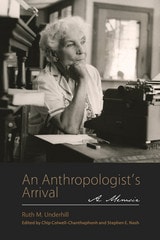
An Anthropologist's Arrival
A MemoirRuth M. Underhill, Edited by Chip Colwell-Chanthaphonh and Stephen E. Nash
University of Arizona Press, 2014
In brutally honest words, Underhill describes her uneven passage through life, beginning with a searing portrait of the Victorian restraints on women and her struggle to break free from her Quaker family’s privileged but tightly laced control. Tenderly and with humor she describes her transformation from a struggling “sweet girl” to wife and then divorcée. Professionally she became a welfare worker, a novelist, a frustrated bureaucrat at the Bureau of Indian Affairs, a professor at the University of Denver, and finally an anthropologist of distinction.
Her witty memoir reveals the creativity and tenacity that pushed the bounds of ethnography, particularly through her focus on the lives of women, for whom she served as a role model, entering a working retirement that lasted until she was nearly 101 years old.
No quotation serves to express Ruth Underhill’s adventurous view better than a line from her own poetry: “Life is not paid for. Life is lived. Now come.”
Ancestral Landscapes of the Pueblo World
James E. Snead
University of Arizona Press, 2008
Architecture Of Grasshopper Pueblo, The
Charles Riggs
University of Utah Press, 2011
The long history of field research at Grasshopper, a massive, 500-room pueblo in an isolated mountain meadow in east-central Arizona, has produced a wealth of architectural information. Drawing on this extensive research, Charles Riggs reconstructs the pueblo, and provides a glimpse into the everyday life of the community at a critical time in Southwest prehistory.
Between AD 1300 and 1330, a group consisting mainly of newcomers to the area established and then enlarged Grasshopper. From the architectural remnants excavated by the University of Arizona Archaeological Field School it is possible to determine that the earliest arrivals settled Grasshopper relatively quickly and that subsequent groups from the region and the Colorado Plateau built their houses next to kinsmen. The houses of locals and immigrants remained separate in discrete room blocks despite their occupants’ participation in communal groups.
Ultimately short-lived, by AD 1330 the influx of immigrants tapered and the architecture came to reflect a more seasonal, less intensive use of the area. Eventually the community was abandoned and the walls were left to crumble. In The Architecture of Grasshopper Pueblo, Riggs gives us a new view of community life at this ancient Puebloan site.