Results by title
5 books match the query 'Pugh, Christina'
Ghosts and the Overplus
Reading Poetry in the Twenty-First CenturyChristina Pugh
University of Michigan Press, 2024
Grains of the Voice
PoemsChristina Pugh
Northwestern University Press, 2013
Christina Pugh’s Grains of the Voice exhibits a pervasive fascination with sound in all its manifestations. The human voice, musical instruments, the sounds produced by the natural and man-made worlds—all serve at one time or another as both the framework of poems and the occasion for their lightning-quick changes of direction, of tone, of point of reference. The poems are eclectic in their allusiveness, filled with echoes—and sometimes the words themselves—of other poets, but just as often of songs both popular and obscure, of the noise of pop culture, and of philosophers’ writings. But Pugh always wears her learning lightly. Beneath the jewellike surfaces of her poems is a strenuous investigation of the nature of and need for communication and a celebration of the endless variety of its forms.

Restoration
PoemsChristina Pugh
Northwestern University Press, 2008
Complex and focused, this collection of poems moves along the line between waking and sleeping to reveal a narrator who is contemplating her origins as well as her future. Pugh frequently turns in her work to the image of a bed--as a source of comfort, an erotic landing, and a place for dreaming. For Pugh, dreams both obscure and reveal, their language a code to be analyzed, as in her longer meditation inspired by Freud's case history "Dora." After dipping dangerously far into dreams, Pugh's poems return to a world of activity, full of physicality before becoming calm. At the end of the book, the self is restored and can see the world through a newly formed lens taken from its dreams.
Stardust Media
Christina Pugh
University of Massachusetts Press, 2020
Christina Pugh's fifth book of poems explores the technologies both ancient and new that inhabit our contemporary cultural moment. Mapping an uncanny journey through the clusters of media we encounter daily but seldom stop to contemplate, Pugh's focused descriptions, contrasting linguistic textures, and acute poetic music become multifarious sources of beauty, disruption, humor, and hurt. Here, Netflix and YouTube share space with eighteenth-century paintings, Italian graffiti, ballet, Kurt Cobain's recordings, and even a collection of rocks. Whether technology is a vessel for joy or grief in these poems, it is always an expression of our continuing desire to invent and to mediate. At once personal archive and cultural barometer, Stardust Media traces the moving constellations of life in the distant twenty-first century, “a kaleidoscope / . . . half-filled with sky-blue glass-cut blossoming, / then labored to crystallize.”
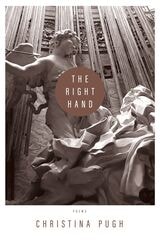
The Right Hand
Christina Pugh
Tupelo Press, 2024
Pain, piercing, and language: with urgent lyricism and lacunae on the page, The Right Hand explores the physical, emotional, and philosophical experiences of chronic pain, bodywork (especially acupuncture), and healing. In the second half of the collection, the poet spends extended time with Bernini's sculpture of St. Teresa in Ecstasy in Rome, finding this famous scene of wounding to be in dialogue with her own experience of pain, as well as her suspension between languages and spiritual isolation. In The Right Hand, the hidden sites of the body speak, and Bernini’s centuries-old arrow pierces us with hurting eloquence.