Results by title
3 books match the query 'Purcell, Rosamond'
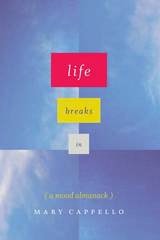
Life Breaks In
A Mood AlmanackMary Cappello
University of Chicago Press, 2016
Some books start at point A, take you by the hand, and carefully walk you to point B, and on and on.
This is not one of those books. This book is about mood, and how it works in and with us as complicated, imperfectly self-knowing beings existing in a world that impinges and infringes on us, but also regularly suffuses us with beauty and joy and wonder. You don’t write that book as a linear progression—you write it as a living, breathing, richly associative, and, crucially, active, investigation. Or at least you do if you’re as smart and inventive as Mary Cappello.
What is a mood? How do we think about and understand and describe moods and their endless shadings? What do they do to and for us, and how can we actively generate or alter them? These are all questions Cappello takes up as she explores mood in all its manifestations: we travel with her from the childhood tables of “arts and crafts” to mood rooms and reading rooms, forgotten natural history museums and 3-D View-Master fairytale tableaux; from the shifting palette of clouds and weather to the music that defines us and the voices that carry us. The result is a book as brilliantly unclassifiable as mood itself, blue and green and bright and beautiful, funny and sympathetic, as powerfully investigative as it is richly contemplative.
“I’m one of those people who mistrusts a really good mood,” Cappello writes early on. If that made you nod in recognition, well, maybe you’re one of Mary Cappello’s people; you owe it to yourself to crack Life Breaks In and see for sure.
[more]
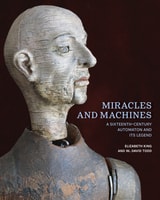
Miracles and Machines
A Sixteenth-Century Automaton and Its LegendElizabeth King
J. Paul Getty Trust, The, 0
An abundantly illustrated narrative that draws from the history of art, science, technology, artificial intelligence, psychology, religion, and conservation in telling the extraordinary story of a Renaissance robot that prays.
This volume tells the singular story of an uncanny, rare object at the cusp of art and science: a 450-year-old automaton known as “the monk.” The walking, gesticulating figure of a friar, in the collection of the Smithsonian Institution’s National Museum of American History, is among the earliest extant ancestors of the self-propelled robot. According to legend connected to the court of Philip II of Spain, the monk represents a portrait of Diego de Alcalá, a humble Franciscan lay brother whose holy corpse was said to be agent to the miraculous cure of Spain’s crown prince as he lay dying in 1562.
In tracking the origins of the monk and its legend, the authors visited archives, libraries, and museums across the United States and Europe, probing the paradox of a mechanical object performing an apparently spiritual act. They identified seven kindred automata from the same period, which, they argue, form a paradigmatic class of walking “prime movers,” unprecedented in their combination of visual and functional realism. While most of the literature on automata focuses on the Enlightenment, this enthralling narrative journeys back to the late Renaissance, when clockwork machinery was entirely new, foretelling the evolution of artificial life to come.
[more]
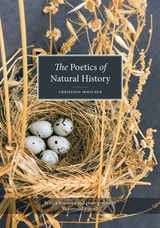
The Poetics of Natural History
Christoph Irmscher
Rutgers University Press, 2019
Winner of the 2000 American Studies Network Prize and the Literature and Language Award from the Association of American Publishers, Inc.
Early American naturalists assembled dazzling collections of native flora and fauna, from John Bartram’s botanical garden in Philadelphia and the artful display of animals in Charles Willson Peale’s museum to P. T. Barnum’s American Museum, infamously characterized by Henry James as “halls of humbug.” Yet physical collections were only one of the myriad ways that these naturalists captured, catalogued, and commemorated America’s rich biodiversity. They also turned to writing and art, from John Edward Holbrook’s forays into the fascinating world of herpetology to John James Audubon’s masterful portraits of American birds.
In this groundbreaking, now classic book, Christoph Irmscher argues that early American natural historians developed a distinctly poetic sensibility that allowed them to imagine themselves as part of, and not apart from, their environment. He also demonstrates what happens to such inclusiveness in the hands of Harvard scientist-turned Amazonian explorer Louis Agassiz, whose racist pseudoscience appalled his student William James.
This expanded, full-color edition of The Poetics of Natural History features a preface and art from award-winning artist Rosamond Purcell and invites the reader to be fully immersed in an era when the boundaries between literature, art, and science became fluid.
[more]