Results by title
3 books match the query 'Putnam, Hilary'
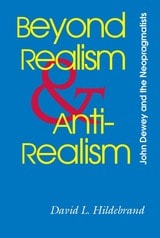
Beyond Realism and Antirealism
John Dewey and the NeopragmatistsDavid L. Hildebrand
Vanderbilt University Press, 2003
Perhaps the most significant development in American philosophy in recent times has been the extraordinary renaissance of Pragmatism, marked most notably by the reformulations of the so-called "Neopragmatists" Richard Rorty and Hilary Putnam. With Pragmatism offering the allure of potentially resolving the impasse between epistemological realists and antirealists, analytic and continental philosophers, as well as thinkers across the disciplines, have been energized and engaged by this movement.
In Beyond Realism and Antirealism: John Dewey and the Neopragmatists, David L. Hildebrand asks two important questions: first, how faithful are the Neopragmatists' reformulations of Classical Pragmatism (particularly Deweyan Pragmatism)? Second, and more significantly, can their Neopragmatisms work?
In assessing Neopragmatism, Hildebrand advances a number of historical and critical points:
• Current debates between realists and antirealists (as well as objectivists and relativists) are similar to early twentieth-century debates between realists and idealists that Pragmatism addressed extensively.
• Despite their debts to Dewey, the Neopragmatists are reenacting realist and idealist stands in their debate over realism, thus giving life to something shown fruitless by earlier Pragmatists.
• What is absent from the Neopragmatist's position is precisely what makes Pragmatism enduring: namely, its metaphysical conception of experience and a practical starting point for philosophical inquiry that such experience dictates.
• Pragmatism cannot take the "linguistic turn" insofar as that turn mandates a theoretical starting point.
• While Pragmatism's view of truth is perspectival, it is nevertheless not a relativism.
• Pace Rorty, Pragmatism need not be hostile to metaphysics; indeed, it demonstrates how pragmatic instrumentalism and metaphysics are complementary.
In examining these and other difficulties in Neopragmatism, Hildebrand is able to propose some distinct directions for Pragmatism. Beyond Realism and Antirealism will provoke specialists and non-specialists alike to rethink not only the definition of Pragmatism, but its very purpose.
[more]
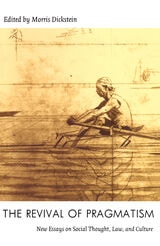
The Revival of Pragmatism
New Essays on Social Thought, Law, and CultureMorris Dickstein, ed.
Duke University Press, 1998
Although long considered the most distinctive American contribution to philosophy, pragmatism—with its problem-solving emphasis and its contingent view of truth—lost popularity in mid-century after the advent of World War II, the horror of the Holocaust, and the dawning of the Cold War. Since the 1960s, however, pragmatism in many guises has again gained prominence, finding congenial places to flourish within growing intellectual movements. This volume of new essays brings together leading philosophers, historians, legal scholars, social thinkers, and literary critics to examine the far-reaching effects of this revival.
As the twenty-five intellectuals who take part in this discussion show, pragmatism has become a complex terrain on which a rich variety of contemporary debates have been played out. Contributors such as Richard Rorty, Stanley Cavell, Nancy Fraser, Robert Westbrook, Hilary Putnam, and Morris Dickstein trace pragmatism’s cultural and intellectual evolution, consider its connection to democracy, and discuss its complex relationship to the work of Emerson, Nietzsche, and Wittgenstein. They show the influence of pragmatism on black intellectuals such as W. E. B. Du Bois, explore its view of poetic language, and debate its effects on social science, history, and jurisprudence. Also including essays by critics of the revival such as Alan Wolfe and John Patrick Diggins, the volume concludes with a response to the whole collection from Stanley Fish.
Including an extensive bibliography, this interdisciplinary work provides an in-depth and broadly gauged introduction to pragmatism, one that will be crucial for understanding the shape of the transformations taking place in the American social and philosophical scene at the end of the twentieth century.
Contributors. Richard Bernstein, David Bromwich, Ray Carney, Stanley Cavell, Morris Dickstein, John Patrick Diggins, Stanley Fish, Nancy Fraser, Thomas C. Grey, Giles Gunn, Hans Joas, James T. Kloppenberg, David Luban, Louis Menand, Sidney Morgenbesser, Richard Poirier, Richard A. Posner, Ross Posnock, Hilary Putnam, Ruth Anna Putnam, Richard Rorty, Michel Rosenfeld, Richard H. Weisberg, Robert B. Westbrook, Alan Wolfe
[more]

The Structure of Scientific Theories
Edited by Frederick Suppe
University of Illinois Press, 1977
[more]