Results by title
2 books match the query 'Qianlong, 1736-1795'
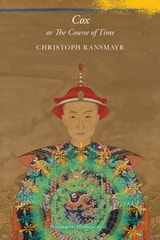
Cox
or, The Course of TimeChristoph Ransmayr
Seagull Books, 2020
Richly imagined and recounted in vivid prose of extraordinary beauty, this book is a stunning illustration of Ransmayr’s talent for imbuing a captivating tale with intense metaphorical, indeed metaphysical force.
The world’s most powerful man, Qiánlóng, emperor of China, invites the famous eighteenth-century clockmaker Alister Cox to his court in Beijing. There, in the heart of the Forbidden City, the Englishman and his assistants are to build machines that mark the passing of time as a child or a condemned man might experience it and that capture the many shades of happiness, suffering, love, and loss that come with that passing.
Mystified by the rituals of a rigidly hierarchical society dominated by an unimaginably wealthy, god-like ruler, Cox musters all his expertise and ingenuity to satisfy the emperor’s desires. Finally, Qiánlóng, also known by the moniker Lord of Time, requests the construction of a clock capable of measuring eternity—a perpetuum mobile. Seizing this chance to realize a long-held dream and honor the memory of his late beloved daughter, yet conscious of the impossibility of his task, Cox sets to work. As the court is suspended in a never-ending summer, festering with evil gossip about the monster these foreigners are creating, the Englishmen wonder if they will ever escape from their gilded cage. More than a meeting of two men, one isolated by power, the other by grief, this is an exploration of mortality and a virtuoso demonstration that storytelling alone can truly conquer time.
[more]
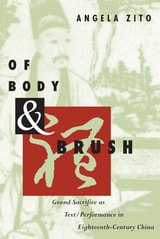
Of Body and Brush
Grand Sacrifice as Text/Performance in Eighteenth-Century ChinaAngela Zito
University of Chicago Press, 1997
The Qianlong emperor, who dominated the religious and political life of eighteenth-century China, was in turn dominated by elaborate ritual prescriptions. These texts determined what he wore and ate, how he moved, and above all how he performed the yearly Grand Sacrifices. In Of Body and Brush, Angela Zito offers a stunningly original analysis of the way ritualizing power was produced jointly by the throne and the official literati who dictated these prescriptions.
Forging a critical cultural historical method that challenges traditional categories of Chinese studies, Zito shows for the first time that in their performance, the ritual texts embodied, literally, the metaphysics upon which imperial power rested. By combining rule through the brush (the production of ritual texts) with rule through the body (mandated performance), the throne both exhibited its power and attempted to control resistance to it. Bridging Chinese history, anthropology, religion, and performance and cultural studies, Zito brings an important new perspective to the human sciences in general.
Forging a critical cultural historical method that challenges traditional categories of Chinese studies, Zito shows for the first time that in their performance, the ritual texts embodied, literally, the metaphysics upon which imperial power rested. By combining rule through the brush (the production of ritual texts) with rule through the body (mandated performance), the throne both exhibited its power and attempted to control resistance to it. Bridging Chinese history, anthropology, religion, and performance and cultural studies, Zito brings an important new perspective to the human sciences in general.
[more]