Results by title

5 books match the query 'Qing dynasty, 1644-1912'
cover of Conflicting Counsels to Confuse the Age: A Documentary Study of Political Economy in Qing China, 1644–1840

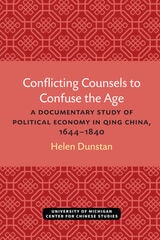
Conflicting Counsels to Confuse the Age

A Documentary Study of Political Economy in Qing China, 1644–1840

Helen Dunstan

University of Michigan Press, 1996
Conflicting Counsels to Confuse the Age translates and analyzes thirty-eight memorials to the throne and other Qing documents dealing with important issues of Chinese political economy, providing thoughtful and provocative commentary. Subjects covered by the texts include water control, mining, grain trade, pawnshops, brewing, and commercial shipping. The documents also contain detailed discussions of how the state should control wealth, self-interest, profit, hoarding, and the market.
In translating these primary sources, Helen Dunstan invites fellow specialists in Chinese studies, including Qing historians, to watch Qing officials and others thinking through problems of political economy and developing arguments to persuade colleagues or superiors. By emphasizing their rhetorical nature and genre conventions, Dunstan offers a reminder that it is improper to use the “information” in such texts without attention to the author’s purpose, and without grasping the rhetorical structure of the text as a whole. As a model for close reading, Conflicting Counsels aims to induce greater sensitivity to the nature of Qing records.
The second purpose of Conflicting Counsels is to help dispel the notion that economic liberalism is necessarily a Western, “modern” phenomenon. Many of the texts translated record areas of tension and controversy in eighteenth-century approaches to a central project of Confucian paternalist administration, “nourishing the people” (yangmin). Although Dunstan attempts to present both sides fairly, some materials included present the opinion that, in certain vital matters, it was better for the state to stand aside, and leave society’s own economic institutions, trade in particular, to handle things. While not a majority, the texts that build some kind of market mechanism argument should be of greatest interest to Qing historians.
[more]
cover of Geographical Sources of Ming-Qing History

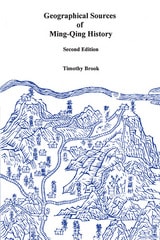
Geographical Sources of Ming-Qing History

Timothy Brook

University of Michigan Press, 2002
First published in 1988 in response to the growing need for documentation concerning local history in the late imperial period, Geographical Sources provides bibliographical data regarding two distinct genres: route books, and topographical and institutional gazetteers. In its second edition, this essential research tool has been completely revised and expanded with close to one hundred new entries, which provide complete coverage of these important sources for research in Chinese social, cultural, and religious history. The separate introductions to the two genres introduce the student to the history and uses of these materials. In addition to providing bibliographic data and noting variant editions, each entry provides locations where a work or its later editions can be found, whether in North America, Europe, China, or Japan.
[more]
cover of Qing Colonial Enterprise: Ethnography and Cartography in Early Modern China

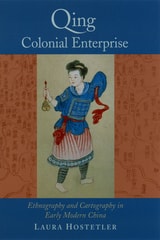
Qing Colonial Enterprise

Ethnography and Cartography in Early Modern China

Laura Hostetler

University of Chicago Press, 2001

In Qing Colonial Enterprise, Laura Hostetler shows how Qing China (1636-1911) used cartography and ethnography to pursue its imperial ambitions. She argues that far from being on the periphery of developments in the early modern period, Qing China both participated in and helped shape the new emphasis on empirical scientific knowledge that was simultaneously transforming Europe—and its colonial empires—at the time.

Although mapping in China is almost as old as Chinese civilization itself, the Qing insistence on accurate, to-scale maps of their territory was a new response to the difficulties of administering a vast and growing empire. Likewise, direct observation became increasingly important to Qing ethnographic writings, such as the illustrated manuscripts known as "Miao albums" (from which twenty color paintings are reproduced in this book). These were intended to educate Qing officials about various non-Han peoples so that they could govern these groups more effectively.Hostetler's groundbreaking account will interest anyone studying the history of the early modern period and colonialism.
[more]
cover of The ALA Guide to Researching Modern China

The ALA Guide to Researching Modern China

Yunshan Ye

American Library Association, 2014
[more]
cover of The Emperor’s New Epistemology: Music, Empire, and Empiricism in Early Modern China

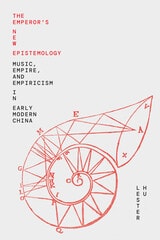
The Emperor’s New Epistemology

Music, Empire, and Empiricism in Early Modern China

Lester Hu

University of Chicago Press, 2027

An innovative account of listening and empire-building in 17th- and 18th-century China.

The Emperor’s New Epistemology explores how listening shaped knowledge and empire-building in seventeenth- and eighteenth-century China. As the Manchu dynasty expanded deep into Inner Asian territories deemed foreign by the majority-Han population, the Qing Empire’s musical culture encompassed the sounds of Mongols, Uyghurs, and Tibetans, as well as Western music brought by Jesuit and other Christian missionaries. Lester Hu reveals that this diversity transformed not only Qing court culture but the very grounds on which knowledge and power could be established.

In one revealing episode from 1692, the Kangxi Emperor (1654–1722) misinterpreted a key term of Classical Chinese music after studying European music with the Jesuits. Hu situates this anecdote within the political, social, and epistemic shifts that transformed late-imperial China. As Hu shows, listening was an instrument of Qing imperial authority: Knowledge about music, language, and even the universe could only be verified through the emperor’s ears. Furthermore, listening facilitated new theories of empirical knowledge, which both lent themselves to Qing-imperial ideology and generated new epistemic tensions. By exploring their echoes in similar shifts in early modern Europe, Hu’s book brings a global perspective to the study of music in the early modern world and reconsiders the transcendental ground on which such comparative and intercultural knowledge is possible.

[more]